
Unnumbered pageScan 3 of 8
Printed: Notes on the Excavations at Engomi.
----------
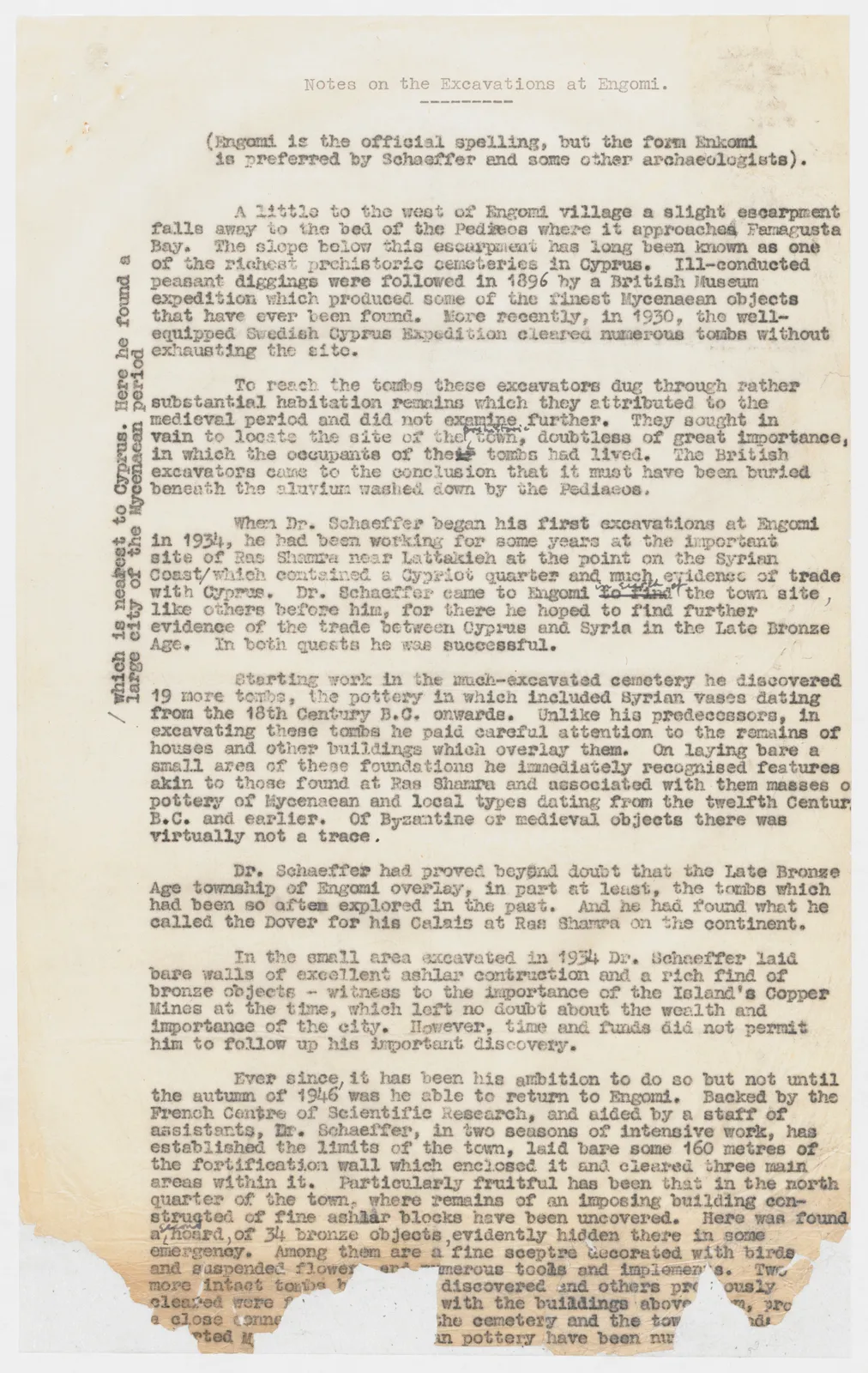
(Engomi is the official spelling, but the form Enkomi is preferred by Schaeffer and some other archaeologists).
Vertical margin text: which is nearest to Cyprus. Here he found a large city of the Mycenaean period
A little to the west of Engomi village a slight escarpment falls away to the bed of the Pediaeos where it approaches Famagusta Bay. The slope below this escarpment has long been known as one of the richest prehistoric cemeteries in Cyprus. Ill-conducted peasant diggings were followed in 1896 by a British Museum expedition which produced some of the finest Mycenaean objects that have ever been found. More recently, in 1930, the wellequipped Swedish Cyprus Expedition cleared numerous tombs without exhausting the site.
To reach the tombs these excavators dug through rather substantial habitation remains which they attributed to the medieval period and did not examine further. They sought in vain to locate the site of the [handwritten: town] town, doubtless of great importance, in which the occupants of the[handwritten: their] tombs had lived. The British excavators came to the conclusion that it must have been buried beneath the alluvium washed down by the Pediaeos.
When Dr. Schaeffer began his first excavations at Engomi in 1934, he had been working for some years at the important site of Ras Shamra near Lattakieh at the point on the Syrian Coast which contained a Cypriot quarter and much evidence of trade with Cyprus. Dr. Schaeffer came to Engomi to find the town site, like others before him, for there he hoped to find further evidence of the trade between Cyprus and Syria in the Late Bronze Age. In both quests he was successful.
Starting work in the much-excavated cemetery he discovered 19 more tombs, the pottery in which included Syrian vases dating from the 18th Century B.C. onwards. Unlike his predecessors, in excavating these tombs he paid careful attention to the remains of houses and other buildings which overlay them. On laying bare a small area of these foundations he immediately recognised features akin to those found at Ras Shamra and associated with them masses of pottery of Mycenaean and local types dating from the twelfth Century B.C. and earlier. Of Byzantine or medieval objects there was virtually not a trace.
Dr. Schaeffer had proved beyond doubt that the Late Bronze Age township of Engomi overlay, in part at least, the tombs which had been so often explored in the past. And he had found what he called the Dover for his Calais at Ras Shamra on the continent.
In the small area excavated in 1934 Dr. Schaeffer laid bare walls of excellent ashlar construction and a rich find of bronze objects - witness to the importance of the Island's Copper Mines at the time, which left no doubt about the wealth and importance of the city. However, time and funds did not permit him to follow up his important discovery.
Ever since, it has been his ambition to do so but not until the autumn of 1946 was he able to return to Engomi. Backed by the French Centre of Scientific Research, and aided by a staff of assistants, Dr. Schaeffer, in two seasons of intensive work, has established the limits of the town, laid bare some 160 metres of the fortification wall which enclosed it and cleared three main areas within it. Particularly fruitful has been that in the north quarter of the town, where remains of an imposing building constructed of fine ashlar blocks have been uncovered. Here was found a [handwritten: hoard] hoard, of 34 bronze objects evidently hidden there in some emergency. Among them are a fine sceptre decorated with birds and suspended flowers and numerous tools and implements. Two more intact tombs h[illegible] discovered and others previously cleared were r[illegible] with the buildings above them, proa close conne[illegible] the cemetery and the tow[illegible] [illegible]ted M[illegible]an pottery have been nu[illegible]
65 figures hard to readstruck struck outadded written in above” jug ditto, and what it repeatsword reading not certain