
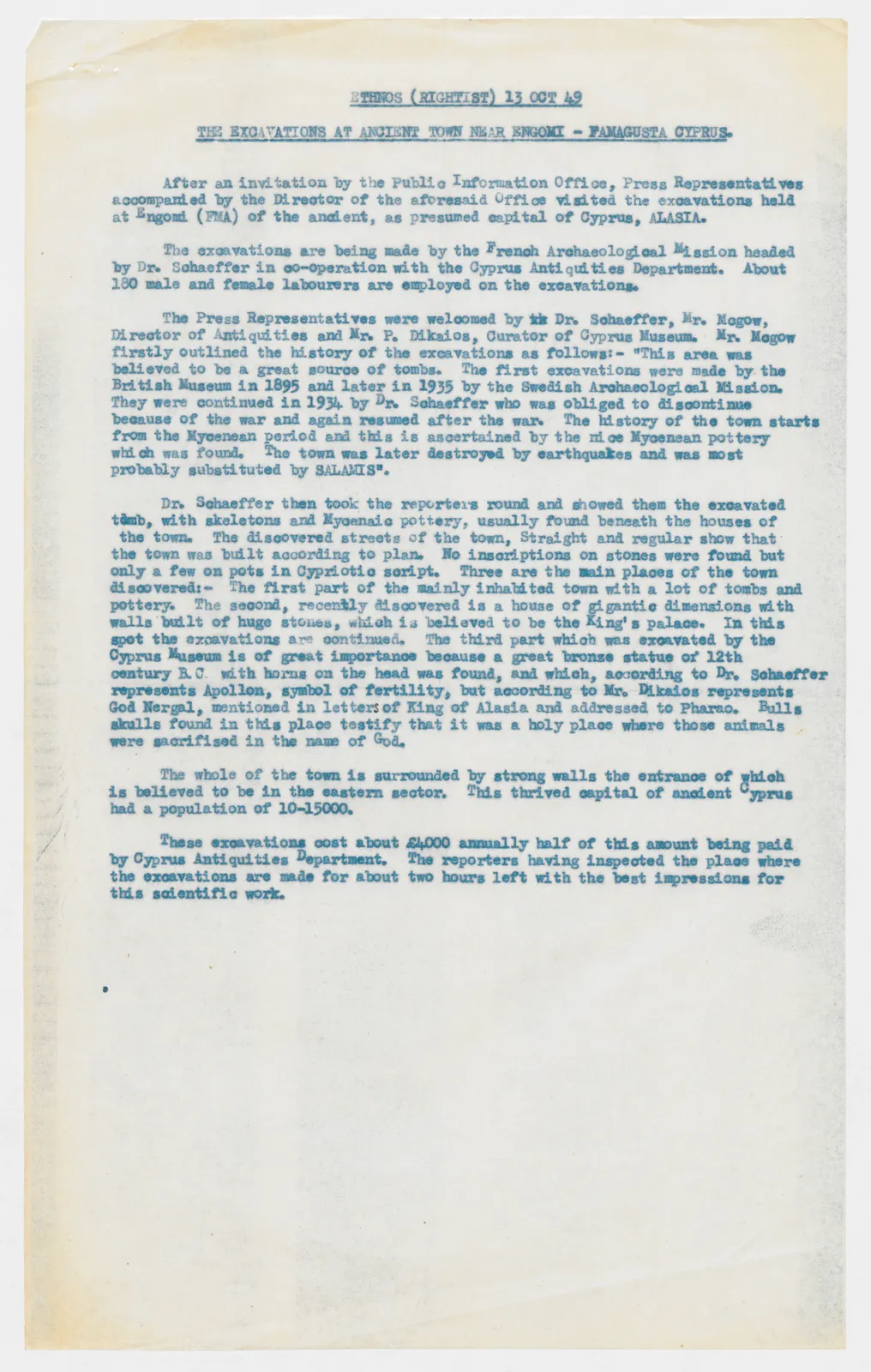
Unnumbered pageScan 1 of 2
ETHNOS (RIGHTIST) 13 OCT 49
THE EXCAVATIONS AT ANCIENT TOWN NEAR ENGOMI - FAMAGUSTA CYPRUS.
After an invitation by the Public Information Office, Press Representatives accompanied by the Director of the aforesaid Office visited the excavations held at Engomi (FMA) of the ancient, as presumed capital of Cyprus, ALASIA.
The excavations are being made by the French Archaeological Mission headed by Dr. Schaeffer in co-operation with the Cyprus Antiquities Department. About 180 male and female labourers are employed on the excavations.
The Press Representatives were welcomed by Dr. Schaeffer, Mr. Megow, Director of Antiquities and Mr. P. Dikaios, Curator of Cyprus Museum. Mr. Megow firstly outlined the history of the excavations as follows:- "This area was believed to be a great source of tombs. The first excavations were made by the British Museum in 1895 and later in 1935 by the Swedish Archaeological Mission. They were continued in 1934 by Dr. Schaeffer who was obliged to discontinue because of the war and again resumed after the war. The history of the town starts from the Mycenean period and this is ascertained by the nice Mycenean pottery which was found. The town was later destroyed by earthquakes and was most probably substituted by SALAMIS".
Dr. Schaeffer then took the reporters round and showed them the excavated tomb, with skeletons and Mycenaic pottery, usually found beneath the houses of the town. The discovered streets of the town, Straight and regular show that the town was built according to plan. No inscriptions on stones were found but only a few on pots in Cypriotic script. Three are the main places of the town discovered:- The first part of the mainly inhabited town with a lot of tombs and pottery. The second, recently discovered is a house of gigantic dimensions with walls built of huge stones, which is believed to be the King's palace. In this spot the excavations are continued. The third part which was excavated by the Cyprus Museum is of great importance because a great bronze statue of 12th century B.C. with horns on the head was found, and which, according to Dr. Schaeffer represents Apollon, symbol of fertility, but according to Mr. Dikaios represents God Nergal, mentioned in letters of King of Alasia and addressed to Pharao. Bulls skulls found in this place testify that it was a holy place where those animals were sacrifised in the name of God.
The whole of the town is surrounded by strong walls the entrance of which is believed to be in the eastern sector. This thrived capital of ancient Cyprus had a population of 10-15000.
These excavations cost about £4000 annually half of this amount being paid by Cyprus Antiquities Department. The reporters having inspected the place where the excavations are made for about two hours left with the best impressions for this scientific work.
65 figures hard to readstruck struck outadded written in above” jug ditto, and what it repeatsword reading not certain