
Unnumbered pageScan 2 of 2
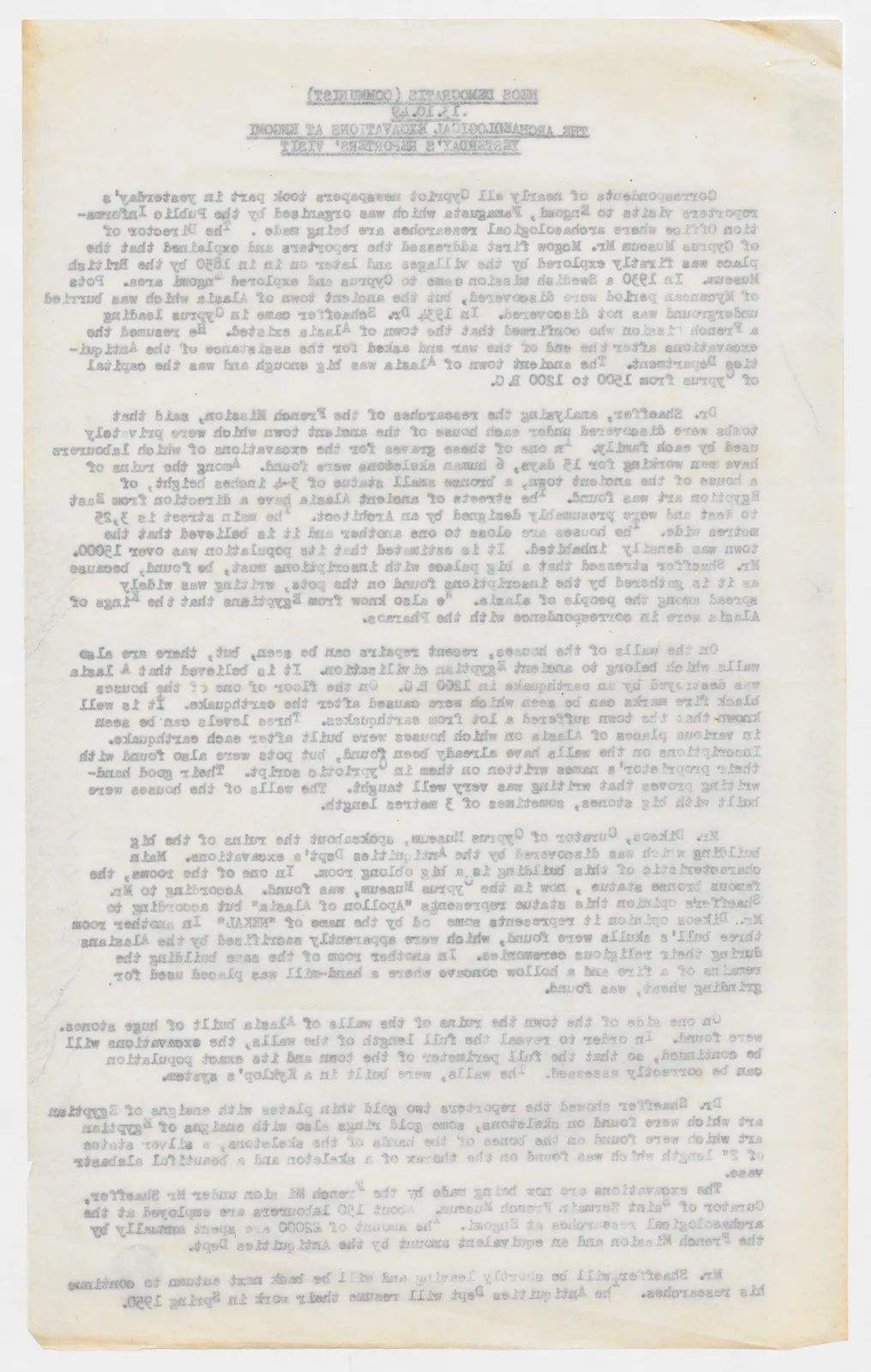
NEOS DEMOKRATIS (COMMUNIST) 13.10.49 THE ARCHAEOLOGICAL EXCAVATIONS AT ENGOMI YESTERDAY'S REPORTERS' VISIT
Correspondents of nearly all Cypriot newspapers took part in yesterday's reporters visit to Engomi, a manguration which was organised by the Public Information Office where archaeological researches are being made. ¹The Director of Cyprus Museum Mr. Megaw first addressed the reporters and explained that the place was firstly explored by the villagers and later on in 1890 by the British Museum. In 1930 a Swedish mission came to Cyprus and explored Engomi area. Pottery of Mycenean period were discovered, but the ancient town of Alasia which was buried underground was not discovered. In 1934 Dr. Schaeffer came to Cyprus leading a ²French mission who confirmed that the town of Alasia existed. He resumed the excavations after the end of the war and asked for the assistance of the Antiquities Department. ³The ancient town of Alasia was big enough and was the capital of Cyprus from 1500 to 1200 B.C.
Dr. Schaeffer, analysing the researches of the ⁴French Mission, said that tombs were discovered under each house of the ancient town which were privately used by each family. ⁵In one of these graves for the excavations of which labourers have been working for 15 days, 6 human skeletons were found. ⁶Among the ruins of a house of the ancient town, a bronze small statue of 3-4 inches height, of Egyptian art was found. ⁷The streets of ancient Alasia have a direction from East to West and were presumably designed by an Architect. ⁸The main street is 3.25 metres wide. ⁹The houses are close to one another and it is believed that the town was densely inhabited. It is estimated that its population was over 15000. Mr. Schaeffer stressed that a big palace with inscriptions must be found, because as it is gathered by the inscriptions found on the pots, writing was widely spread among the people of Alasia. ¹⁰We also know from Egyptians that the kings of Alasia were in correspondence with the Pharaos.
On the walls of the houses, recent repairs can be seen, but, there are also walls which belong to ancient Egyptian destruction. It is believed that Alasia was destroyed by an earthquake in 1200 B.C. On the floor of one of the houses black fire marks can be seen which were caused after the earthquake. It is well known that the town suffered a lot from earthquakes. Three levels can be seen in various places of Alasia on which houses were built after each earthquake. Inscriptions on the walls have already been found, but pots were also found with their proprietor's names written on them in Syllabic script. Their good handwriting proves that writing was very well taught. The walls of the houses were built with big stones, sometimes of 3 metres length.
Mr. Dikeos, Curator of Cyprus Museum, spoke about the ruins of the big building which was discovered by the Antiquities Dept's excavations. Main characteristic of this building is a big oblong room. In one of the rooms, the famous bronze statue, now in the Cyprus Museum, was found. According to Mr. Shaeffer's opinion this statue represents "Apollon of Alasia" but according to Mr. Dikeos opinion it represents some god by the name of "NEKAL". In another room three bull's a skulls were found, which were apparently sacrificed by the Alasians during their religious ceremonies. In another room of the same building the remains of a fire and a hollow concave where a hand-mill was placed used for grinding wheat, was found.
On one side of the ruins of the town the walls of Alasia built of huge stones were found. In order to reveal the full length of the walls, the excavations will be continued, so that the full perimeter of the town and its exact population can be correctly assessed. The walls, were built in a Kyklop's system.
Dr. Shaeffer showed the reporters two gold thin plates with engrave of Egyptian art which were found on skeletons, some gold rings also with engrave of Egyptian art which were found on the bones of the hands of the skeletons, a silver statue of 2" length which was found on the thorax of a skeleton and a beautiful alabaster vase.
The excavations are now being made by the French Mission under Mr Shaeffer, Curator of Saint Germain French Museum. About 120 labourers are employed at the archaeological researches at Engomi. The amount of £2000 are spent annually by the French Mission and an equivalent amount by the Antiquities Dept.
Mr. Shaeffer will be shortly leaving and will be back next autumn to continue his researches. The Antiquities Dept will resume their work in Spring 1950.
65 figures hard to readstruck struck outadded written in above” jug ditto, and what it repeatsword reading not certain