
Unnumbered pageScan 2 of 4
NEOS KYPRIAKOS PHYLAX (RIGHTIST) 13/10/49.
THE EXCAVATIONS AT ENGOMI.
FOR THE DISCOVERY OF THE PALACE OF THE ANCIENT TOWN OF ALASIA.
YESTERDAY'S REPORTERS VISIT.
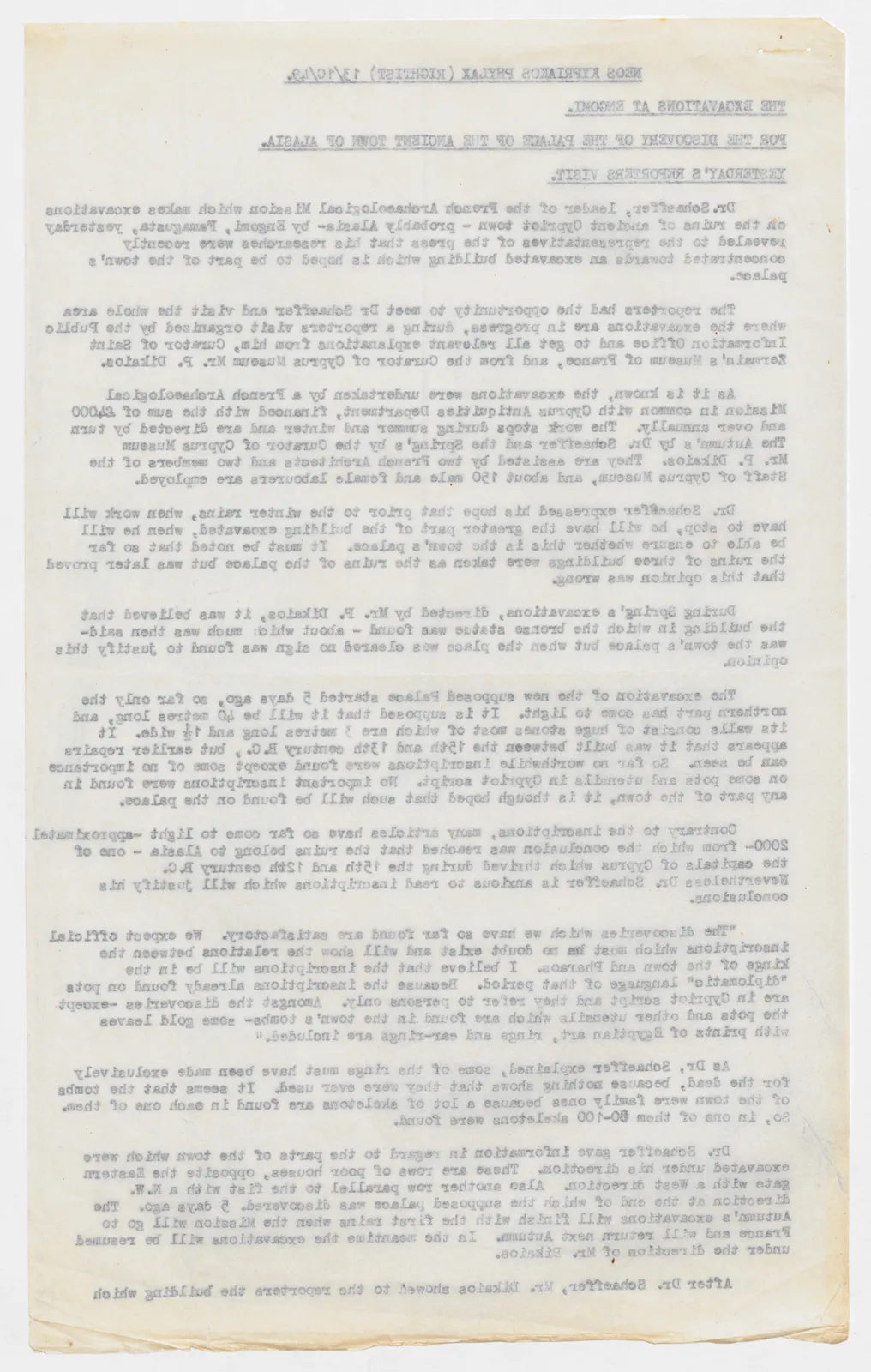
Dr. Schaeffer, leader of the French Archaeological Mission which makes excavations on the ruins of ancient Cypriot town - probably Alasia - by Engomi, Famagusta, yesterday revealed to the representatives of the press that his researches were recently concentrated towards an excavated building which is hoped to be part of the town's palace.
The reporters had the opportunity to meet Dr Schaeffer and visit the whole area where the excavations are in progress, during a reporters visit organised by the Public Information Office and to get all relevant explanations from him, Curator of Saint Germain's Museum of France, and from the Curator of Cyprus Museum Mr. P. Dikaios.
As it is known, the excavations were undertaken by a French Archaeological Mission in common with Cyprus Antiquities Department, financed with the sum of £4000 and over annually. The work stops during summer and winter and are directed by turn the Autumn's by Dr. Schaeffer and the Spring's by the Curator of Cyprus Museum Mr. P. Dikaios. They are assisted by two French Architects and two members of the Staff of Cyprus Museum, and about 150 male and female labourers are employed.
Dr. Schaeffer expressed his hope that prior to the winter rains, when work will have to stop, he will have the greater part of the building excavated, when he will be able to ensure whether this is the town's palace. It must be noted that so far the ruins of these buildings were taken as the ruins of the palace but later proved that this opinion was wrong.
During Spring's excavations, directed by Mr. P. Dikaios, it was believed that the building in which the bronze statue was found - about which much was then saidwas the town's palace but when the place was cleared no sign was found to justify this opinion.
The excavation of the new supposed palace started 5 days ago, so far only the northern part has come to light. It is supposed that it will be 40 metres long and its walls consist of huge stones most of which are 3 metres long and 1½ wide. It appears that it was built between the 15th and 13th century B.C., but earlier repairs can be seen. So far no worthwhile inscriptions were found except some of no importance on some pots and utensils in Cypriot script. No important inscriptions were found in any part of the town. It is though hoped that such will be found on the palace.
Contrary to the inscriptions, many articles have so far come to light -approximately 2000- from which the conclusion was reached that the ruins belong to Alasia - one of the capitals of Cyprus which thrived during the 15th and 12th century B.C. Nevertheless Dr. Schaeffer is anxious to read inscriptions which will justify his conclusions.
"The discoveries which we have so far found are satisfactory. We expect official inscriptions which must in no doubt exist and will show the relations between the kings of the town and Pharaos. I believe that the inscriptions will be in the "diplomatic" language of that period. Because the inscriptions already found on pots are in Cypriot script and they refer to persons only. Amongst the discoveries -except the pots and other utensils which are found in the town's a tomba- some gold leaves with prints of Egyptian art, rings and ear-rings are included."
As Dr. Schaeffer explained, some of the rings must have been made exclusively for the dead, because nothing shows that they were ever used. It seems that the tomba of the town were family ones because a lot of skeletons are found in each one of them. So, in one of them 80-100 skeletons were found.
Dr. Schaeffer gave information in regard to the parts of the town which were excavated under his direction. These are rows of poor houses, opposite the Eastern gate with a West direction. Also another row parallel to the flat with a N.W. direction at the end of which the supposed palace was discovered, 5 days ago. The Autumn's excavations will finish with the first rains when the Mission will go to France and will return next Autumn. In the meantime the excavations will be resumed under the direction of Mr. Dikaios.
After Dr. Schaeffer, Mr. Dikaios showed to the reporters the building which … continues
65 figures hard to readstruck struck outadded written in above” jug ditto, and what it repeatsword reading not certain