
Page - 2 -Scan 1 of 2
Printed: AFFAIRES ÉTRANGÈRES
Printed: EN CLAIR
TELEGRAMME AU DEPART
Le Castel Blanc, 14 Rue Turgot, St. Germain-en-Laye, (Seine et Oise).
Dear Megaw and Dikaios, 27 January 1949.
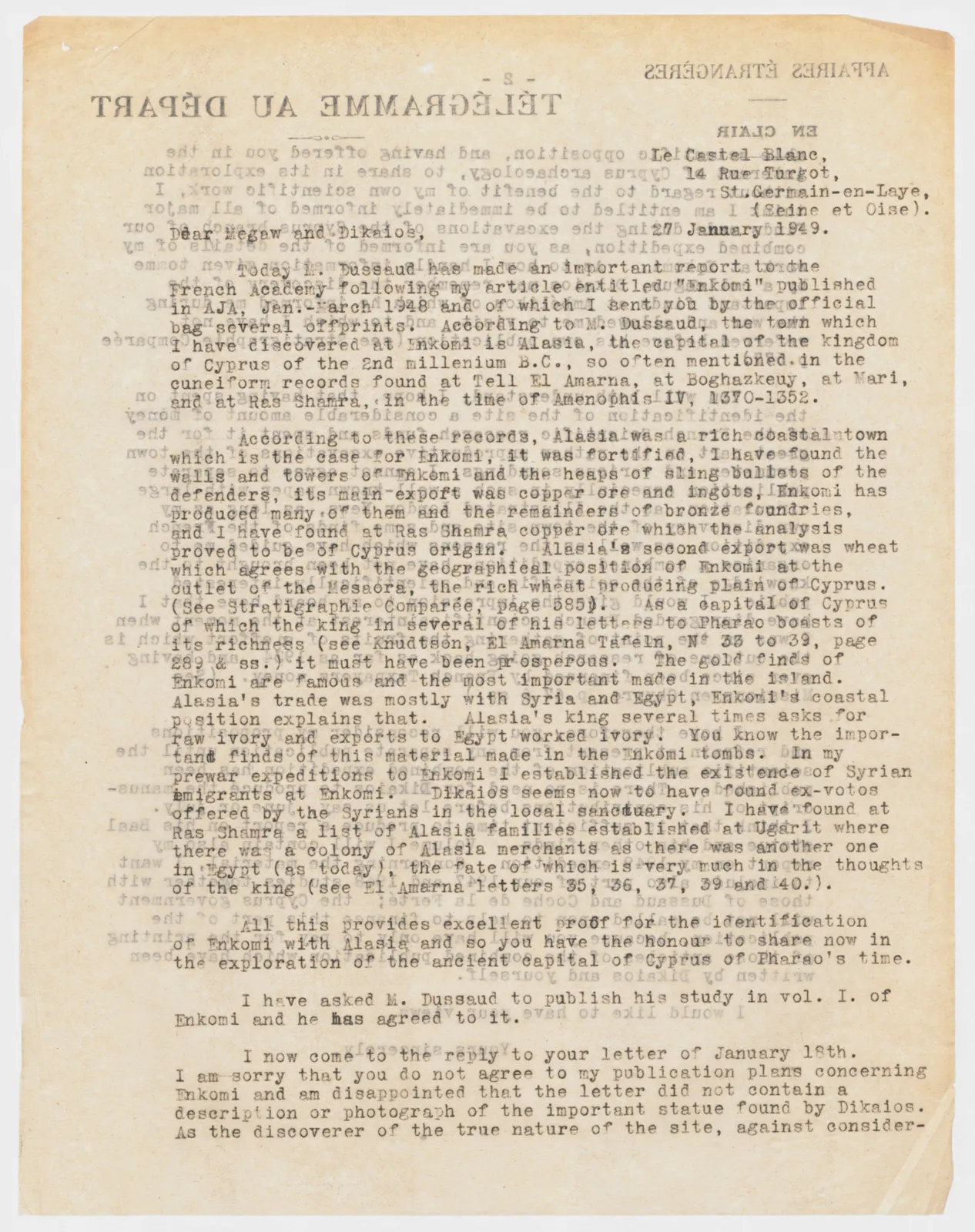
Today M. Dussaud has made an important report to the French Academy following my article entitled "Enkomi" published in AJA, Jan.-March 1948 and of which I sent you by the official bag several offprints. According to M. Dussaud, the town which I have discovered at Enkomi is Alasia, the capital of the kingdom of Cyprus of the 2nd millenium B.C., so often mentioned in the cuneiform records found at Tell El Amarna, at Boghazkeuy, at Mari, and at Ras Shamra, in the time of Amenophis IV, 1370-1352.
According to these records, Alasia was a rich coastal town which is the case for Enkomi, it was fortified, I have found the walls and towers of Enkomi and the heaps of sling bullets of the defenders, its main export was copper ore and ingots, Enkomi has produced many of them and the remainders of bronze foundries, and I have found at Ras Shamra copper ore which the analysis proved to be of Cyprus origin. Alasia's second export was wheat which agrees with the geographical position of Enkomi at the outlet of the Mesaora, the rich wheat producing plain of Cyprus. (See Stratigraphie Comparée, page 585). As a capital of Cyprus of which the king in several of his letters to Pharao boasts of its richness (see Knudtson, El Amarna Tafeln, N° 33 to 39, page 289 & ss.) it must have been prosperous. The gold finds of Enkomi are famous and the most important made in the island. Alasia's trade was mostly with Syria and Egypt, Enkomi's coastal position explains that. Alasia's king several times asks for raw ivory and exports to Egypt worked ivory. You know the important finds of this material made in the Enkomi tombs. In my prewar expeditions to Enkomi I established the existence of Syrian emigrants at Enkomi. Dikaios seems now to have found ex-votos offered by the Syrians in the local sanctuary. I have found at Ras Shamra a list of Alasia families established at Ugarit where there was a colony of Alasia merchants as there was another one in Egypt (as today), the fate of which is very much in the thoughts of the king (see El Amarna letters 35, 36, 37, 39 and 40.)
All this provides excellent proof for the identification of Enkomi with Alasia and so you have the honour to share now in the exploration of the ancient capital of Cyprus of Pharao's time.
I have asked M. Dussaud to publish his study in vol. I. of Enkomi and he has agreed to it.
I now come to the reply to your letter of January 18th. I am sorry that you do not agree to my publication plans concerning Enkomi and am disappointed that the letter did not contain a description or photograph of the important statue found by Dikaios. As the discoverer of the true nature of the site, against consider-
65 figures hard to readstruck struck outadded written in above” jug ditto, and what it repeatsword reading not certain