
Unnumbered pageScan 4 of 4
Press Communiqué
Excavations at Enkomi
events and thus explain their exact causes. It is hoped, however, that much light will be thrown on the eventful history of Cyprus during the thirteenth and early twelfth century B.C.
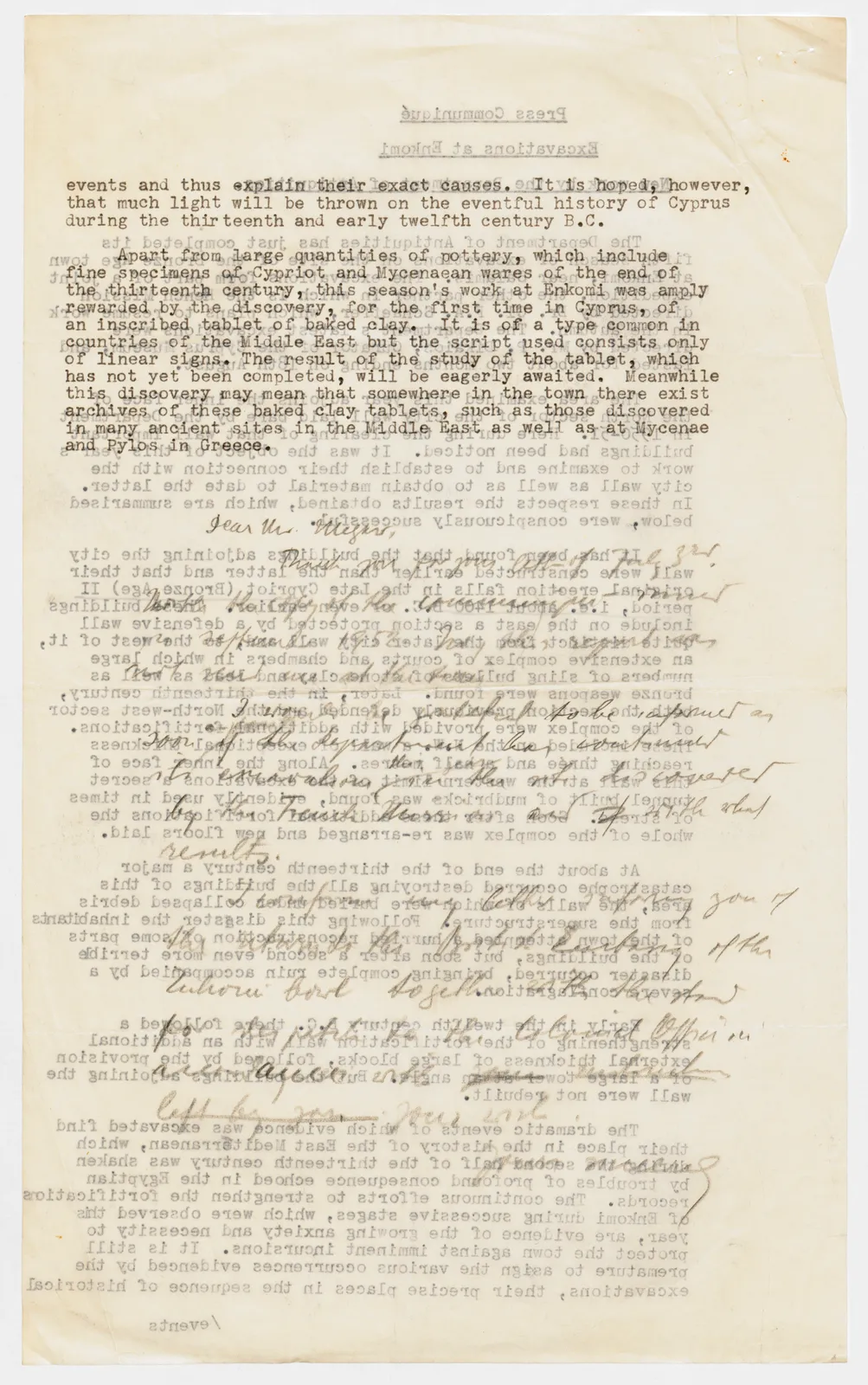
Apart from large quantities of pottery, which include fine specimens of Cypriot and Mycenaean wares of the end of the thirteenth century, this season's work at Enkomi was amply rewarded by the discovery, for the first time in Cyprus, of an inscribed tablet of baked clay. It is of a type common in countries of the Middle East but the script used consists only of linear signs. The result of the study of the tablet, which has not yet been completed, will be eagerly awaited. Meanwhile this discovery may mean that somewhere in the town there exist archives of these baked clay tablets, such as those discovered in many ancient sites in the Middle East as well as at Mycenae and Pylos in Greece.
work to examine and to establish their connection with the city wall as well as to obtain material to date the latter. In these respects the results obtained, which are summarised below, were conspicuously successful.
Handwritten: Dear Mr. Megaw,
It has been found that the buildings adjoining the city wall were constructed earlier than the latter and that their original erection falls in the Late Cypriot (Bronze Age) II period, i.e. about 1400 B.C. or even earlier. [handwritten: [illegible]] Quite apart from the later city wall, the west of it, an extensive complex of courts and chambers in which large numbers of sling bullets of stone, clay and bronze weapons were found. Later, in the thirteenth century the section was particularly defended and the north-west sector of the complex were provided with additional fortifications. These included the building of a rampart exceptionally thickness reaching three and a half metres. Along the inner face of this wall at the western limit, cross excavations a secret tunnel built of mudbricks was found, evidently used in times of siege. Soon after this addition fortifications the whole of the complex was re-arranged and new floors laid.
Handwritten: results.
At about the end of the thirteenth century a major catastrophe occurred destroying all the buildings of this area. The walls of many were buried under collapsed debris from the superstructure. Following this disaster the inhabitants of the town attempted a hurried reconstruction of some parts of the buildings, but soon after a second even more terrible disaster occurred, bringing complete ruin accompanied by a severe conflagration.
Early in the twelfth century B.C. there followed a strengthening of the fortification wall with an additional external thickness of large blocks, followed by the provision of a large tower against the buildings adjoining the wall were not rebuilt.
The dramatic events of which evidence was excavated find their place in the history of the East Mediterranean, which in the second half of the thirteenth century was shaken by troubles of profound consequence echoed in the Egyptian records. The continuous efforts to strengthen the fortifications of Enkomi during successive stages, which were observed this year, are evidence of the growing anxiety and necessity to protect the town against imminent incursions. It is still premature to assign the various occurrences evidenced by the excavations, their precise places in the sequence of historical
events
65 figures hard to readstruck struck outadded written in above” jug ditto, and what it repeatsword reading not certain