
Unnumbered pageScan 1 of 4
Press Communiqué.
Excavations at Enkomi New work by the Department of Antiquities.
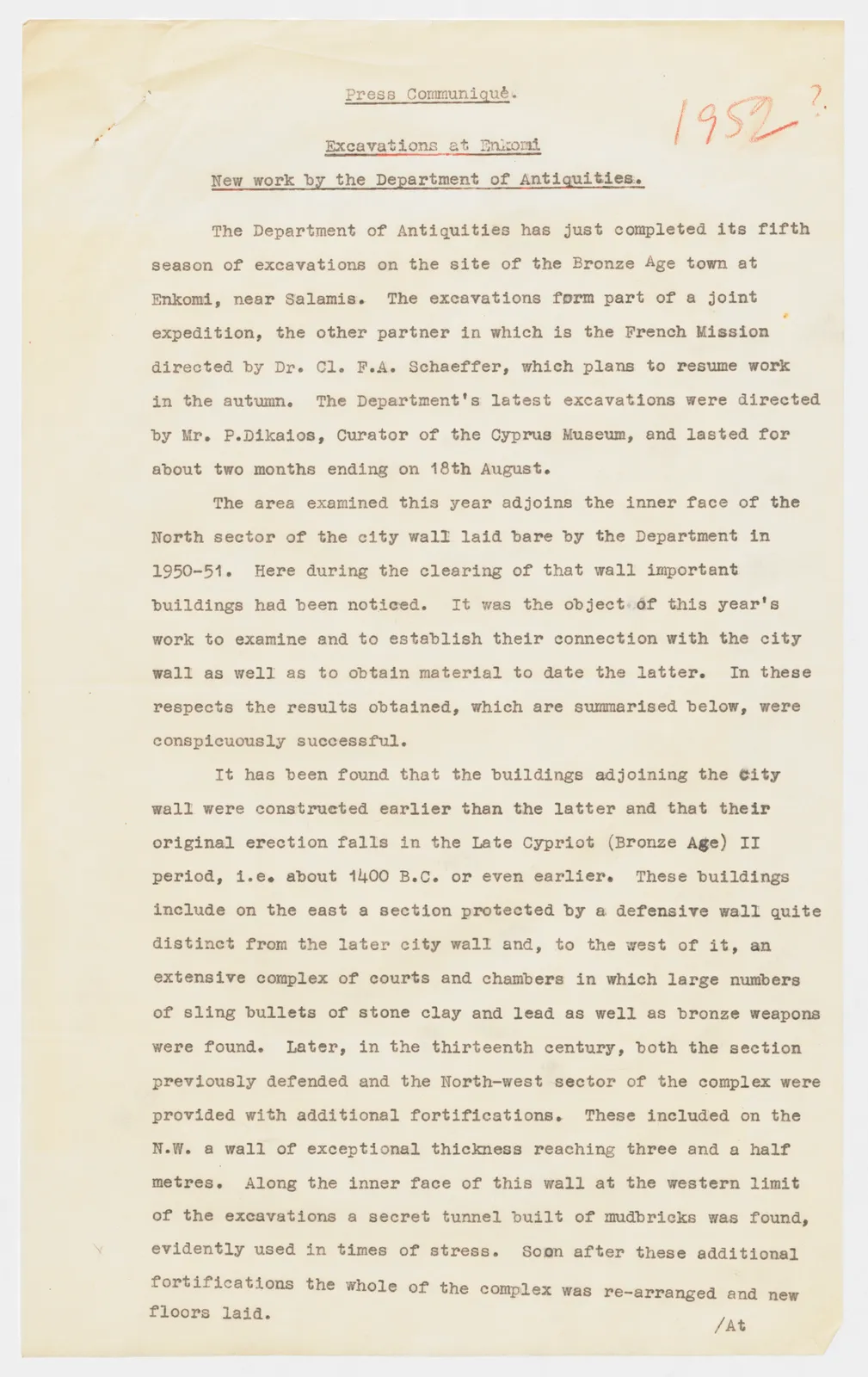
The Department of Antiquities has just completed its fifth season of excavations on the site of the Bronze Age town at Enkomi, near Salamis. The excavations form part of a joint expedition, the other partner in which is the French Mission directed by Dr. Cl. F.A. Schaeffer, which plans to resume work in the autumn. The Department's latest excavations were directed by Mr. P.Dikaios, Curator of the Cyprus Museum, and lasted for about two months ending on 18th August.
The area examined this year adjoins the inner face of the North sector of the city wall laid bare by the Department in 1950-51. Here during the clearing of that wall important buildings had been noticed. It was the object of this year's work to examine and to establish their connection with the city wall as well as to obtain material to date the latter. In these respects the results obtained, which are summarised below, were conspicuously successful.
It has been found that the buildings adjoining the city wall were constructed earlier than the latter and that their original erection falls in the Late Cypriot (Bronze Age) II period, i.e. about 1400 B.C. or even earlier. These buildings include on the east a section protected by a defensive wall quite distinct from the later city wall and, to the west of it, an extensive complex of courts and chambers in which large numbers of sling bullets of stone clay and lead as well as bronze weapons were found. Later, in the thirteenth century, both the section previously defended and the North-west sector of the complex were provided with additional fortifications. These included on the N.W. a wall of exceptional thickness reaching three and a half metres. Along the inner face of this wall at the western limit of the excavations a secret tunnel built of mudbricks was found, evidently used in times of stress. Soon after these additional fortifications the whole of the complex was re-arranged and new floors laid.
/At
[handwritten: 1952 ?] — written in red at top right, handwritten.
65 figures hard to readstruck struck outadded written in above” jug ditto, and what it repeatsword reading not certain