
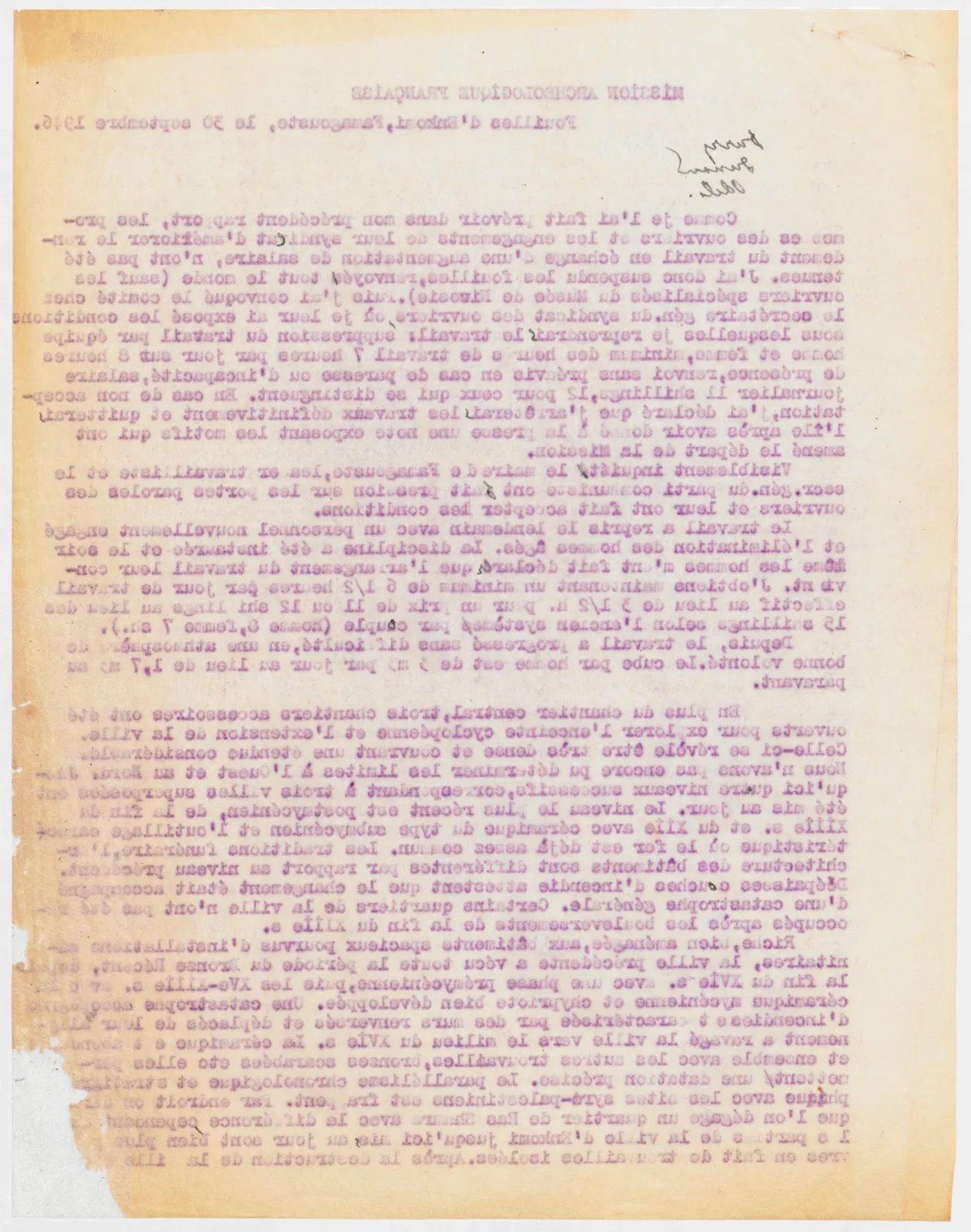
Unnumbered pageScan 2 of 8
FRENCH ARCHAEOLOGICAL MISSION
Excavations at Enkomi, Famagusta, 30 September 1946.
Handwritten: initials, illegible
As I foresaw in my previous report, the promises of the workmen and the undertakings of their union to improve the output of work in exchange for an increase in wages have not been kept. I have therefore suspended the excavations and dismissed everyone (except the specialist workmen of the Nicosia museum). But I summoned the committee to the general secretary of the workmen's union, where I set out for them the conditions under which I would take on the work: abolition of work by team man and woman, minimum working hours 7 hours per day or 8 hours on site, dismissal without notice in case of idleness or incapacity, wage daily 11 shillings 12 for those who distinguish themselves. In case of non acceptance, I declared that I would stop the work definitively and leave the island after giving the press a note setting out the reasons which had led to the departure of the Mission.
Probably alarmed the mayor of Famagusta, the workmen and labourers and the gen. sec. of the communist party put pressure on the spokesmen of the workmen and made them accept the conditions.
Work resumed the next day with newly engaged staff and the elimination of older men. Discipline was uncompromising and the exit of the men made me declare that the working arrangement suited them well. I now obtain a minimum of 6 1/2 hours per day of actual work instead of 5 1/2 h. for a price of 11 or 12 shillings instead of 15 shillings under the old system per couple (man & woman 7 sh.). Since then, work has progressed without difficulty, in an atmosphere of goodwill. The volume per man is 3 m3 per day instead of 1,7 m3 on average.
In addition to the central area, three subsidiary areas have been opened to explore the Cyclopean enclosure and the extension of the town. This proves to be very dense and covering a considerable extent. We have not yet been able to determine the limits to the W. and N. Eighteen, four successive levels corresponding to three superimposed villages have been uncovered. The most recent level, post-Byzantine, of the end of the 13th c. and of the 13th with pottery of the sub-Mycenaean type and the characteristic toolkit where iron is already fairly common. The funerary traditions, the architecture of the buildings are different from the previous level. Copper palaces of enormous size attest that the change was accompanied by a general catastrophe. Certain quarters of the town were not reoccupied after the upheavals of the end of the 13th c.
Rich, well laid out, with spacious buildings provided with domestic installations, the preceding town lived through the whole of the Late Bronze period, until the end of the 13th c. with a probably phase, then the 15th-13th c. Mycenaean and Cypriot pottery well developed. A geological catastrophe of fires characterised by walls overturned and displaced from their alignment ... [illegible]
and together with the other finds, corroded bronzes etc. ...
[illegible]
that one clears a quarter of Ras Shamra with the difference however ... [illegible]
the part of the town of Enkomi until place to the day ... [illegible]
vres in the way of isolated walls. After the construction of the town [illegible]
65 figures hard to readstruck struck outadded written in above” jug ditto, and what it repeatsword reading not certain