
Unnumbered pageScan 1 of 2
FRENCH ARCHAEOLOGICAL MISSION
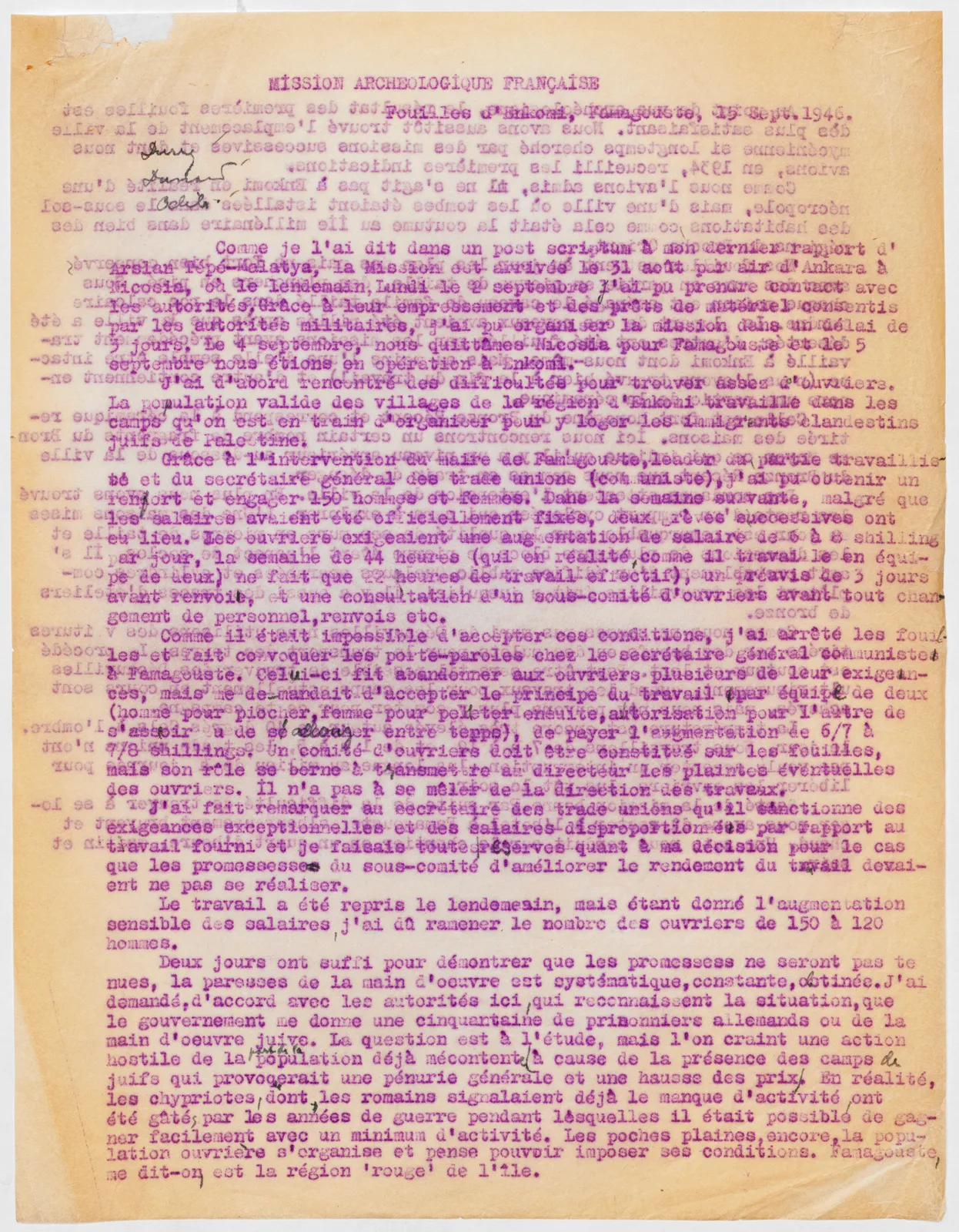
Excavations at Enkomi, Famagusta, 15 Sept. 1946.
As I said in a postscript to my last report on Arslan Tepé-Malatya, the Mission arrived on 31 August by air from Ankara to Nicosia, where the next day, Monday 2 September, I was able to make contact with the authorities. Thanks to their eagerness and loans of equipment granted by the military authorities, I was able to organise the mission within a period of 3 days. On 4 September we left Nicosia for Famagusta and on 5 September we were operating at Enkomi.
I first encountered difficulties in finding enough workmen.
The able-bodied population of the villages of the Enkomi region works in the camps being organised to house the illegal immigrants Jewish from Palestine.
Thanks to the intervention of the mayor of Famagusta, leader of the Labour party and of the general secretary of the trade unions (communist), I was able to obtain a reinforcement and engage 150 men and women. In the following week, although the wages had been officially fixed, two successive strikes have taken place. The workmen demanded a wage increase from 6 to 8 shillings a day, a 44-hour week (which in reality, since he works in equipe of two amounts to only 22 hours of effective work), a notice of 3 days before dismissal, and consultation of a workmen's sub-committee before any changeover of staff, dismissals etc.
As it was impossible to accept these conditions, I stopped the excavations and had the spokesmen summoned to the communist general secretary at Famagusta. He had the workmen abandon several of their demands but asked me to accept the principle of work in teams of two (man to pick, woman to shovel afterwards, permission for the other to sit down or unload between teppe), to pay the increase from 6/7 to 7/8 shillings. A workmen's committee must be formed on the excavations, but its role is limited to passing on to the director any complaints from the workmen. It has no business interfering in the direction of the work.
I pointed out to the secretary of the trade unions that he is sanctioning exceptional demands and wages out of proportion to the work supplied, and I made all reservations about my decision in the event that the sub-committee's promises to improve work output should not be fulfilled.
Work was resumed the next day, but given the appreciable increase in wages I had to reduce the number of workmen from 150 to 120 men.
Two days were enough to show that the promises will not be kept , the laziness of the labour force is systematic, constant, obstinate. I have asked, in agreement with the local authorities, who recognise the situation, that the government give me some fifty German prisoners or of the Jewish labour force. The question is under study, but one fears an action hostile from the population already discontented because of the presence of the camps of Jews which would cause a general shortage and a rise in prices. In reality, the Cypriots, whose lack of activity the Romans already noted, have been spoiled by the war years, during which it was possible to earn easily with a minimum of activity. The pockets full, moreover, the working population organises itself and thinks it can impose its conditions. Famagusta they tell me, is the 'red' region of the island.
Handwritten: signatures/initials at upper left margin, illegible
65 figures hard to readstruck struck outadded written in above” jug ditto, and what it repeatsword reading not certain