
Unnumbered pageScan 2 of 2
Printed: MISSION ARCHEOLOGIQUE FRANCAISE
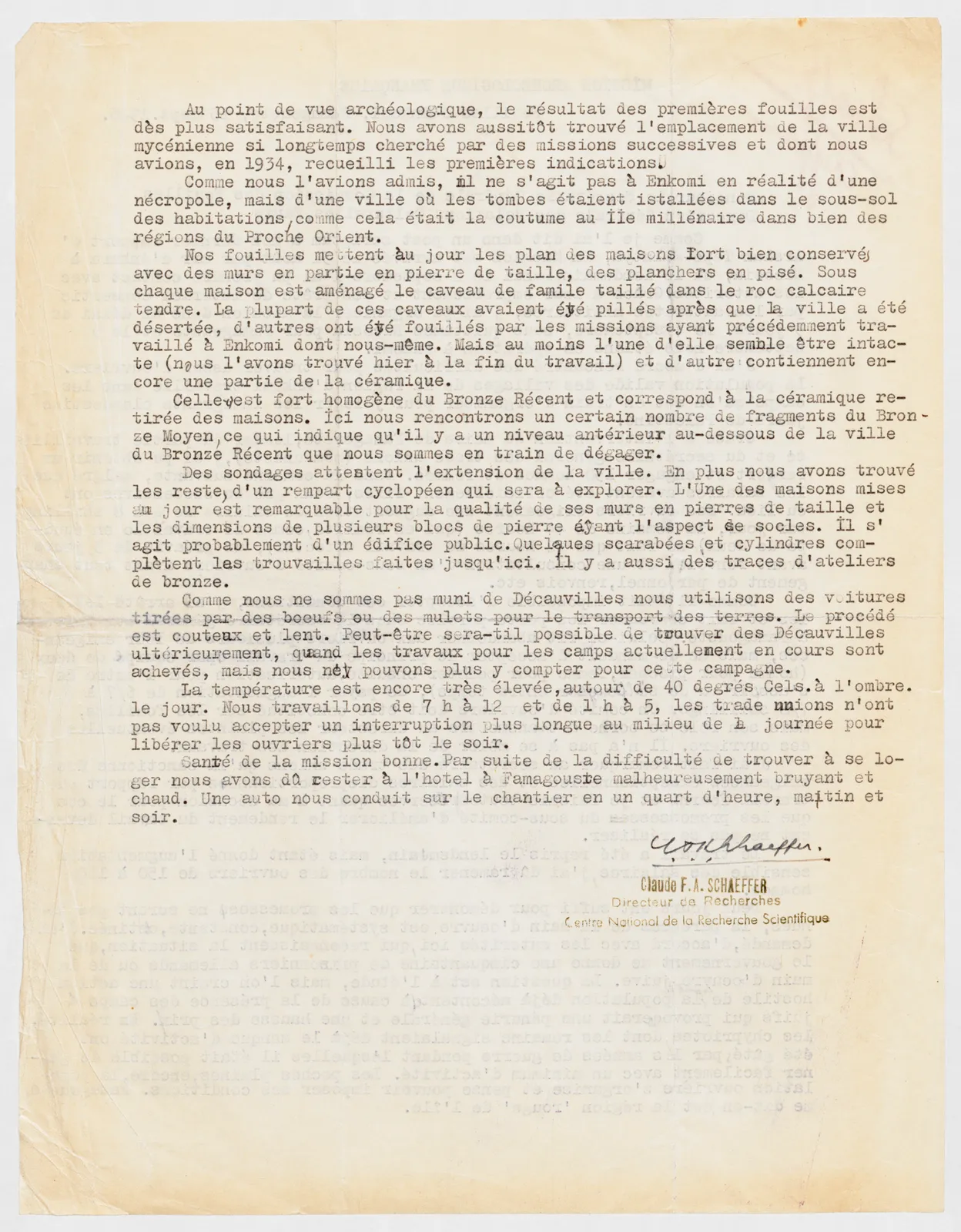
From the archaeological point of view, the result of the first excavations is most satisfactory. We immediately found the site of the town Mycenaean, so long sought by successive missions and of which we had, in 1934, recovered the first indications. As we had assumed, it is not in fact a necropolis at Enkomi that we are dealing with, but a town where the tombs were installed in the basement of the houses, as was the custom in the 2nd millennium in many regions of the Near East. Our excavations uncover the plans of the houses, very well preserved, with walls partly of ashlar, and floors of pisé. Beneath each house is arranged the family burial chamber cut into the soft limestone rock. Most of these burial chambers had been looted after the town had been deserted; others were excavated by the missions previously working at Enkomi, including ourselves. But at least one of them appears to be intact- (we found it yesterday at the end of the work) and others still contain part of the pottery. This is very homogeneous Late Bronze and corresponds to the pottery removed from the houses. Here we encounter a number of fragments of Bronze- Middle, which indicates that there is an earlier level below the town of Late Bronze that we are in the process of clearing. Soundings attest to the extent of the town. Moreover we have found the remains of a Cyclopean rampart which remains to be explored. One of the houses uncovered is remarkable for the quality of its ashlar walls and the dimensions of several stone blocks having the appearance of plinths. It is probably a public building. Some scarabs and cylinder seals complete the finds made so far. There are also traces of workshops for bronze. As we are not provided with Decauville lines we use carts drawn by oxen or mules for the transport of earth. The method is costly and slow. Perhaps it will be possible to find Decauville lines later, when the work for the camps currently under way is finished, but we can no longer count on them for this campaign. The temperature is still very high, around 40 degrees Celsius in the shade. during the day. We work from 7 h to 12 and from 1 h to 5; the trade unions have not wished to accept a longer interruption in the middle of the day in order to release the workmen earlier in the evening. Health of the mission good. Owing to the difficulty of finding lodging we had to stay at the hotel in Famagusta, unfortunately noisy and hot. A car takes us to the area in a quarter of an hour, morning and evening.
Handwritten: signature
Stamp: Claude F.A. SCHAEFFER / Directeur de Recherches / Centre National de la Recherche Scientifique
65 figures hard to readstruck struck outadded written in above” jug ditto, and what it repeatsword reading not certain