
Unnumbered pageScan 6 of 10
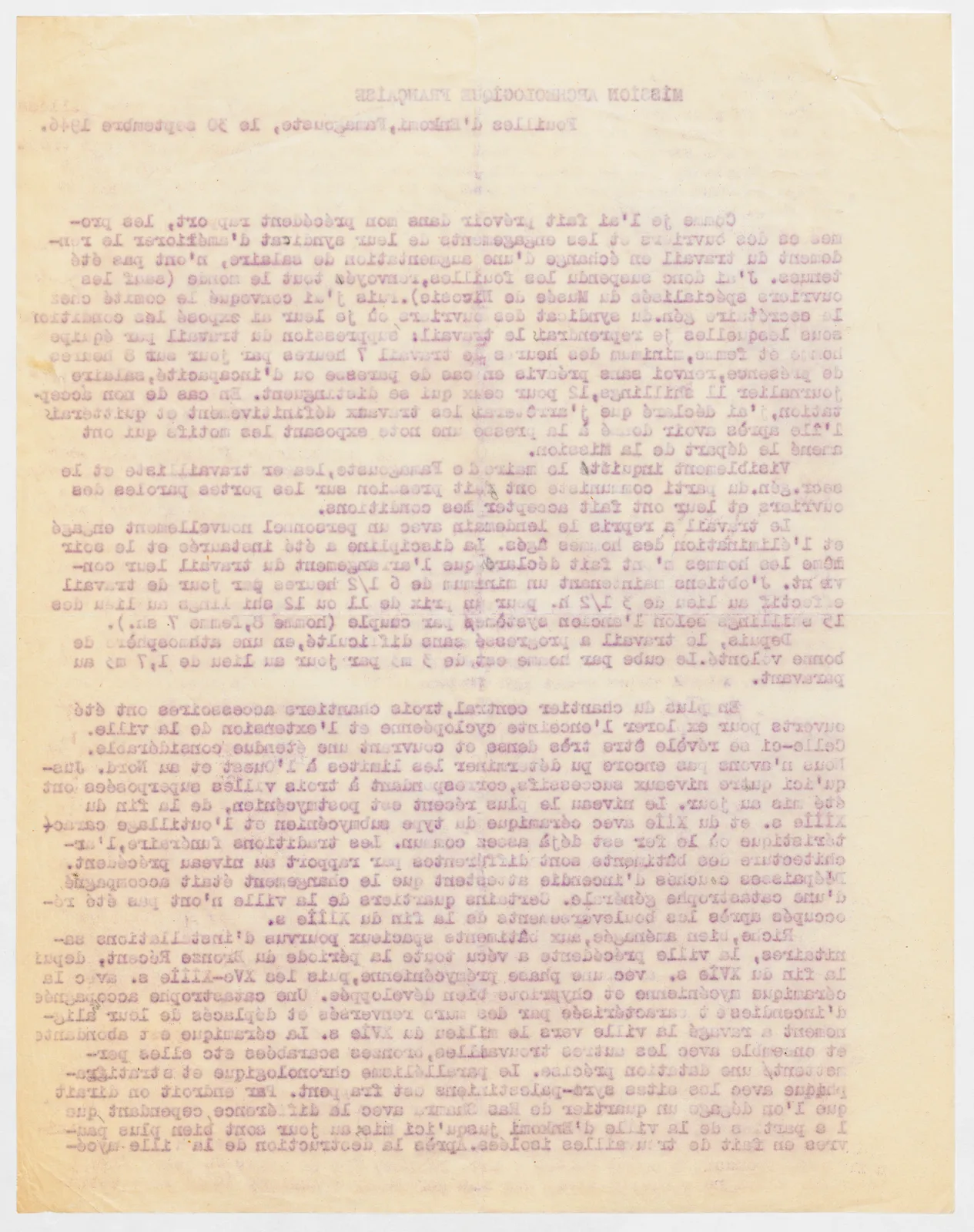
FRENCH ARCHAEOLOGICAL MISSION Excavations of Enkomi, Famagusta, 30 September 1946.
As I predicted in my previous report, the promises of the workmen and the commitments of their union to improve the output of work in exchange for a wage increase, have not been kept. I therefore suspended the Excavations, dismissed everyone (except the specialised workmen of the Nicosia Museum). But I convened the committee at the Gen. Sec. of the workmen's union, where I set out the conditions under which I would continue the work: abolition of team work overtime, minimum working hours 7 hours per day, i.e. 8 hours on site, work to be suspended in case of rain or incapacity, daily wage 11 shillings 12 for those who do not travel. In case of non-acceptance, I declared that I would stop the work definitively and that they would be dismissed. I then gave the press a note setting out the reasons that led to the Mission's departure.
Evidently powerless, the mayor of Famagusta, the workmen and their union have had these conditions accepted.
The work resumed the next day with newly engaged personnel and the elimination of the older men. Discipline was introduced and that evening the men themselves declared that the arrangement of the work suits them. I obtained in particular a minimum of 6 1/2 hours per day of work effective instead of 5 1/2 h. for a rate of 11 or 12 sh. a day instead of 13 shillings under the former system, for example (man 8, woman 7 sh.).
Since then, work has progressed without difficulty, in an atmosphere of good will. The volume per man is 3 m3 per day instead of 1,7 m3 in the previous.
In addition to the central area, three subsidiary areas have been opened to explore the cyclopean enclosure and the extension of the town. This does not appear to be very dense and covers a considerable area. We have not yet been able to determine the limits to the W. and N. The four necessary levels, corresponding to three superimposed towns, have been uncovered. The most recent level is post-Mycenaean, from the end of the 13th c. and the 12th with sub-Mycenaean type pottery and the characteristic tools where iron is already fairly common. The funerary traditions, the architecture of the buildings are different from the previous level. Burnt traces caused by fire attest that the change was accompanied by a general catastrophe. Some quarters of the town have not been reoccupied after the upheavals at the end of the 13th c.
Rich, well laid out, with spacious buildings provided with sanitary installations, the previous town lived through the whole Late Bronze period, from the end of the 16th c. with a Protogeometric phase, then the 15th-13th c. with the well-developed Mycenaean and Cypriot pottery. A catastrophe accompanied by fires, characterised by walls overturned and displaced in every altement through the town towards the middle of the 17th c. The pottery is abundant and together with the other finds, bronzes, scarabs etc. effects permit a precise dating. The chronological and stratigraphic parallelism with the other Syro-Palestinian is striking. In places one would say that one is uncovering a quarter of Ras Shamra, with the difference however that the part of the town of Enkomi is more closely linked. After the destruction of the town ayocvres in fact all the houses no longer well pen- … continues
65 figures hard to readstruck struck outadded written in above” jug ditto, and what it repeatsword reading not certain