
Unnumbered pageScan 28 of 38
- 13 -
extensive compound there is one long room with a central hearth, is at that stage at least premature, and dangerous for it introduces the idea of an eventual Aegean or Greek influence, when danger is clearly shown p.178 of Dikaios' summary, we are soon reaching.
P.171: The humble character of the earlier structures belonging to LC I is mentioned; this tendency to minimize the structures before the so-called LC III buildings serves the general spirit of the interpretation, but it is dangerous, even more, it is wrong.
P.172. Here is another serious statement, the consequences of which have probably escaped Dikaios, otherwise he would have tried to explain me why he reversed his first statements in his letters to me and understates in this way one of the main results of my work at Enkomi, that of the discovery of the town site of Bronze Age period, to which belong the majority of the tombs so far found at Enkomi. The statement reads: "We also found evidence that the site had been used as a cemetery." And he explains: "In the eastward extension of the excavated area, he found a Middle Cypriot tomb entirely emptied with a LC III wall built in it. In other words, at the time of the Middle Cypriot tomb there was no town on that site. How can Dikaios rule out the possibility, without having explored his area below floor V and earlier floors?"
Another tomb, he reports here, was found immediately outside the northern façade of the compound which passed along the edge of the dromos. This is the tomb of which Dikaios wrote to me in his letter during the dig, May 30th 1949, in the following terms:
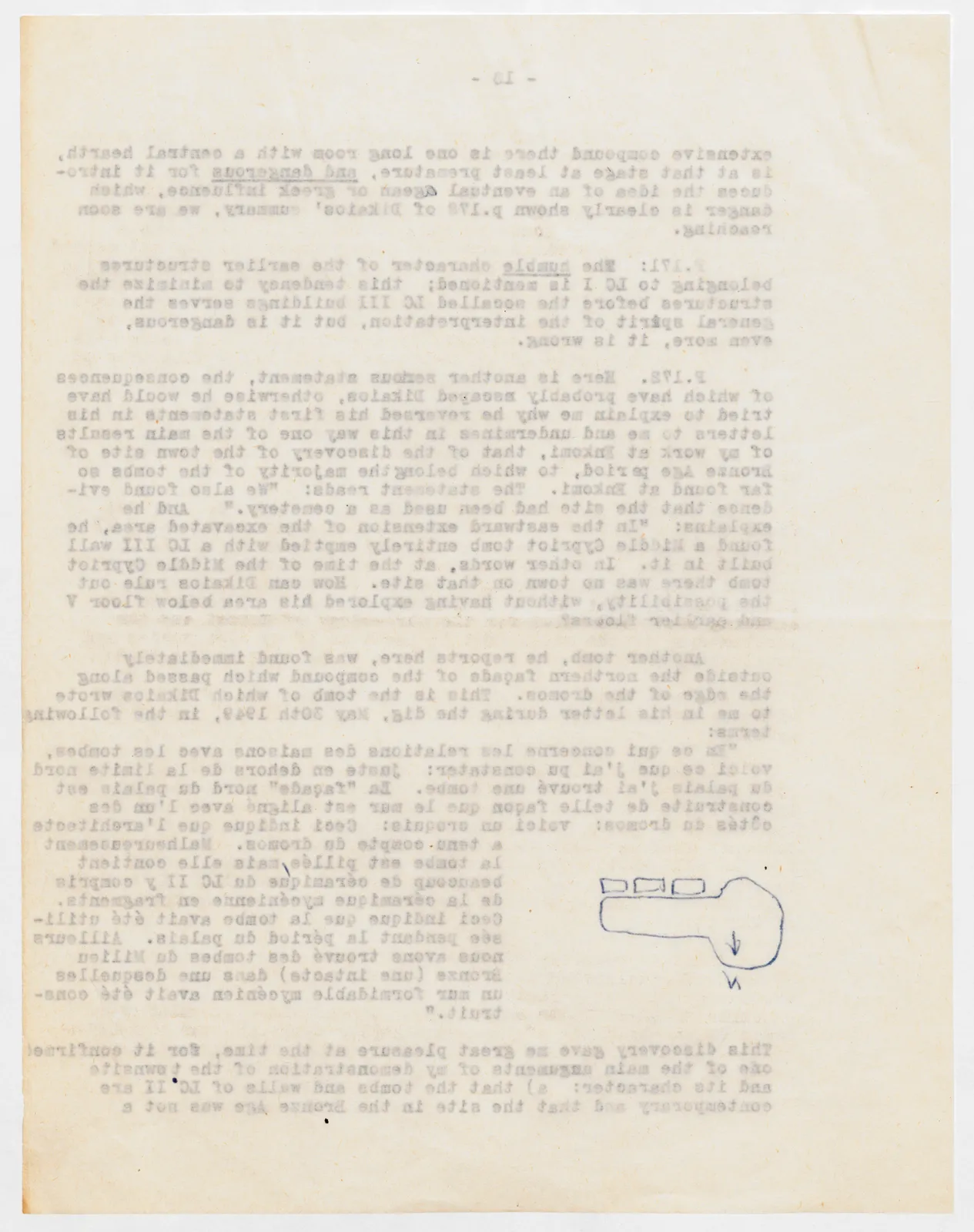
"As regards the relations of the houses with the tombs, here is what I was able to observe: just outside the northern limit of the palace I found a tomb. The northern "façade" of the palace is built in such a way that the wall is alligned with one of the sides of the dromos: here is a sketch. This indicates that the architect took account of the dromos. Unfortunately the tomb has been looted, but it contains a lot of LC II pottery, including Mycenaean pottery in fragments. This indicates that the tomb had been utilised during the palace period. Elsewhere we have found tombs of the Middle Bronze Age (one intact) in one of which a formidable Mycenaean wall had been constructed."
This discovery gave me great pleasure at the time, for it confirmed one of the main arguments of my demonstration of the townsite and its character: a) that the tombs and walls of LC II are contemporary and that the site in the Bronze Age was not a
Figure: hand-drawn plan of a building with a row of rectangular units along the top, a rounded irregular outline at right, a long arrow pointing downward, and a north arrow with label "N"; labels: N
65 figures hard to readstruck struck outadded written in above” jug ditto, and what it repeatsword reading not certain