
Unnumbered pageScan 18 of 38
Continued from scan 17
… could explain the other.
All this is like a struggle in a morass of wrong arguments. But there is worse to come.
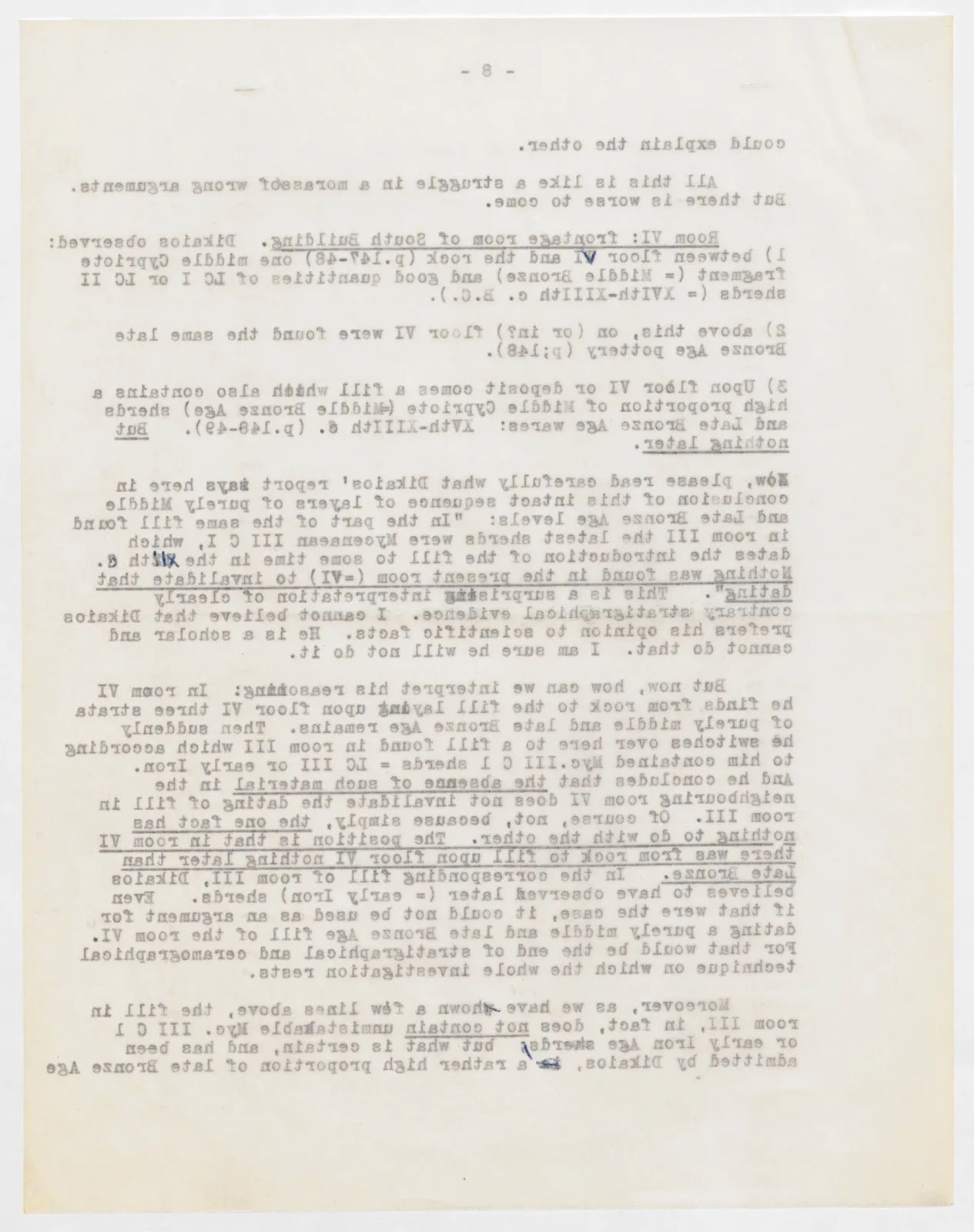
Room VI: frontage room of South Building. Dikaios observed: 1) between floor VI and the rock (p.147-48) one middle Cypriote fragment (= Middle Bronze) and good quantities of LC I or LC II sherds (= XVIIth-XIIIth c. B.C.).
2) above this, on (or in?) floor VI were found the same late Bronze Age pottery (p;148).
3) Upon floor VI or deposit comes a fill which also contains a high proportion of Middle Cypriote (=Middle Bronze Age) sherds and Late Bronze Age wares: XVth-XIIIth c. (p.148-49). But nothing later.
Now, please read carefully what Dikaios' report says here in conclusion of this intact sequence of layers of purely Middle and Late Bronze Age levels: "In the part of the same fill found in room III the latest sherds were Mycenaean III C 1, which dates the introduction of the fill to some time in the XIIth c. Nothing was found in the present room (=VI) to invalidate that dating". This is a surprising interpretation of clearly contrary stratigraphical evidence. I cannot believe that Dikaios prefers his opinion to scientific facts. He is a scholar and cannot do that. I am sure he will not do it.
But now, how can we interpret his reasoning: In room VI he finds from rock to the fill laying upon floor VI three strata of purely middle and late Bronze Age remains. Then suddenly he switches over here to a fill found in room III which according to him contained Myc.III C 1 sherds = LC III or early Iron. And he concludes that the absence of such material in the neighbouring room VI does not invalidate the dating of fill in room III. Of course, not, because simply, the one fact has nothing to do with the other. The position is that in room VI there was from rock to fill upon floor VI nothing later than late Bronze. In the corresponding fill of room III, Dikaios believes to have observed later (= early Iron) sherds. Even if that were the case, it could not be used as an argument for dating a purely middle and late Bronze Age fill of the room VI. For that would be the end of stratigraphical and ceramographical technique on which the whole investigation rests.
Moreover, as we have shown a few lines above, the fill in room III, in fact, does not contain unmistakable Myc. III C 1 or early Iron Age sherds, but what is certain, and has been admitted by Dikaios, [handwritten: blue pen stroke] is a rather high proportion of late Bronze Age … continues
65 figures hard to readstruck struck outadded written in above” jug ditto, and what it repeatsword reading not certain