
Unnumbered pageScan 1 of 2
Handwritten: C.R. Acad.
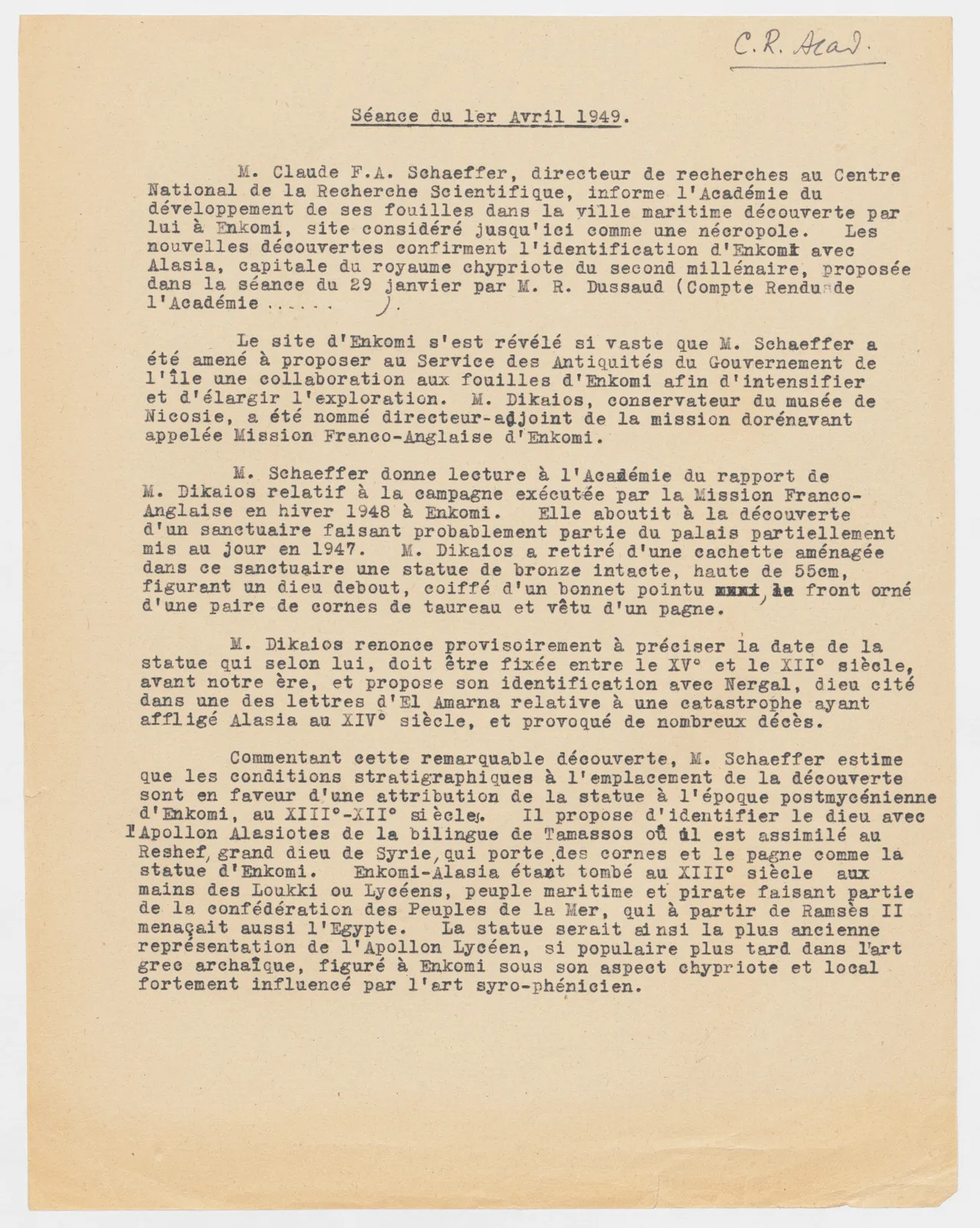
Session of 1st April 1949.
Mr Claude F.A. Schaeffer, research director at the Centre National de la Recherche Scientifique, informs the Academy of the development of his excavations in the maritime city discovered by him at Enkomi, a site hitherto considered a necropolis. The new discoveries confirm the identification of Enkomi with Alasia, capital of the Cypriot kingdom of the second millennium, proposed at the session of 29 January by Mr R. Dussaud (Compte Rendu de l'Académie ...... )
The site of Enkomi proved so vast that Mr Schaeffer was led to propose to the Antiquities Service of the Government of the island a collaboration in the excavations at Enkomi in order to intensify and widen the exploration. Mr Dikaios, curator of the Nicosia museum, was appointed deputy director of the mission, henceforth called the Franco-English Mission of Enkomi.
Mr Schaeffer reads to the Academy the report of Mr Dikaios on the campaign carried out by the Franco-English Mission in winter 1948 at Enkomi. It led to the discovery of a sanctuary probably forming part of the palace partly uncovered in 1947. Mr Dikaios removed from a hiding place arranged in this sanctuary an intact bronze statue, 55cm high, depicting a standing god, wearing a pointed cap xxxx [handwritten: ,] the forehead decorated with a pair of bull's horns and dressed in a loincloth.
Mr Dikaios provisionally refrains from specifying the date of the statue, which in his view should be placed between the 15th and the 12th century BC, and proposes its identification with Nergal, a god cited in one of the El Amarna letters concerning a catastrophe that struck Alasia in the 14th century and caused numerous deaths.
Commenting on this remarkable discovery, Mr Schaeffer considers that the stratigraphic conditions at the find spot favour attributing the statue to the post-Mycenaean period of Enkomi, to the 13th-12th century. He proposes identifying the god with the Apollo Alasiotes of the Tamassos bilingual, where he is assimilated to Reshef, the great god of Syria, who wears horns and the loincloth like the Enkomi statue. Enkomi-Alasia having fallen in the 13th century into the hands of the Loukki or Lycians, a maritime and piratical people belonging to the confederation of the Sea Peoples, who from the time of Ramesses II also threatened Egypt. The statue would thus be the earliest representation of Apollo Lykeios, so popular later in Archaic Greek art, depicted at Enkomi in its Cypriot and local aspect, strongly influenced by Syro-Phoenician art.
65 figures hard to readstruck struck outadded written in above” jug ditto, and what it repeatsword reading not certain