
Unnumbered pageScan 426 of 438
240
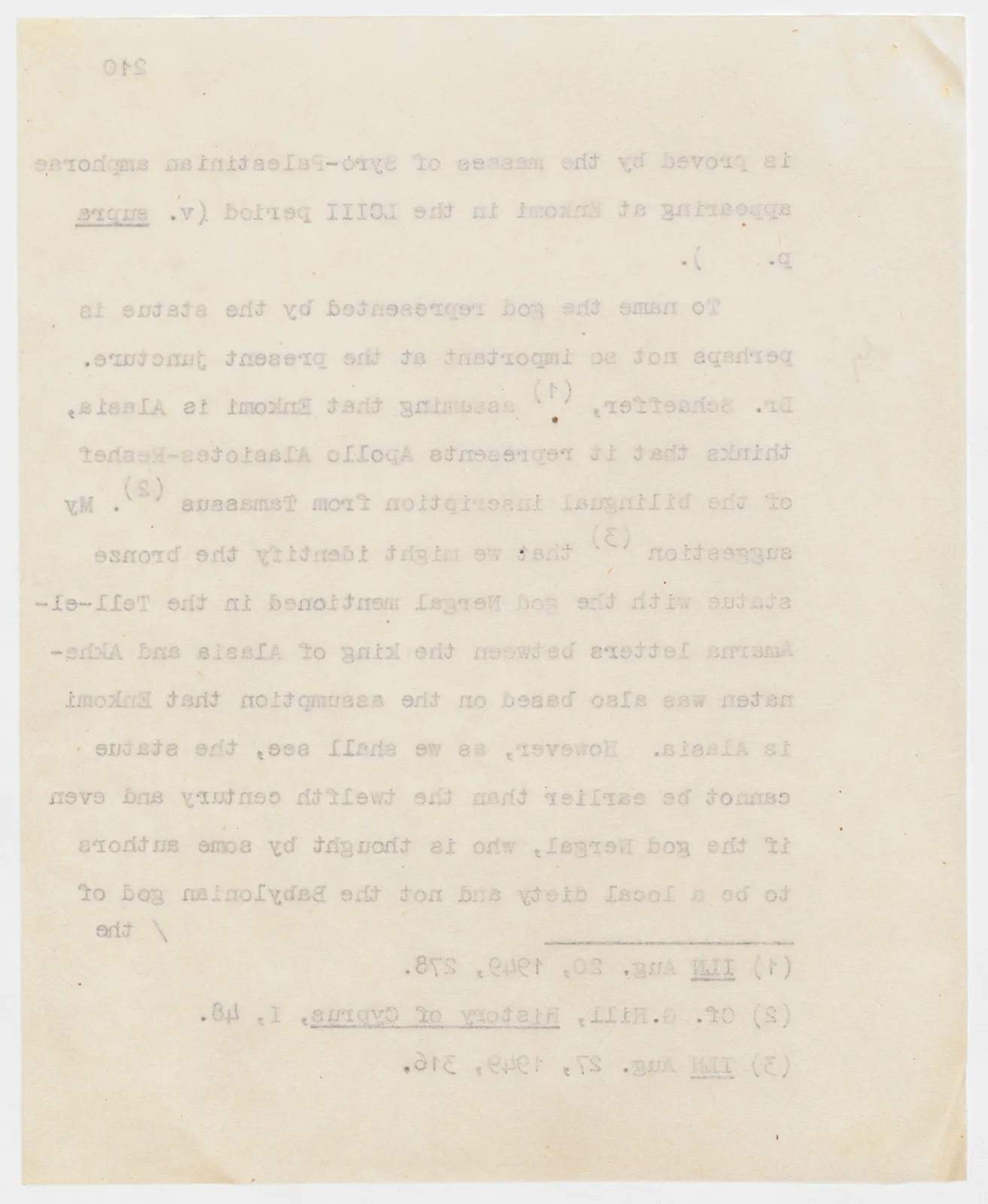
is proved by the masses of Syro-Palestinian amphorae appearing at Enkomi in the LCIII period (v. supra p. ).
To name the god represented by the statue is perhaps not so important at the present juncture. Dr. Schaeffer, (1) assuming that Enkomi is Alasia, thinks that it represents Apollo Alasiotes-Reshef of the bilingual inscription from Tamassus (2). My suggestion (3) that we might identify the bronze statue with the god Nergal mentioned in the Tell-el- Amarna letters between the king of Alasia and Alchenaten was also based on the assumption that Enkomi is Alasia. However, as we shall see, the statue cannot be earlier than the twelfth century and even if the god Nergal, who is thought by some authors to be a local deity and not the Babylonian god of the
Handwritten: illegible mark in right margin
(1)ILN Aug. 20, 1949, 278.
(2)Cf. G.Hill, History of Cyprus, I, 48.
(3)ILN Aug. 27, 1949, 316.
65 figures hard to readstruck struck outadded written in above” jug ditto, and what it repeatsword reading not certain