
Page 142Scan 287 of 438
Continued from p. 141
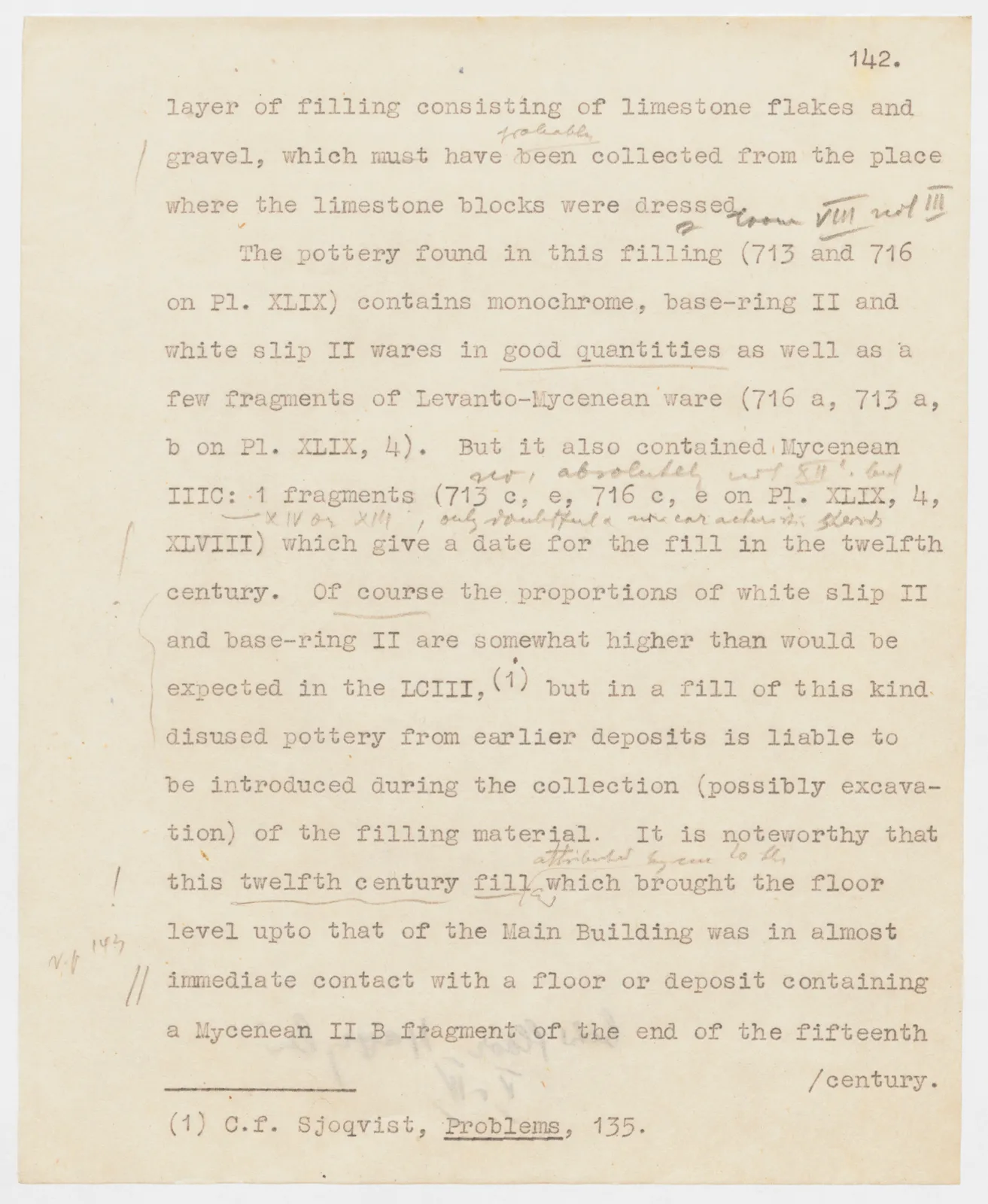
… layer of filling consisting of limestone flakes and [handwritten: probably] gravel, which must have [handwritten: been] collected from the place where the limestone blocks were dressed [handwritten: a from VIII not III] The pottery found in this filling (713 and 716 on Pl. XLIX) contains monochrome, base-ring II and white slip II wares in good quantities as well as a few fragments of Levanto-Mycenean ware (716 a, 713 a, b on Pl. XLIX, 4). But it also contained Mycenean [handwritten: very, absolutely, not XII? and] IIIC: 1 fragments (713 c, e, 716 c, e on Pl. XLIX, 4, [handwritten: XIV or XIII] [handwritten: only doubtful a unclear characteristic sherds] XLVIII) which give a date for the fill in the twelfth century. Of course the proportions of white slip II and base-ring II are somewhat higher than would be expected in the LCIII,(1) but in a fill of this kind disused pottery from earlier deposits is liable to be introduced during the collection (possibly excavation) of the filling material. It is noteworthy that this twelfth century fill [handwritten: attributed by me to Lh] [handwritten: 2] which brought the floor level upto that of the Main Building was in almost immediate contact with a floor or deposit containing a Mycenean II B fragment of the end of the fifteenth /century.
(1) C.f. Sjoqvist, Problems, 135.
Handwritten: N.4 143
[illegible]
65 figures hard to readstruck struck outadded written in above” jug ditto, and what it repeatsword reading not certain