
Unnumbered pageScan 224 of 438
410.
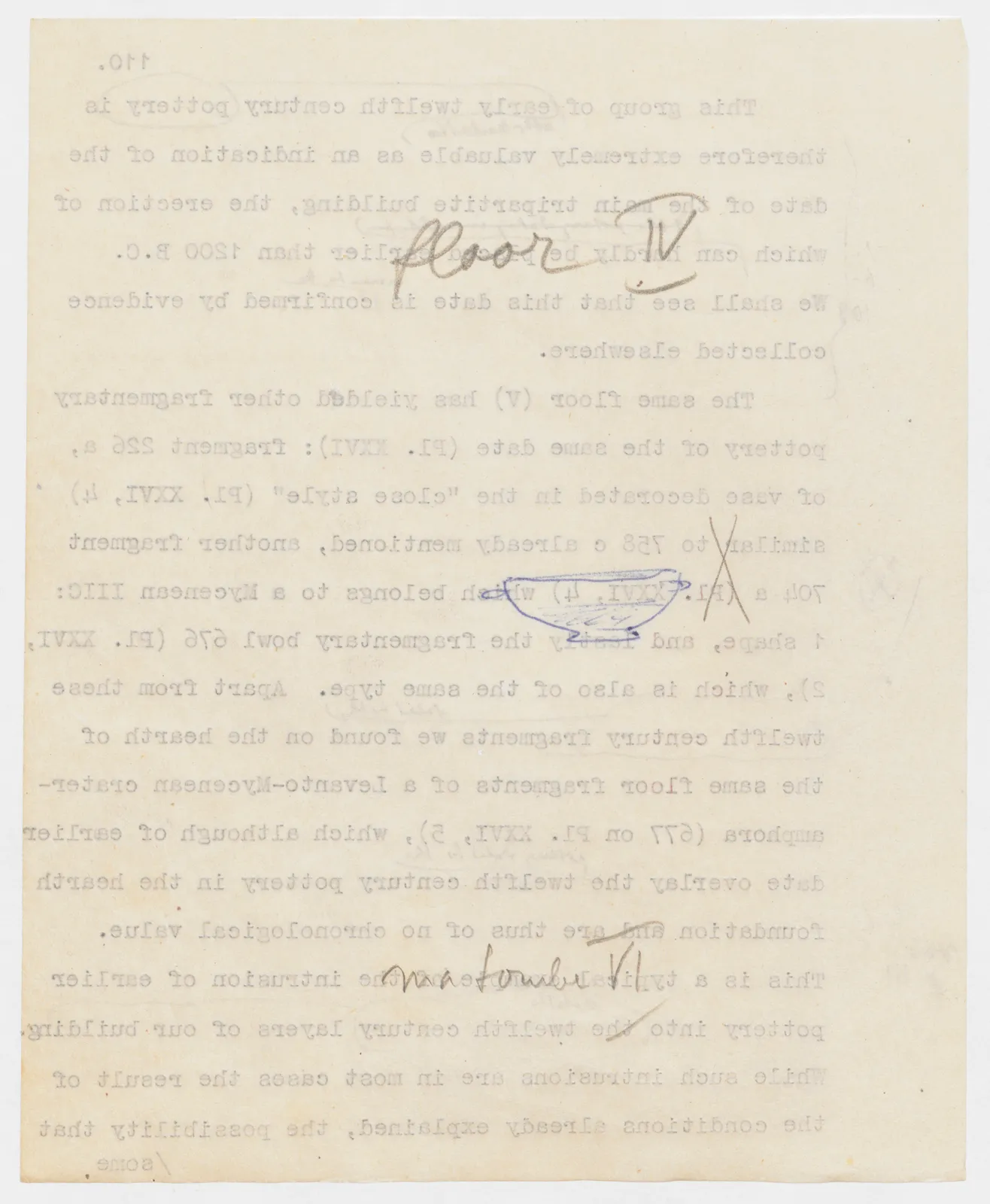
This group of early twelfth century pottery is therefore extremely valuable as an indication of the date of the main tripartite building, the erection of which can hardly be placed earlier than 1200 B.C. We shall see that this date is confirmed by evidence collected elsewhere.
The same floor (V) has yielded other fragmentary pottery of the same date (Pl. XXVI): fragment 226 a, of vase decorated in the "close style" (Pl. XXVI, 4) similar to 758 e already mentioned, another fragment 704 a (Pl. XXVI, 4) which belongs to a Mycenean IIIC: 1 shape, and lastly the fragmentary bowl 676 (Pl. XXVI, 2), which is also of the same type. Apart from these twelfth century fragments we found on the hearth of the same floor fragments of a Levanto-Mycenean krateramphora (677 on Pl. XXVI, 5), which although of earlier date overlay the twelfth century pottery in the hearth foundation and are thus of no chronological value. This is a typical intrusion of earlier pottery into the twelfth century layers of our building. While such intrusions are in most cases the result of the conditions already explained, the possibility that some
Figure: bowl drawn in blue ink, a handwritten sketch of a shallow bowl with a foot; labels: none
Handwritten: floor IV, underlined with flourish
Handwritten: "V" corrected/annotated in pencil above typed "(V)"? — reading: "IV" written over typed "(V)"
Handwritten: "twelfth century" annotated in pencil: "nineteenth"? illegible
Handwritten: "Lamenter"? handwritten word "Mycenaean VI"-type note: "Mycenaean VI" with underline
65 figures hard to readstruck struck outadded written in above” jug ditto, and what it repeatsword reading not certain