
Page 56Scan 115 of 438
Continued from scan 114
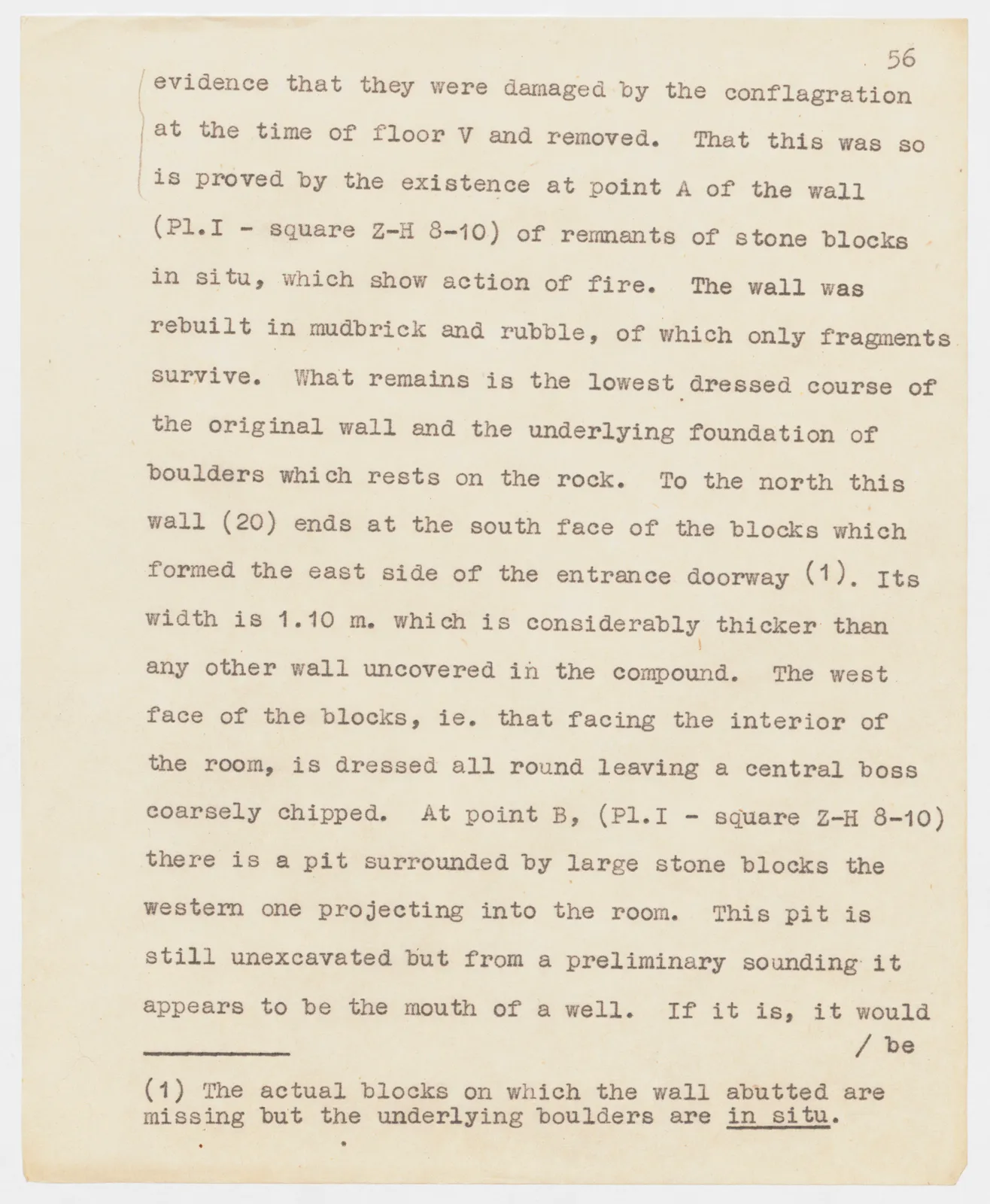
… evidence that they were damaged by the conflagration at the time of floor V and removed. That this was so is proved by the existence at point A of the wall (Pl.I - square Z-H 8-10) of remnants of stone blocks in situ, which show action of fire. The wall was rebuilt in mudbrick and rubble, of which only fragments survive. What remains is the lowest dressed course of the original wall and the underlying foundation of boulders which rests on the rock. To the north this wall (20) ends at the south face of the blocks which formed the east side of the entrance doorway (1). Its width is 1.10 m. which is considerably thicker than any other wall uncovered in the compound. The west face of the blocks, ie. that facing the interior of the room, is dressed all round leaving a central boss coarsely chipped. At point B, (Pl.I - square Z-H 8-10) there is a pit surrounded by large stone blocks the western one projecting into the room. This pit is still unexcavated but from a preliminary sounding it appears to be the mouth of a well. If it is, it would / be
(1) The actual blocks on which the wall abutted are missing but the underlying boulders are in situ.
65 figures hard to readstruck struck outadded written in above” jug ditto, and what it repeatsword reading not certain