
Page - 3 -Scan 5 of 36
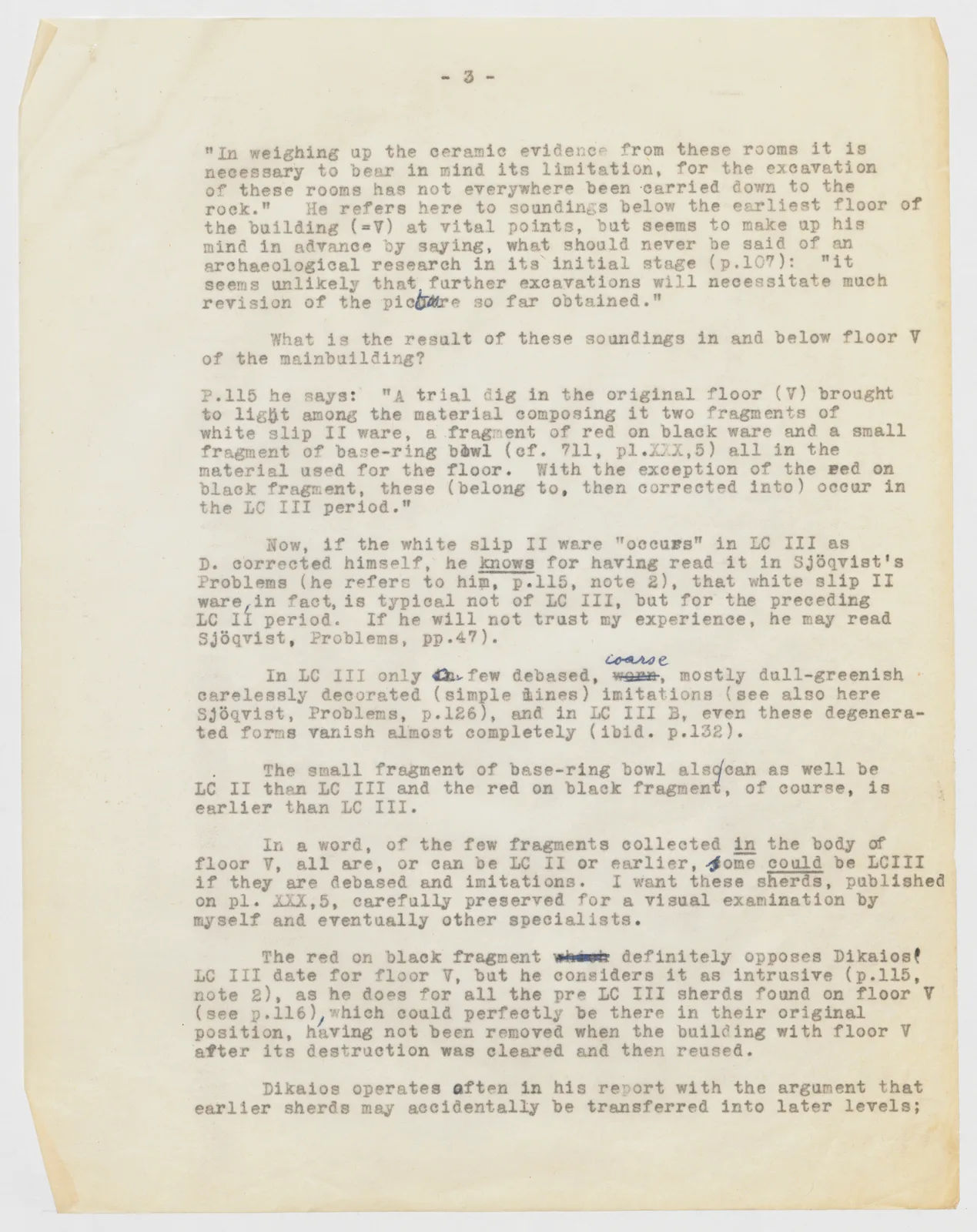
"In weighing up the ceramic evidence from these rooms it is necessary to bear in mind its limitation, for the excavation of these rooms has not everywhere been carried down to the rock." He refers here to soundings below the earliest floor of the building (=V) at vital points, but seems to make up his mind in advance by saying, what should never be said of an archaeological research in its initial stage (p.107): "it seems unlikely that further excavations will necessitate much revision of the picture so far obtained."
What is the result of these soundings in and below floor V of the mainbuilding?
P.115 he says: "A trial dig in the original floor (V) brought to light among the material composing it two fragments of white slip II ware, a fragment of red on black ware and a small fragment of base-ring bowl (cf. 711, pl.XXX,5) all in the material used for the floor. With the exception of the red on black fragment, these (belong to, then corrected into) occur in the LC III period."
Now, if the white slip II ware "occurs" in LC III as D. corrected himself, he knows for having read it in Sjöqvist's Problems (he refers to him, p.115, note 2), that white slip II ware, in fact, is typical not of LC III, but for the preceding LC II period. If he will not trust my experience, he may read Sjöqvist, Problems, pp.47).
In LC III only a few debased, worn, mostly dull-greenish carelessly decorated (simple lines) imitations (see also here Sjöqvist, Problems, p.126), and in LC III B, even these degenerated forms vanish almost completely (ibid. p.132).
The small fragment of base-ring bowl also can as well be LC II than LC III and the red on black fragment, of course, is earlier than LC III.
In a word, of the few fragments collected in the body of floor V, all are, or can be LC II or earlier, some could be LCIII if they are debased and imitations. I want these sherds, published on pl. XXX,5, carefully preserved for a visual examination by myself and eventually other specialists.
The red on black fragment which definitely opposes Dikaios' LC III date for floor V, but he considers it as intrusive (p.115, note 2), as he does for all the pre LC III sherds found on floor V (see p.116), which could perfectly be there in their original position, having not been removed when the building with floor V after its destruction was cleared and then reused.
Dikaios operates often in his report with the argument that earlier sherds may accidentally be transferred into later levels;
Handwritten: coarse
Handwritten: underlined "knows", "in", "could" and strokes as marked in blue ink; handwritten marks in blue pencil/ink throughout
65 figures hard to readstruck struck outadded written in above” jug ditto, and what it repeatsword reading not certain