
Unnumbered pageScan 33 of 36
- 17 -
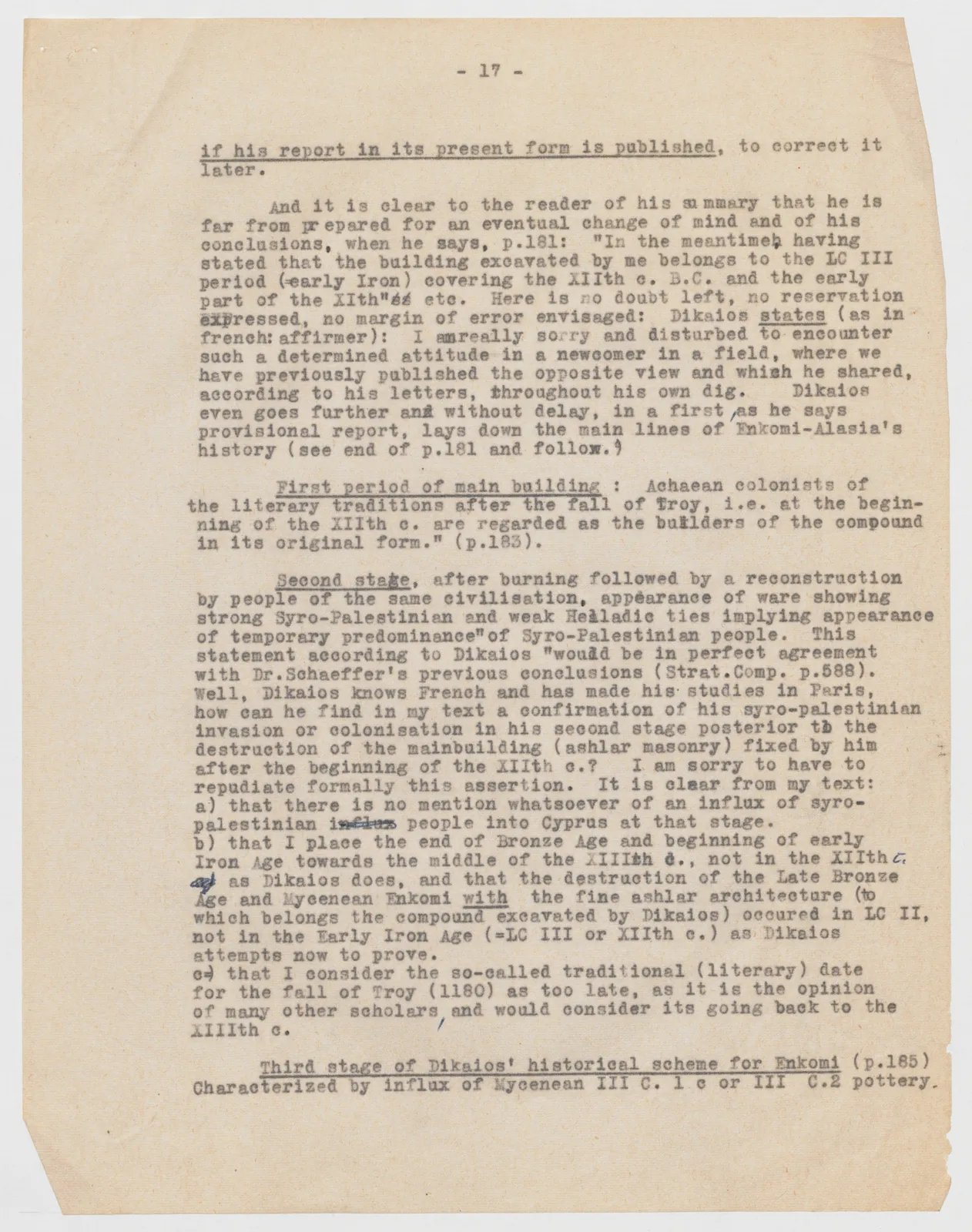
if his report in its present form is published, to correct it later.
And it is clear to the reader of his summary that he is far from prepared for an eventual change of mind and of his conclusions, when he says, p.181: "In the meantimeh having stated that the building excavated by me belongs to the LC III period (=early Iron) covering the XIIth c. B.C. and the early part of the XIth"és etc. Here is no doubt left, no reservation expressed, no margin of error envisaged: Dikaios states (as in french: affirmer): I amreally sorry and disturbed to encounter such a determined attitude in a newcomer in a field, where we have previously published the opposite view and whish he shared, according to his letters, throughout his own dig. Dikaios even goes further and without delay, in a first ,as he says provisional report, lays down the main lines of Enkomi-Alasia's history (see end of p.181 and follow.)
First period of main building : Achaean colonists of the literary traditions after the fall of Troy, i.e. at the beginning of the XIIth c. are regarded as the builders of the compound in its original form." (p.183).
Second stage, after burning followed by a reconstruction by people of the same civilisation, appearance of ware showing strong Syro-Palestinian and weak Healadic ties implying appearance of temporary predominance"of Syro-Palestinian people. This statement according to Dikaios "would be in perfect agreement with Dr.Schaeffer's previous conclusions (Strat.Comp. p.588). Well, Dikaios knows French and has made his studies in Paris, how can he find in my text a confirmation of his syro-palestinian invasion or colonisation in his second stage posterior tb the destruction of the mainbuilding (ashlar masonry) fixed by him after the beginning of the XIIth c.? I am sorry to have to repudiate formally this assertion. It is clear from my text: a) that there is no mention whatsoever of an influx of syropalestinian influx people into Cyprus at that stage. b) that I place the end of Bronze Age and beginning of early Iron Age towards the middle of the XIIIth c., not in the XIIth c. as Dikaios does, and that the destruction of the Late Bronze Age and Mycenean Enkomi with the fine ashlar architecture (to which belongs the compound excavated by Dikaios) occured in LC II, not in the Early Iron Age (=LC III or XIIth c.) as Dikaios attempts now to prove. c) that I consider the so-called traditional (literary) date for the fall of Troy (1180) as too late, as it is the opinion of many other scholars and would consider its going back to the XIIIth c.
Third stage of Dikaios' historical scheme for Enkomi (p.185) Characterized by influx of Mycenean III C. 1 c or III C.2 pottery.
Handwritten: /
65 figures hard to readstruck struck outadded written in above” jug ditto, and what it repeatsword reading not certain