
Page 54 2Scan 5 of 34
Margin left: italics
1. the sector of the built tombs.
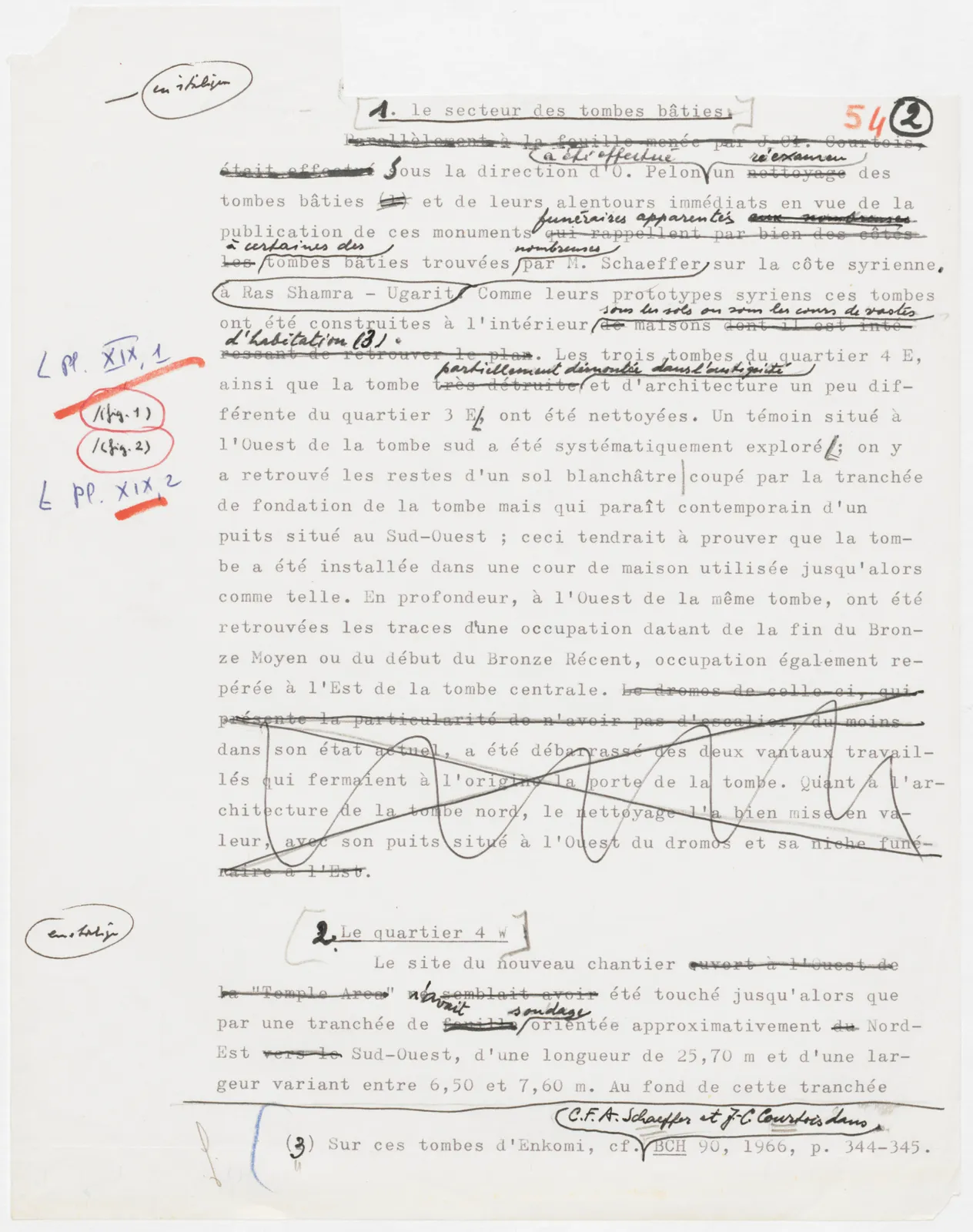
Pl. XIX, 1/(fig. 1)/(fig. 2)Pl. XIX, 2Parallel to the excavation conducted by J.-Cl. Courtois, was carried out under the direction was carried out by O. Pelon a cleaning re-examination of the built tombs (1) and their immediate surroundings with a view to the publication of these related funerary monuments to the numerous<s>/ which in many respects recall the to some of the built tombs found numerous by Mr Schaeffer, on the Syrian coast, at Ras Shamra - Ugarit. Like their Syrian prototypes these tombs were built inside of houses of which it is inter- under the floors or under the courtyards of large dwellings (3). esting to recover the plan. The three tombs of quarter 4 E, as well as the tomb very destroyed partially dismantled in antiquity and of slightly different architecture from quarter 3 E, were cleaned. A baulk situated at the West of the south tomb was systematically explored; there were found the remains of a whitish floor | cut by the trench of the tomb's foundation but which appears contemporary with a well situated to the S.-W.; this would tend to prove that the tomb was installed in a house courtyard previously used as such until then. In depth, to the West of the same tomb, were found traces of an occupation dating from the end of the Bronze Middle or the beginning of Late Bronze, occupation also recorded to the East of the central tomb. The dromos of this one, which is distinctive in having no stairs, at least in its present state, has been cleared of the two worked leaves which originally closed the door of the tomb. As for the arch- itecture of the north tomb, the cleaning has well brought out its val- ue, with its well situated to the West of the dromos and its funerary niche to the East.
italics2. Quarter 4 W
The site of the new area opened to the West of the "Temple Area" had seemed to have been touched until then only by a trench of excavation sounding oriented approximately from the North- East towards the South-West, of a length of 25,70 m and of a width varying between 6,50 and 7,60 m. At the bottom of this trench
(3) On these tombs of Enkomi, cf. C. F. A. Schaeffer et J.-C. Courtois dans BCH 90, 1966, p. 344-345.
65 figures hard to readstruck struck outadded written in above” jug ditto, and what it repeatsword reading not certain