
Page 3Scan 17 of 34
60 ~~[?17~~ 12]
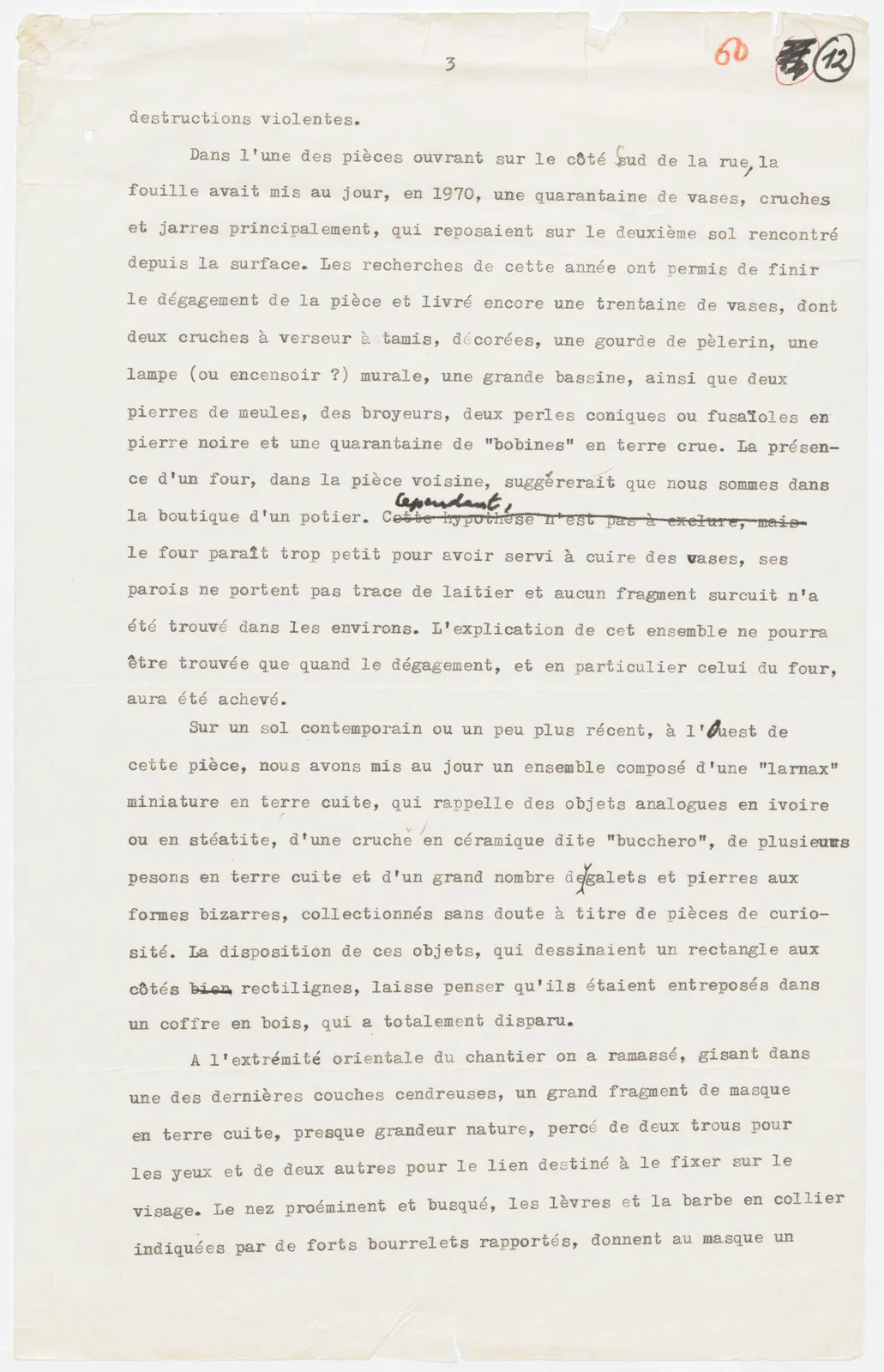
violent destructions. In one of the rooms opening onto the south side of the street, the excavation had uncovered, in 1970, some forty vessels, jugs and jars mainly, which lay on the second floor encountered from the surface. This year's investigations made it possible to finish clearing the room and yielded a further thirty or so vessels, including two decorated jugs with strainer spout, a pilgrim's flask, a wall lamp (or incense burner?), a large basin, as well as two querns, grinding stones, two conical beads or spindle whorls in black stone and some forty "spools" of unbaked clay. The presence of a kiln in the neighbouring room would suggest that we are in the workshop of a potter. However, This hypothesis is not to be excluded, but the kiln seems too small to have been used to fire vessels, its walls bear no trace of slag and no overfired fragment has been found in the vicinity. The explanation of this group can only be found once the clearing, and in particular that of the kiln, has been completed. On a floor contemporary with or slightly later than this room, to the W. of this room, we uncovered a group consisting of a miniature "larnax" in terracotta, which recalls similar objects in ivory or steatite, a jug in so-called "bucchero" pottery, several terracotta loom weights and a large number of pebbles and stones of odd shapes, no doubt collected as curiosities. The arrangement of these objects, which formed a rectangle with well straight sides, suggests that they were stored in a wooden chest, which has disappeared completely. At the eastern end of the area one collected, lying in one of the last ash layers, a large fragment of a mask in terracotta, almost life-size, pierced with two holes for the eyes and two others for the tie intended to fasten it to the face. The prominent, hooked nose, the lips and the collar beard indicated by strong applied ridges, give the mask a
65 figures hard to readstruck struck outadded written in above” jug ditto, and what it repeatsword reading not certain