
Page 5Scan 9 of 22
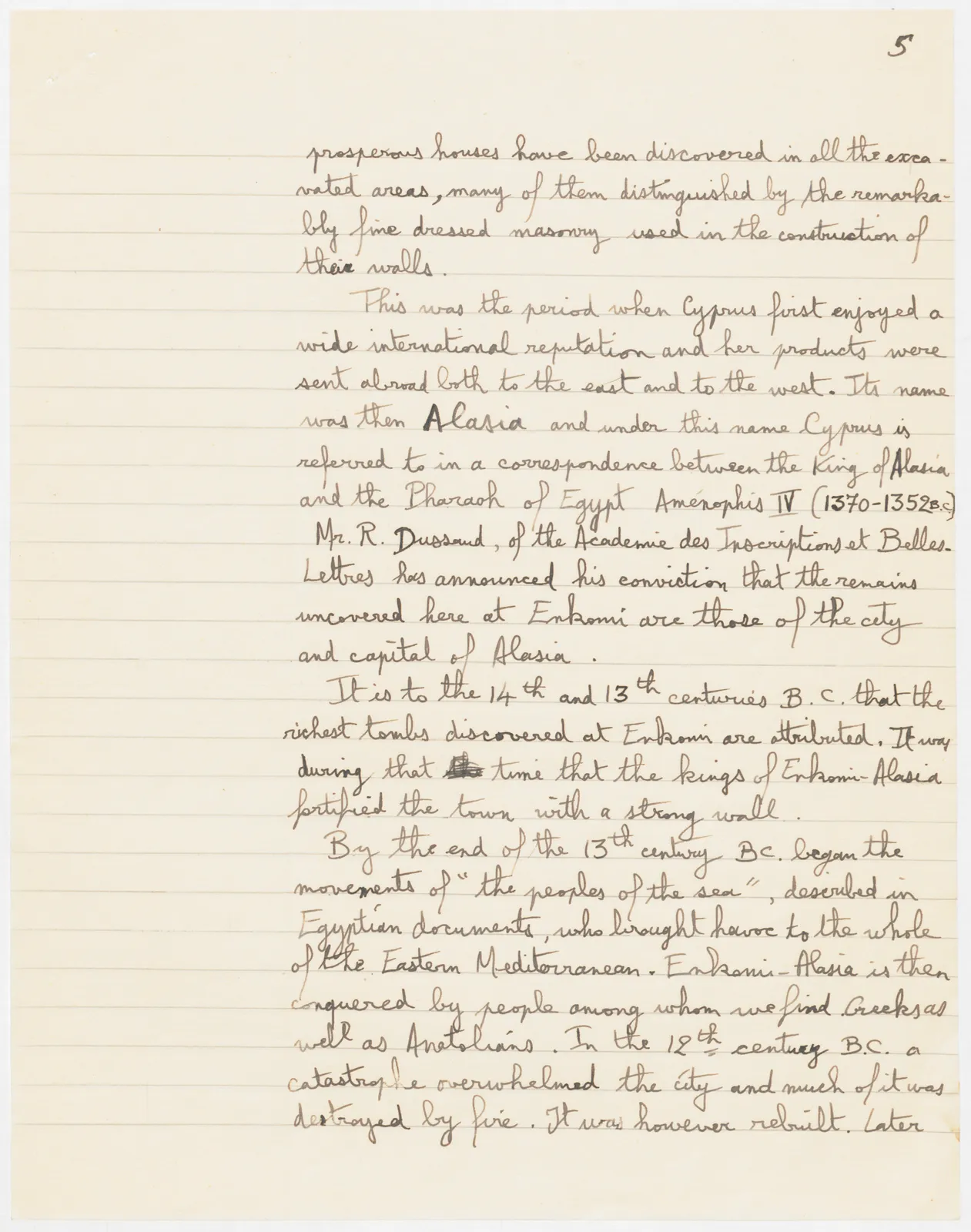
prosperous houses have been discovered in all the excavated areas, many of them distinguished by the remarkably fine dressed masonry used in the construction of their walls. This was the period when Cyprus first enjoyed a wide international reputation and her products were sent abroad both to the east and to the west. Its name was then Alasia and under this name Cyprus is referred to in a correspondence between the King of Alasia and the Pharaoh of Egypt Aménophis IV (1370-1352 B.C.) Mr. R. Dussaud, of the Academie des Inscriptions et Belles- Lettres has announced his conviction that the remains uncovered here at Enkomi are those of the city and capital of Alasia . It is to the 14th and 13th centuries B.C. that the richest tombs discovered at Enkomi are attributed. It was during that the time that the kings of Enkomi-Alasia fortified the town with a strong wall . By the end of the 13th century B.C. began the movements of "the peoples of the sea", described in Egyptian documents, who brought havoc to the whole of the Eastern Mediterranean. Enkomi-Alasia is then conquered by people among whom we find Greeks as well as Anatolians . In the 12th century B.C. a catastrophe overwhelmed the city and much of it was destroyed by fire . It was however rebuilt. Later
65 figures hard to readstruck struck outadded written in above” jug ditto, and what it repeatsword reading not certain