
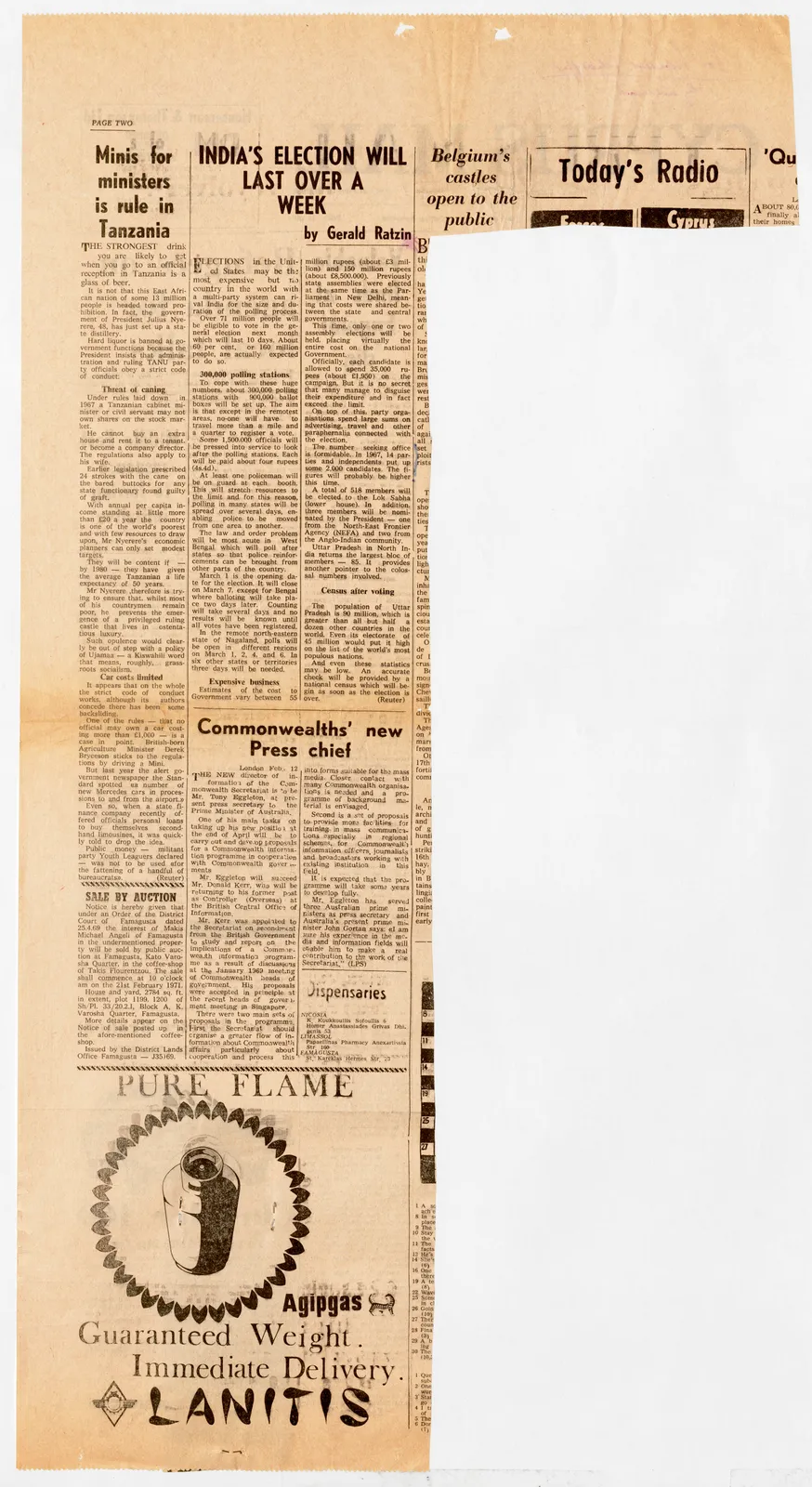
Unnumbered pageScan 2 of 2
Printed: PAGE TWO
Minis for ministers is rule in Tanzania
THE STRONGEST drink you are likely to get when you go to an official reception in Tanzania is a glass of beer.
It is not that this East African nation of some 13 million people is headed toward prohibition. In fact, the government of President Julius Nyerere, 48, has just set up a state distillery.
Hard liquor is banned at government functions because the President insists that administration and ruling TANU party officials obey a strict code of conduct.
Threat of caning
Under rules laid down in 1967 a Tanzanian cabinet minister or civil servant may not own shares on the stock market.
He cannot buy an extra house and rent it to a tenant, or become a company director. The regulations also apply to his wife.
Earlier legislation prescribed 24 strokes with the cane on the bared buttocks for any state functionary found guilty of graft.
With annual per capita income standing at little more than £20 a year the country is one of the world's poorest and with few resources to draw upon, Mr Nyerere's economic planners can only set modest targets.
They will be content if — by 1980 — they have given the average Tanzanian a life expectancy of 50 years.
Mr Nyerere ,therefore is trying to ensure that, whilst most of his countrymen remain poor, he prevents the emergence of a privileged ruling caste that lives in ostentatious luxury.
Such opulence would clearly be out of step with a policy of Ujamaa — a Kiswahili word that means, roughly, grassroots socialism.
Car costs limited
It appears that on the whole the strict code of conduct works, although its authors concede there has been some backsliding.
One of the rules — that no official may own a car costing more than £1,000 — is a case in point. British-born Agriculture Minister Derek Bryceson sticks to the regulations by driving a Mini.
But last year the alert government newspaper the Standard spotted €a number of new Mercedes cars in processions to and from the airport.»
Even so, when a state finance company recently offered officials personal loans to buy themselves secondhand limousines, it was quickly told to drop the idea.
Public money — militant party Youth Leaguers declared — was not to be used «for the fattening of a handful of bureaucrats». (Reuter)
SALE BY AUCTION
Notice is hereby given that under an Order of the District Court of Famagusta dated 25.4.69 the interest of Makis Michael Angeli of Famagusta in the undermentioned property will be sold by public auction at Famagusta, Kato Varosha Quarter, in the coffee-shop of Takis Flourentzou. The sale shall commence at 10 o'clock am on the 21st February 1971. House and yard, 2784 sq. ft. in extent, plot 1199. 1200 of Sh/Pl. 33/20.2.1, Block A, K. Varosha Quarter, Famagusta. More details appear on the Notice of sale posted up in the afore-mentioned coffeeshop.
Issued by the District Lands Office Famagusta — J35169.
PURE FLAME
Figure: advertisement for Agipgas with a gas cylinder surrounded by flame motif; labels: Agipgas, Guaranteed Weight. Immediate Delivery., LANITIS
Agipgas
Guaranteed Weight. Immediate Delivery.
LANITIS
INDIA'S ELECTION WILL LAST OVER A WEEK
by Gerald Ratzin
ELECTIONS in the United States may be the most expensive but no country in the world with a multi-party system can rival India for the size and duration of the polling process.
Over 71 million people will be eligible to vote in the general election next month which will last 10 days. About 60 per cent, or 160 million people, are actually expected to do so.
300,000 polling stations
To cope with these huge numbers, about 300,000 polling stations with 900,000 ballot boxes will be set up. The aim is that except in the remotest areas, no-one will have to travel more than a mile and a quarter to register a vote. Some 1,500,000 officials will be pressed into service to look after the polling stations. Each will be paid about four rupees (4s.4d).
At least one policeman will be on guard at each booth. This will stretch resources to the limit and for this reason, polling in many states will be spread over several days, enabling police to be moved from one area to another.
The law and order problem will be most acute in West Bengal which will poll after states so that police reinforcements can be brought from other parts of the country.
March 1 is the opening date for the election. It will close on March 7, except for Bengal where balloting will take place two days later. Counting will take several days and no results will be known until all votes have been registered. In the remote north-eastern state of Nagaland, polls will be open in different regions on March 1, 2, 4, and 6. In six other states or territories three days will be needed.
Expensive business
Estimates of the cost to Government vary between 55 million rupees (about £3 million) and 150 million rupees (about £8,500,000). Previously state assemblies were elected at the same time as the Parliament in New Delhi, meaning that costs were shared between the state and central governments.
This time, only one or two assembly elections will be held, placing virtually the entire cost on the national Government.
Officially, each candidate is allowed to spend 35,000 rupees (about £1,950) on the campaign. But it is no secret that many manage to disguise their expenditure and in fact exceed the limit.
On top of this, party organisations spend large sums on advertising, travel and other paraphernalia connected with the election.
The number seeking office is formidable. In 1967, 14 parties and independents put up some 2,000 candidates. The figures will probably be higher this time.
A total of 518 members will be elected to the Lok Sabha (lower house). In addition, three members will be nominated by the President — one from the North-East Frontier Agency (NEFA) and two from the Anglo-Indian community.
Uttar Pradesh in North India returns the largest bloc of members — 85. It provides another pointer to the colossal numbers involved.
Census after voting
The population of Uttar Pradesh is 90 million, which is greater than all but half a dozen other countries in the world. Even its electorate of 45 million would put it high on the list of the world's most populous nations.
And even these statistics may be low. An accurate check will be provided by a national census which will begin as soon as the election is over. (Reuter)
Commonwealths' new Press chief
London Feb. 12
THE NEW director of information of the Commonwealth Secretariat is to be Mr. Tony Eggleton, at present press secretary to the Prime Minister of Australia.
One of his main tasks on taking up his new position at the end of April will be to carry out and develop proposals for a Commonwealth information programme in cooperation with Commonwealth governments.
Mr. Eggleton will succeed Mr. Donald Kerr, who will be returning to his former post as Controller (Overseas) at the British Central Office of Information.
Mr. Kerr was appointed to the Secretariat on secondment from the British Government to study and report on the implications of a Commonwealth information programme as a result of discussions at the January 1969 meeting of Commonwealth heads of government. His proposals were accepted in principle at the recent heads of government meeting in Singapore.
There were two main sets of proposals in the programme. First the Secretariat should organise a greater flow of information about Commonwealth affairs particularly about cooperation and process this
into forms suitable for the mass media. Closer contact with many Commonwealth organisations is needed and a programme of background material is envisaged.
Second is a set of proposals to provide more facilities for training in mass communications especially in regional schemes, for Commonwealth information officers, journalists and broadcasters working with existing institutions in this field.
It is expected that the programme will take some years to develop fully.
Mr. Eggleton has served three Australian prime ministers as press secretary and Australia's present prime minister John Gorton says: «I am sure his experience in the media and information fields will enable him to make a real contribution to the work of the Secretariat.» (LPS)
Dispensaries
NICOSIA K. Koukkoullis Sofoullis 6 Homer Anastassiades Grivas Dhi. genis 53 LIMASSOL Papaelinas Pharmacy Anexartissia Str. 190 FAMAGUSTA St. Kareklas Hermes Str. 23
Belgium's castles open to the public
Today's Radio
Printed: Cyprus
'Qu
A BOUT 80,0 ... finally al... their homes
65 figures hard to readstruck struck outadded written in above” jug ditto, and what it repeatsword reading not certain