
Page 5Scan 9 of 12
Continued from scan 8
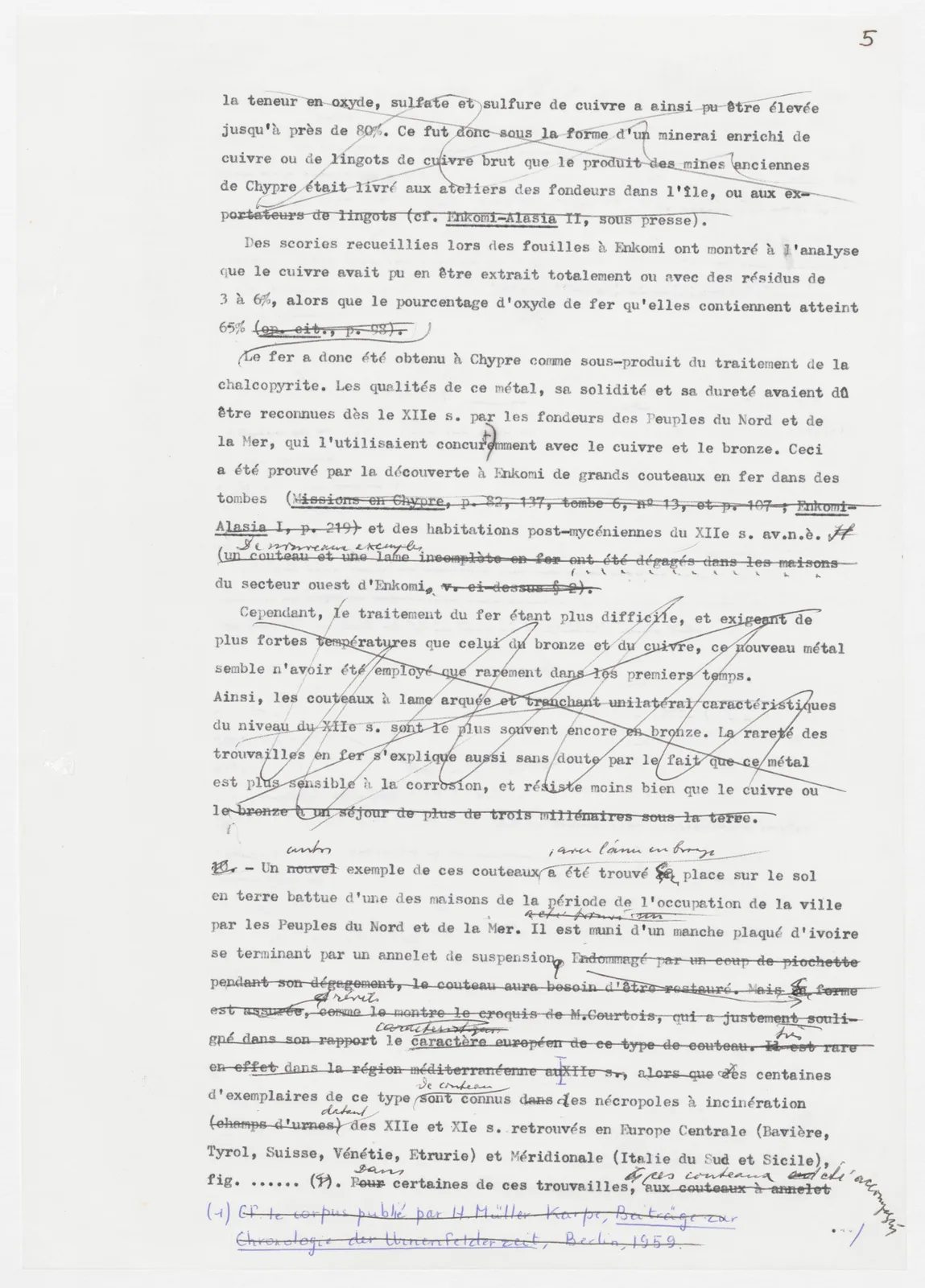
… the content of copper oxide, sulphate and sulphide could thus be raised to nearly 80%. It was therefore in the form of an enriched ore of copper, or of raw copper ingots, that the product of the ancient mines of Cyprus was delivered to the founders' workshops on the island, or to the exingot exporters (cf. Enkomi-Alasia II, in press).
Slag collected during the excavations at Enkomi has shown on analysis that the copper could have been extracted from it entirely or with residues of 3 to 6%, whereas the percentage of iron oxide they contain reaches 65% (op. cit., p. 98).
Iron was therefore obtained in Cyprus as a by-product of the treatment of chalcopyrite. The qualities of this metal, its solidity and hardness, must have been recognised as early as the 12th c. by the founders of the Peoples of the North and of the Sea, who used it alongside copper and bronze. This has been proved by the discovery at Enkomi of large iron knives in tombs (Missions en Chypre, p. 82, 137, tomb 6, no. 13, and p. 107; Enkomi- Alasia I, p. 219) and in post-Mycenaean houses of the 12th c. B.C. [handwritten: ††] (a knife and an incomplete iron blade were cleared in the houses of the west sector of Enkomi, v. above § 2).
However, since working iron was more difficult, and required higher temperatures than that of bronze and copper, this new metal seems to have been used only rarely in the early period. Thus, the knives with curved blade and single cutting edge characteristic of the 12th c. level are most often still in bronze. The rarity of iron finds is also no doubt explained by the fact that this metal is more sensitive to corrosion, and resists less well than copper or bronze to a stay of more than three millennia under the earth.
10. - A new example of these knives was found in place on the floor of beaten earth of one of the houses of the period of the occupation of the town by the Peoples of the North and of the Sea. It is fitted with a handle veneered in ivory ending in a suspension ring. Damaged by a blow from a pick during its clearing, the knife will need restoration. But its shape is assured, as shown by the sketch of Mr Courtois, who rightly underlined in his report the European character of this type of knife. It is rare indeed in the Mediterranean region in the 12th c., whereas these hundreds of examples of this type of knife are known from cremation cemeteries of the 12th and 11th c. found in Central Europe (Bavaria, Tyrol, Switzerland, Veneto, Etruria) and Southern (southern Italy and Sicily), fig. ...... (1). For some of these finds, with knives with ring
(1) Cf. the corpus published by H. Müller Karpe, Beiträge zur Chronologie der Urnenfelderzeit, Berlin, 1959.
65 figures hard to readstruck struck outadded written in above” jug ditto, and what it repeatsword reading not certain