
Unnumbered pageScan 11 of 12
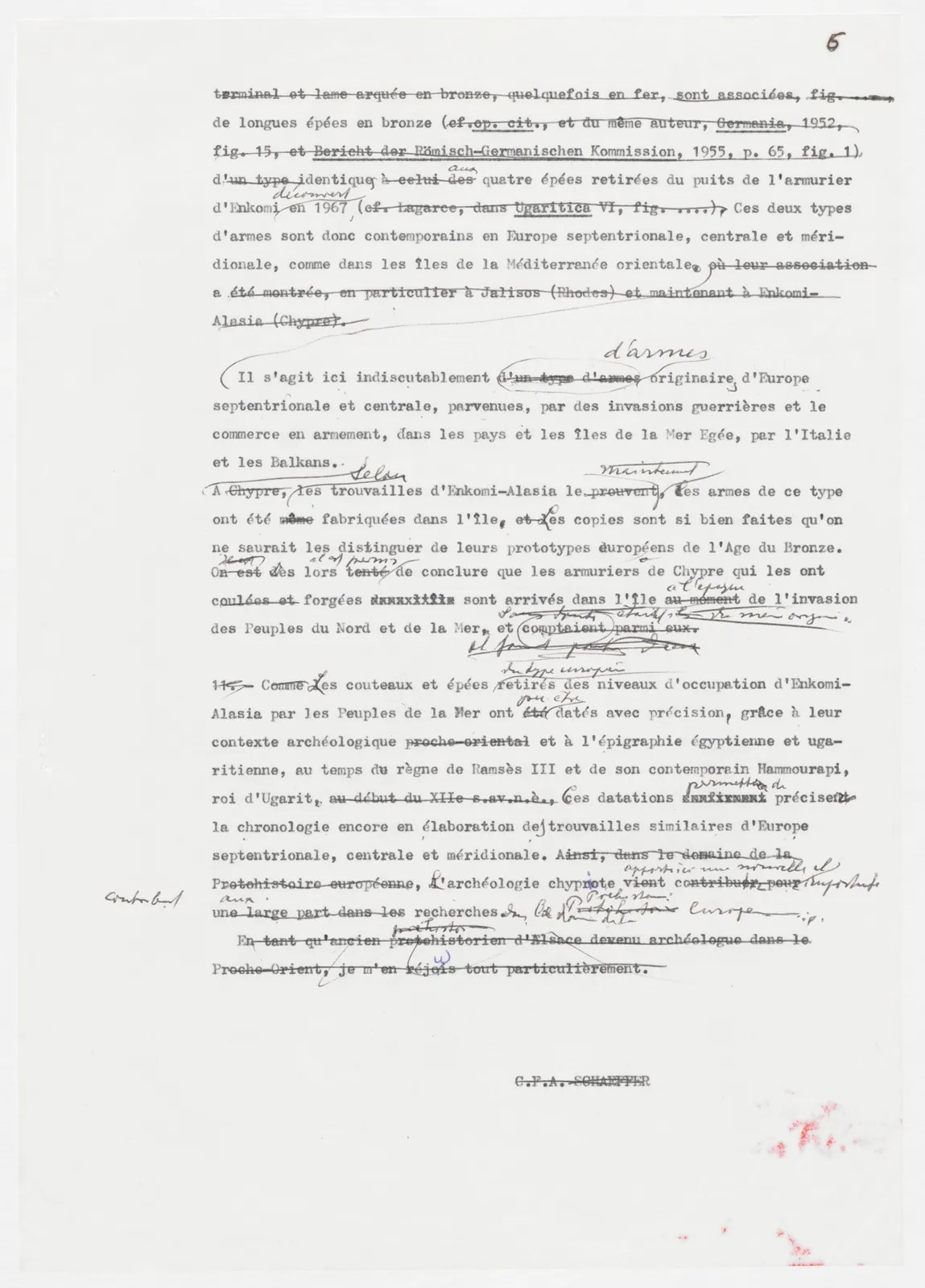
terminal and arched blade in bronze, sometimes in iron, are associated, fig. ..., of long bronze swords (cf. op. cit., and by the same author, Germania, 1952, fig. 15, and Bericht der Römisch-Germanischen Kommission, 1955, p. 65, fig. 1) of a type identical to that of the four swords removed from the armourer's well of Enkomi in 1967 (cf. Lagarce, in Ugaritica VI, fig. ....). These two types of weapons are therefore contemporary in northern, central and southern as in the islands of the eastern Mediterranean, where their association has been shown, in particular at Jalisos (Rhodes) and now at Enkomi- Alasia (Cyprus).
(This is undoubtedly a type of weapon originating in Europe northern and central, having arrived, through warlike invasions and the trade in arms, into the countries and islands of the Aegean Sea, via Italy and the Balkans. In Cyprus, the finds from Enkomi-Alasia prove it, these weapons of this type were even manufactured on the island, and the copies are so well made that one could not distinguish them from their European prototypes of the Bronze Age. One is therefore tempted to conclude that the armourers of Cyprus who made them cast and forged xxxxxxx arrived on the island at the time of the invasion of the Peoples of the North and of the Sea, and were among them.
11. As the knives and swords removed from the occupation levels of Enkomi- Alasia by the Peoples of the Sea have been dated precisely, thanks to their Near Eastern archaeological context and to Egyptian and Ugaritic epigraphy at the time of the reign of Ramesses III and of his contemporary Hammurapi, king of Ugarit, at the beginning of the 12th c. B.C.E., These datings make it possible to specify the chronology still being worked out of similar finds from Europe northern, central and southern. Thus, in the field of European Protohistory, Cypriot archaeology comes to contribute to bring a new a large share in the research of the prehistorian in Europe. As a former protohistorian of Alsace who became an archaeologist in the Near East, I am particularly delighted by this.
C.F.A. SCHAEFFER
65 figures hard to readstruck struck outadded written in above” jug ditto, and what it repeatsword reading not certain