
Unnumbered pageScan 2 of 8
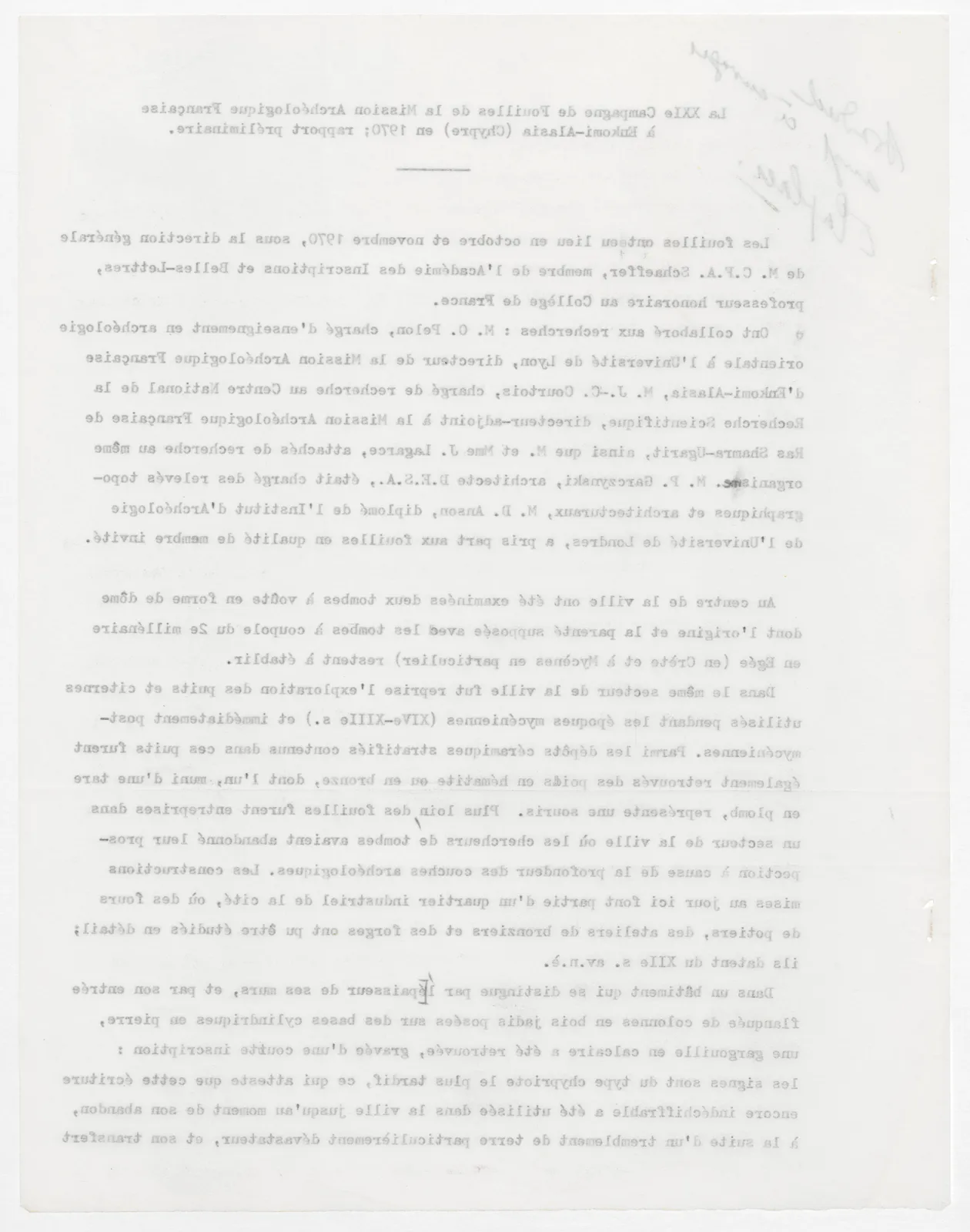
The 21st Campaign of Excavations of the French Archaeological Mission at Enkomi-Alasia (Cyprus) in 1970; preliminary report.
———
The excavations took place in October and November 1970, under the general direction of Mr C.F.A. Schaeffer, member of the Académie des Inscriptions et Belles-Lettres, honorary professor at the Collège de France. Collaborating in the research were: Mr O. Pelon, lecturer in Near Eastern archaeology at the University of Lyon, director of the French Archaeological Mission at Enkomi-Alasia, Mr J.-C. Courtois, research officer at the Centre National de la Recherche Scientifique, deputy director of the French Archaeological Mission at Ras Shamra-Ugarit, as well as Mr and Mrs J. Lagarce, research attachés to the same body. Mr P. Garcznynski, architect D.F.S.A., was in charge of the topographic and architectural surveys; Mr D. Anson, graduate of the Institute of Archaeology of the University of London, took part in the excavations as an invited member.
In the centre of the town two vaulted tombs in the shape of a dome were examined whose origin and supposed relationship with the 2nd millennium domed tombs in the Aegean (in Crete and at Mycenae in particular) remain to be established.
In the same sector of the town the exploration of wells and cisterns was resumed used during the Mycenaean periods (14th-13th c.) and immediately post- Mycenaean. Among the stratified pottery deposits contained in these wells were also found weights in haematite or bronze, one of which, fitted with a lead tare, represents a mouse. Further on, excavations were undertaken in a sector of the town where the tomb-robbers had abandoned their prospection because of the depth of the archaeological layers. The structures uncovered here form part of an industrial quarter of the city, where kilns for potters, workshops of bronzeworkers and forges could be studied in detail; they date to the 12th c. B.C.E.
In a building distinguished by the thickness of its walls, and by its entrance flanked by wooden columns formerly set on cylindrical stone bases, a limestone gargoyle was found, engraved with a short inscription: The signs are of the latest Cypriot type, which attests that this script still undeciphered was used in the town until the moment of its abandonment, following a particularly devastating earthquake, and its transfer
Handwritten: illegible handwritten annotation, upside down, top right margin
65 figures hard to readstruck struck outadded written in above” jug ditto, and what it repeatsword reading not certain