
Page illegibleScan 2 of 6
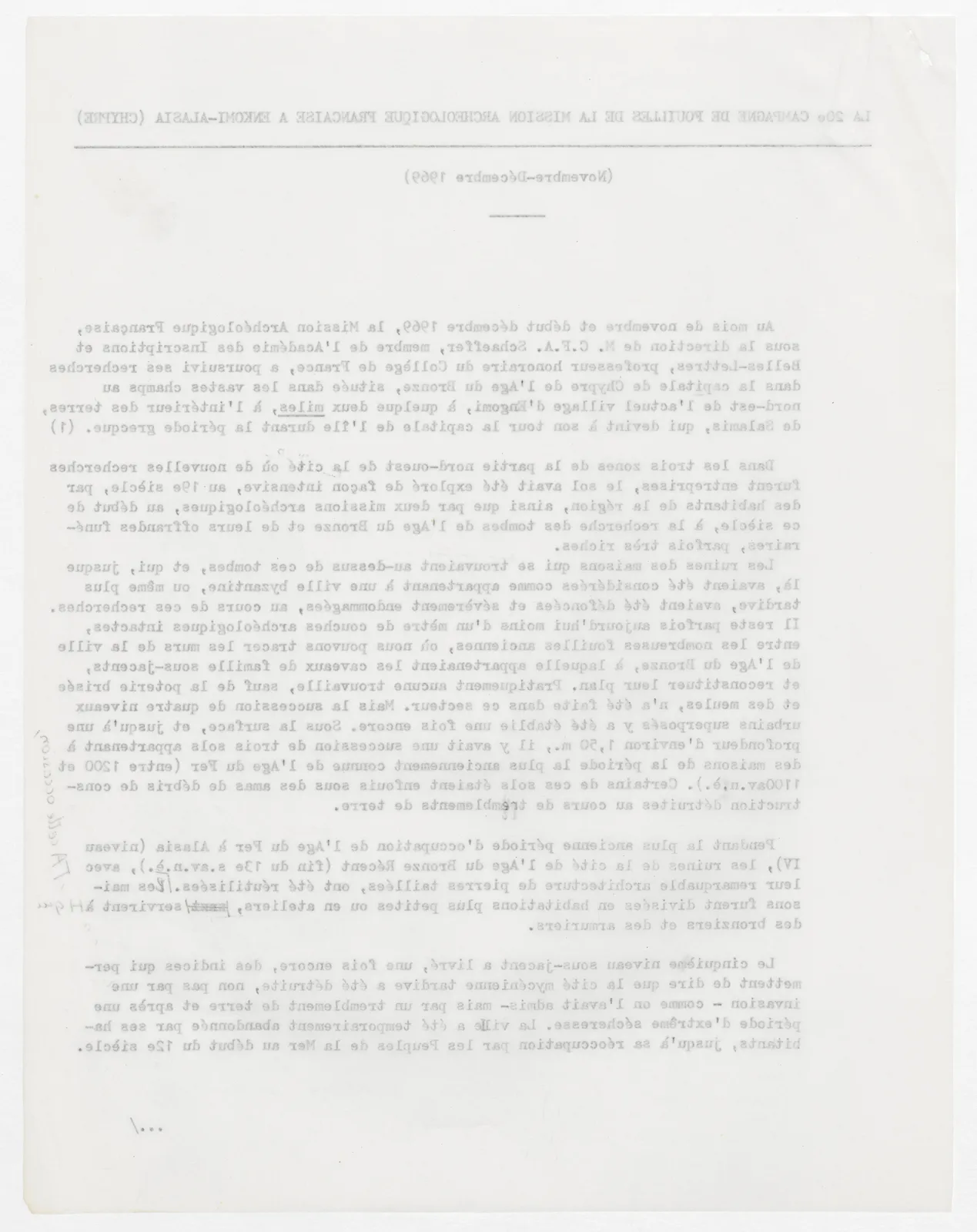
The 20th EXCAVATION CAMPAIGN OF THE FRENCH ARCHAEOLOGICAL MISSION AT ENKOMI-ALASIA (CYPRUS)
(November-December 1969)
In November and early December 1969, the French Archaeological Mission, under the direction of Mr C.F.A. Schaeffer, member of the Académie des Inscriptions et Belles-lettres, honorary professor of the Collège de France, pursued its research in the capital of Cyprus of the Bronze Age, situated in the vast fields to the north-east of the present village of Engomi, some two miles inland, of Salamis, which in turn became the capital of the island during the Greek period. (1)
In the three zones of the north-west part of the city where new research was undertaken, the ground had been intensively explored in the 19th century by local inhabitants, as well as by two archaeological missions, at the beginning of this century, in search of the Bronze Age tombs and their funerary offerings which were sometimes very rich.
The ruins of the houses that lay above these tombs, and which, until then, had been considered as belonging to a Byzantine town, or even more later, had been broken into and severely damaged during these investigations. Today there sometimes remains less than a metre of intact archaeological layers, between the numerous old pits, where we can trace the walls of the town of the Bronze Age, to which the underlying family burial chambers belonged, and to reconstruct their plan. Practically no finds, except broken pottery and querns, were made in this sector. But the succession of four levels of superimposed urban occupation was once again established there. Below the surface, and down to a depth of about 1,50 m., there was a succession of three floors belonging to the houses of the earliest period of the Iron Age (between 1200 and 1100 B.C.). Some of these floors were buried under heaps of construction debris destroyed during earthquakes.
During the earliest period of Iron Age occupation at Alasia (level IV), the ruins of the city of the Late Bronze Age (end of the 13th c. B.C.), with their remarkable ashlar architecture, were reused. The houses were divided into smaller dwellings or workshops, [illegible] served as bronzeworkers' and armourers' workshops.
The underlying fifth level has yielded, once again, indications that permit us to say that the Late Mycenaean city was destroyed, not by an invasion - as had been assumed - but by an earthquake and after a period of extreme drought. The town was temporarily abandoned by its inhabitants, until its reoccupation by the Sea Peoples at the beginning of the 12th century.
Handwritten: vertical annotation in left margin, illegible
65 figures hard to readstruck struck outadded written in above” jug ditto, and what it repeatsword reading not certain