
Page 135Scan 95 of 104
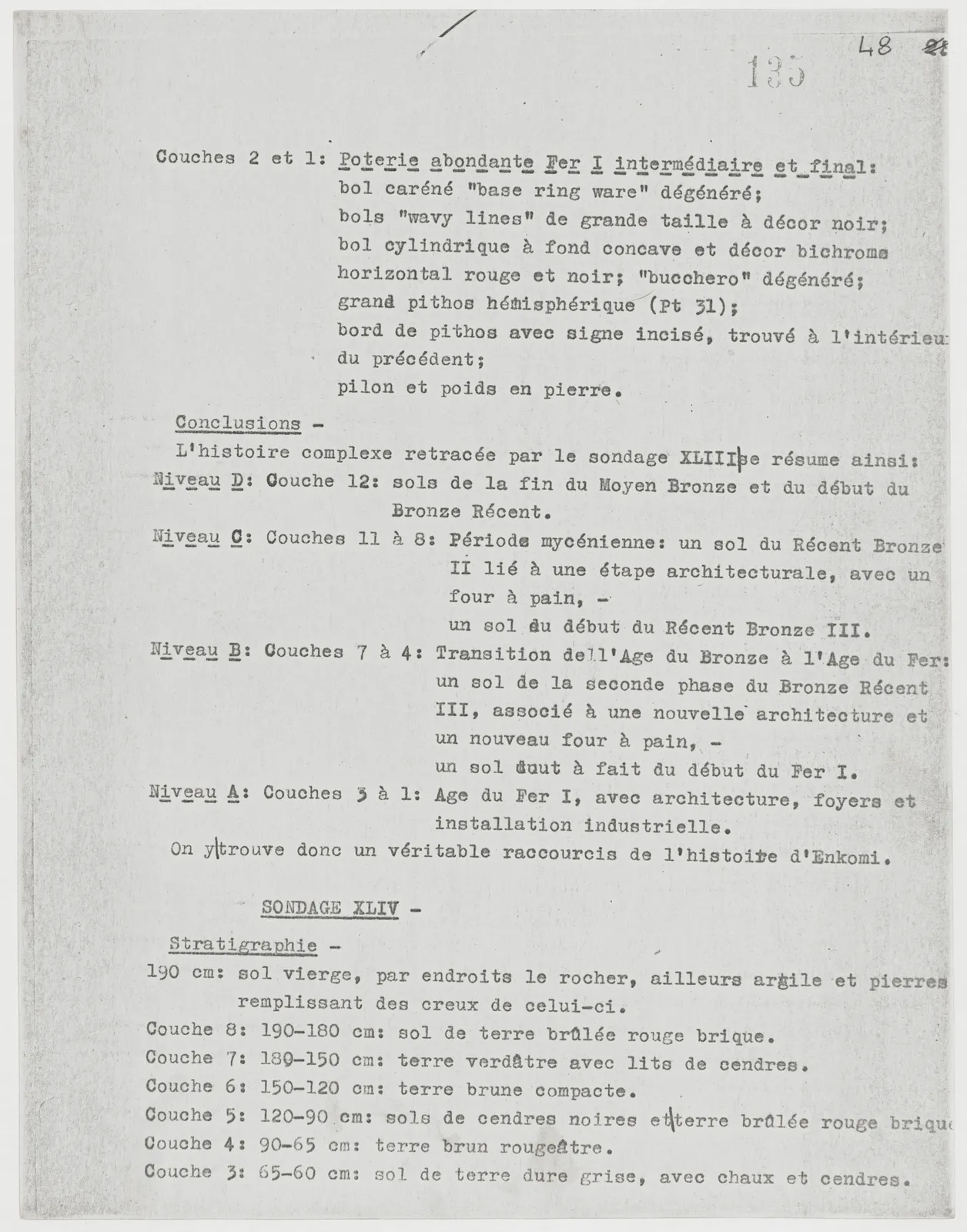
Layers 2 and 1: Abundant pottery, Iron I intermediate and final: carinated bowl, degenerate "base ring ware"; large bowls "wavy lines" with black decoration; cylindrical bowl with concave base and bichrome decoration horizontal, red and black; degenerate "bucchero"; large hemispherical pithos (Pt 31); pithos rim with incised sign, found inside of the preceding; pestle and stone weight.
Conclusions -
The complex history traced by Sounding XLIII is summarised as follows: Level D: Layer 12: floors of the end of the Middle Bronze and of the beginning of the Late Bronze. Level C: Layers 11 to 8: Mycenaean periods: a floor of Late Bronze II linked to an architectural phase, with a bread oven, - a floor of the beginning of Late Bronze III. Level B: Layers 7 to 4: Transition from the Bronze Age to the Iron Age: a floor of the second phase of Late Bronze III, associated with new architecture and a new bread oven, - a floor wholly of the beginning of Iron I. Level A: Layers 3 to 1: Iron I Age, with architecture, hearths and industrial installation. Here one therefore finds a true shortcut through the history of Enkomi.
SOUNDING XLIV -
Stratigraphy - 190 cm: virgin soil, in places the rock, elsewhere clay and stones filling hollows in it. Layer 8: 190-180 cm: floor of red brick burnt earth. Layer 7: 180-150 cm: greenish earth with beds of ash. Layer 6: 150-120 cm: compact brown earth. Layer 5: 120-90 cm: floors of black ash and red brick burnt earth. Layer 4: 90-65 cm: reddish brown earth. Layer 3: 65-60 cm: floor of hard grey earth, with lime and ash.
Stamp: 48
65 figures hard to readstruck struck outadded written in above” jug ditto, and what it repeatsword reading not certain