
Page 33Scan 65 of 104
120
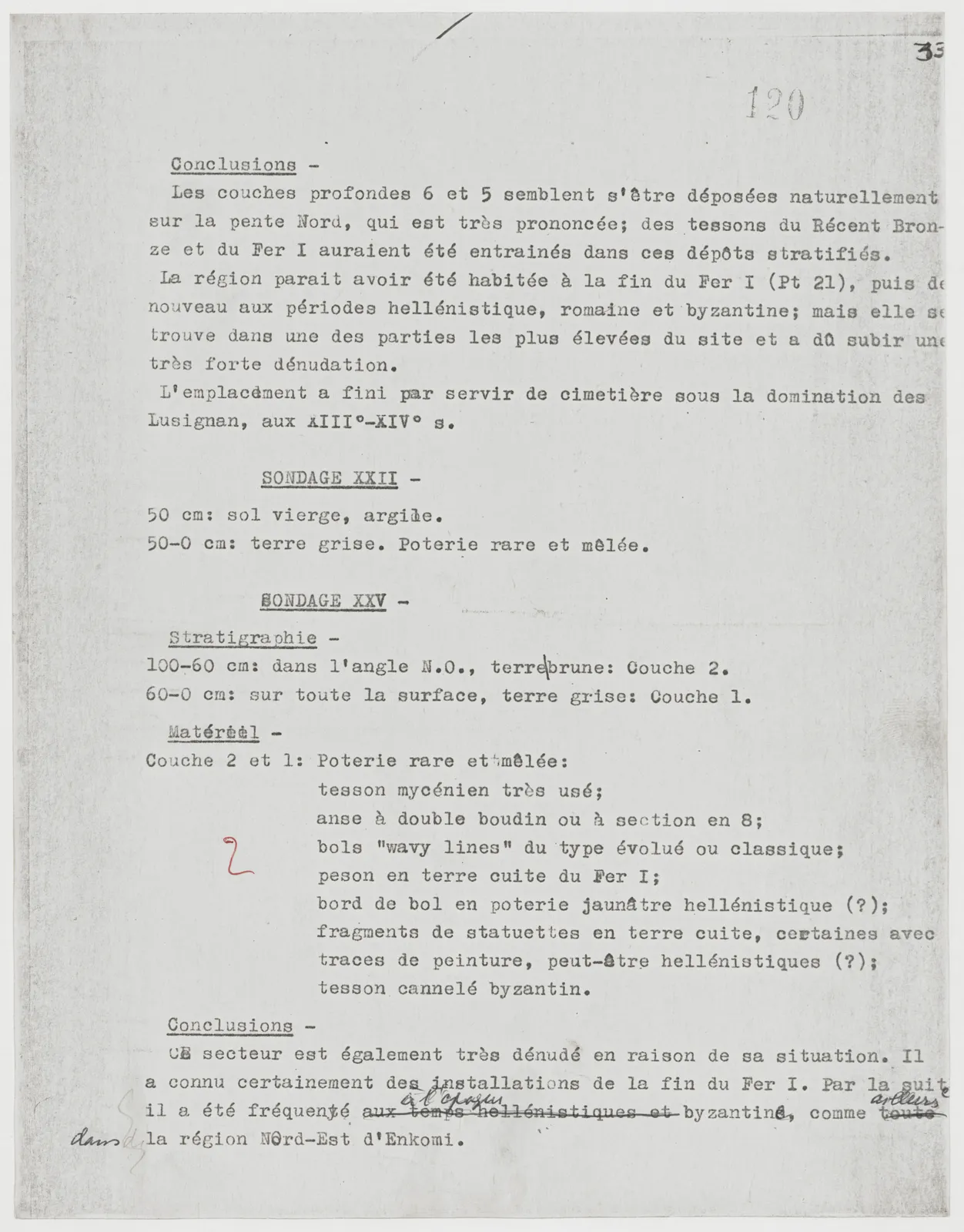
Conclusions - The deep layers 6 and 5 seem to have been deposited naturally on the North slope, which is very steep; sherds of the Late Bronze and Iron I would have been carried into these stratified deposits. The area seems to have been inhabited at the end of Iron I (Pt 21), then again in the Hellenistic, Roman and Byzantine periods; but it lies in one of the highest parts of the site and must have suffered a very heavy denudation. The location was eventually used as a cemetery under the domination of the Lusignans, in the 13th-14th c.
SOUNDING XXII -
50 cm: virgin floor, clay. 50-0 cm: grey earth. Pottery rare and mixed.
SOUNDING XXV -
Stratigraphy - 100-60 cm: in the N.W. corner, brown earth: Layer 2. 60-0 cm: over the whole surface, grey earth: Layer 1.
Material - Layer 2 and 1: Pottery rare and mixed: very worn Mycenaean sherd; handle with double ridge or figure-of-8 section; bowls "wavy lines" of the developed or classical type; Iron I clay loom weight; bowl rim in yellowish Hellenistic pottery (?); fragments of terracotta statuettes, some with traces of paint, perhaps Hellenistic (?); Byzantine fluted sherd.
Conclusions - This sector is also very denuded because of its situation. It certainly saw installations of the end of Iron I. Subsequently it was frequented in Hellenistic and Byzantine times, like the whole North-East area of Enkomi.
Handwritten: at the time
Handwritten: elsewhere
Handwritten: in
Handwritten: 2
65 figures hard to readstruck struck outadded written in above” jug ditto, and what it repeatsword reading not certain