
Page 110Scan 45 of 104
Handwritten: 23
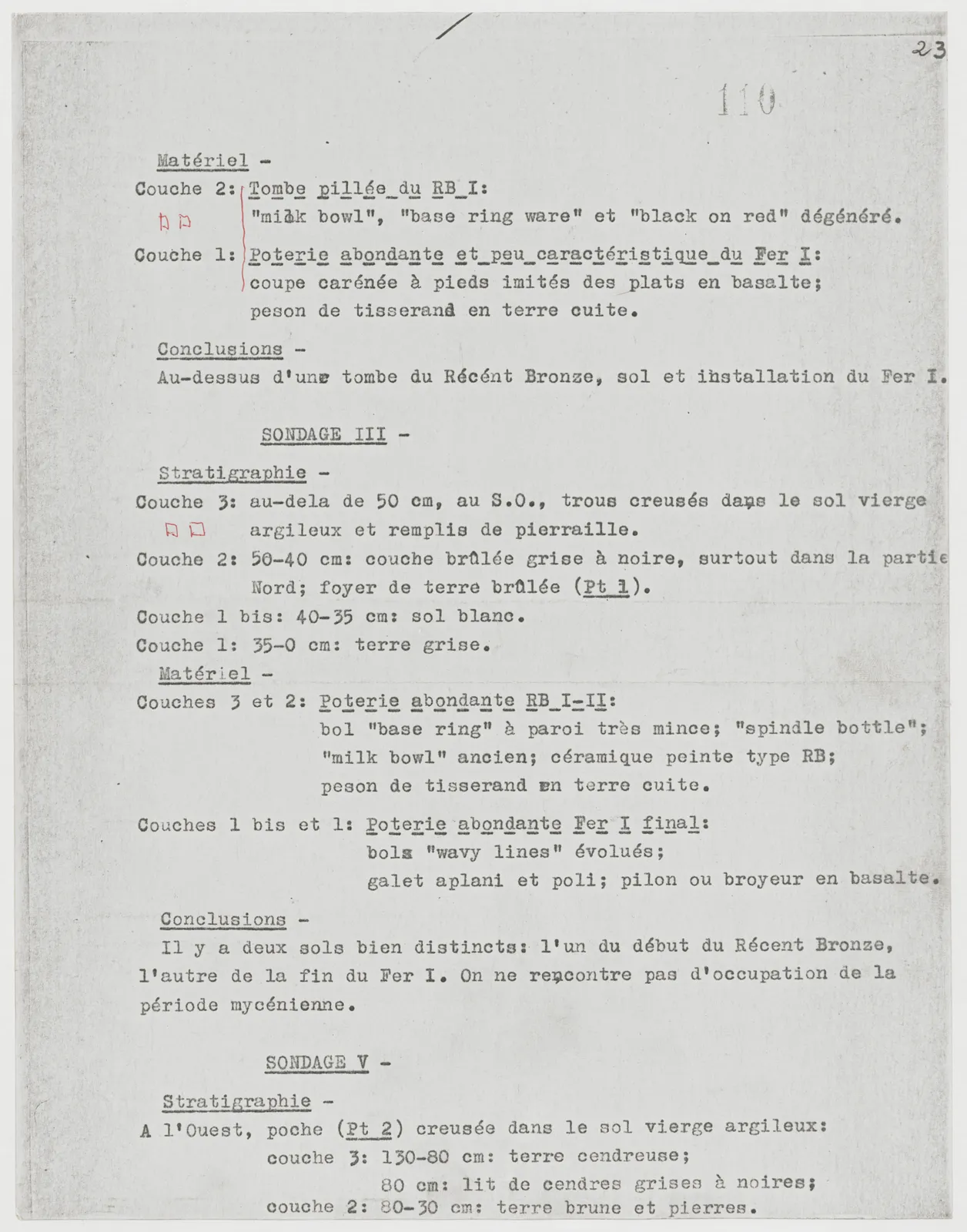
Layer 2:[red markingLayer 1:Material - _Looted tomb of the LB_I_: "milk bowl", "base ring ware" and degenerate "black on red".] Abundant and not very characteristic pottery of Iron I: carinated cup with feet imitating basalt dishes; loom weight in terracotta.
Conclusions - Above a tomb of the Late Bronze, floor and installation of Iron I.
SOUNDING III -
Stratigraphy - Layer 3: beyond 50 cm, to the S.W., holes dug into the virgin soil [red marking] clayey and filled with rubble. Layer 2: 50-40 cm: burnt layer grey to black, especially in the part North; hearth of burnt earth (Pt 1). Layer 1 bis: 40-35 cm: white floor. Layer 1: 35-0 cm: grey earth.
Material - Layers 3 and 2: _Abundant pottery LB_I-II_: bowl "base ring" with very thin wall; "spindle bottle"; early "milk bowl"; painted pottery of LB type; loom weight in terracotta.
Layers 1 bis and 1: Abundant final Iron I pottery: evolved "wavy lines" bowls; flattened and polished pebble; basalt pestle or grinder.
Conclusions - There are two distinct floors: one of the beginning of the Late Bronze, the other of the end of Iron I. No occupation of the Mycenaean period is encountered.
SOUNDING V -
Stratigraphy - To the West, pocket (Pt 2) dug into the clayey virgin soil: layer 3: 130-80 cm: ashy earth; 80 cm: bed of grey to black ash; layer 2: 80-30 cm: brown earth and stones.
65 figures hard to readstruck struck outadded written in above” jug ditto, and what it repeatsword reading not certain