
Unnumbered pageScan 39 of 104
[handwritten: ←] [handwritten: D/] [handwritten: )]
Room at the North-East end of the area.
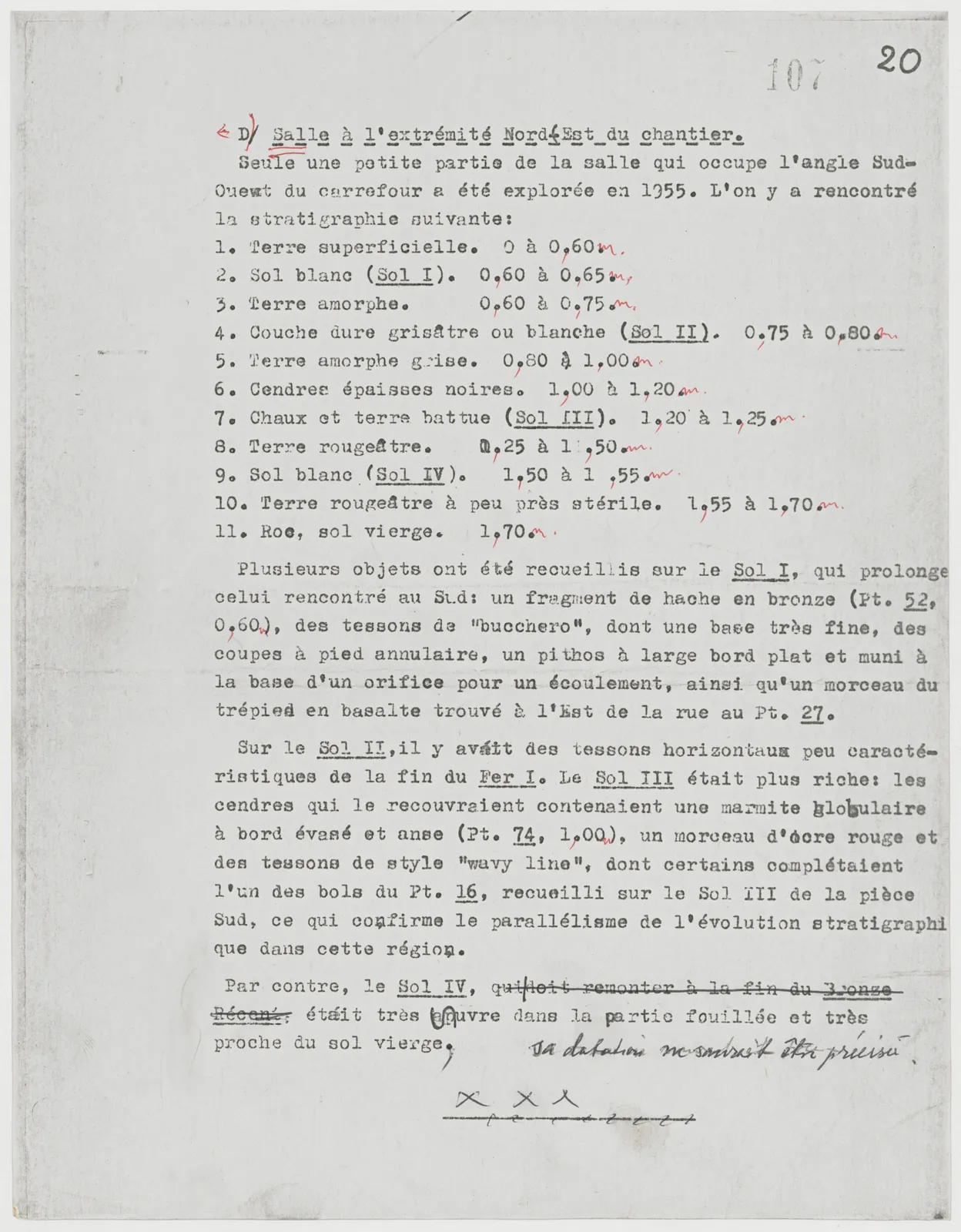
Only a small part of the room occupying the South-West corner of the crossroads was explored in 1955. The following stratigraphy was encountered there: 1. Surface earth. 0 to 0,60 [handwritten: m.] 2. White floor (Floor I). 0,60 to 0,65 [handwritten: m.] 3. Amorphous earth. 0,60 to 0,75 [handwritten: m.] 4. Hard greyish or white layer (Floor II). 0,75 to 0,80 [handwritten: m.] 5. Grey amorphous earth. 0,80 to 1,00 [handwritten: m.] 6. Thick black ashes. 1,00 to 1,20 [handwritten: m.] 7. Lime and beaten earth (Floor III). 1,20 to 1,25 [handwritten: m.] 8. Reddish earth. 0,25 to 1,50 [handwritten: m.] 9. White floor (Floor IV). 1,50 to 1,55 [handwritten: m.] 10. Reddish, almost sterile earth. 1,55 to 1,70 [handwritten: m.] 11. Rock, virgin soil. 1,70 [handwritten: m.]
Several objects were recovered from Floor I, which continues the one met to the South: a fragment of a bronze axe (Pt 52, 0,60), sherds of "bucchero", including a very fine base, cups with ring foot, a pithos with a wide flat rim and, at the base, a hole for a drain, as well as a piece of the basalt tripod found east of the street at Pt 27.
On Floor II there were horizontal sherds, not very characteristic, of the end of Iron I. Floor III was richer: the ashes covering it contained a globular cooking pot with everted rim and handle (Pt 74, 1,00), a piece of red ochre and sherds in "wavy line" style, some of which joined one of the bowls from Pt 16, recovered on Floor III of the South room, which confirms the parallel in the stratigraphic development in this area.
On the other hand, Floor IV, which must date back to the end of the Late Bronze, was very eouvre in the excavated part and very close to the virgin soil. [handwritten: La datation ne saurait être précise.]
Handwritten: X X X
Figure: handwritten signature-like flourish under a horizontal line; labels: none
65 figures hard to readstruck struck outadded written in above” jug ditto, and what it repeatsword reading not certain