
Page 19Scan 37 of 104
106
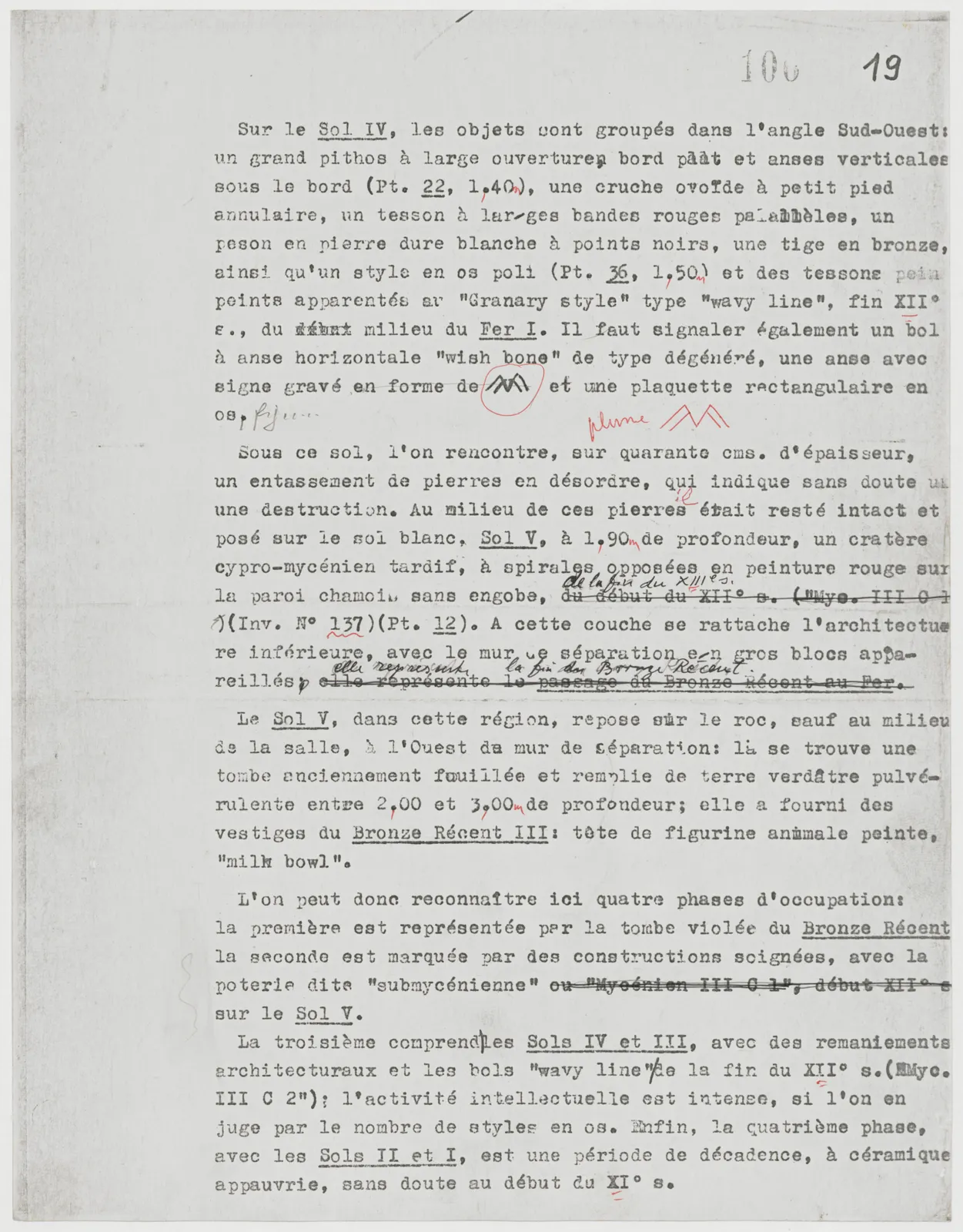
On Floor IV, the objects are grouped in the South-West corner: a large pithos with wide mouth, flat rim and vertical handles under the rim (Pt. 22, 1,40m), an ovoid jug with small ring foot , a sherd with broad parallel red bands, a loom weight of white hard stone with black dots, a bronze rod, as well as a polished bone stylus (Pt. 36, 1,50m) and painted sherds related to the "Granary style" type "wavy line", end of 12th c., of the beginning of the middle of Iron I. It should also be noted a bowl with horizontal "wish bone" handle of degenerate type, a handle with incised sign in the form of [figure: circled incised sign, drawn in red annotation] and a rectangular plaque of bone. [handwritten: signature]
Handwritten: plume; red chevron drawing
Below this floor, one meets, over forty cms. in thickness, a heap of stones in disorder, which doubtless indicates a destruction. In the middle of these stones remained intact and resting on the white floor, Floor V, at 1,90m depth, a krater Late Cypro-Mycenaean, with opposed spirals in red paint on the buff wall without slip, [handwritten: of the end of the 13th c.] of the beginning of the 12th c. ("Myc. III C 1" (Inv. no. 137)(Pt. 12). To this layer is attached the lower architecture, with the separating wall of large coursed blocks; it represents the passage from Late Bronze to Iron. [handwritten: it represents the end of Late Bronze]
Floor V, in this area, rests on the rock, except in the middle of the room, to the West of the separating wall: there lies a formerly excavated tomb filled with powdery greenish earth between 2,00 and 3,00m depth; it yielded remains of Late Bronze III: head of a painted animal figurine, "milk bowl".
One can therefore recognise here four phases of occupation: the first is represented by the plundered tomb of the Late Bronze the second is marked by careful constructions, with the so-called "submycenaean" pottery or "Mycenaean III C 1", beginning of 12th c. on Floor V. The third comprises Floors IV and III, with reworkings architectural and the "wavy line" bowls of the end of the 12th c. (Myc. III C 2"); intellectual activity is intense, judging by the number of bone styli. Finally, the fourth phase, with Floors II and I, is a period of decadence, with impoverished pottery, doubtless at the beginning of the 11th c.
65 figures hard to readstruck struck outadded written in above” jug ditto, and what it repeatsword reading not certain