
Unnumbered pageScan 198 of 204
17 January 1963
Excavations at Enkomi 1962
Press Release
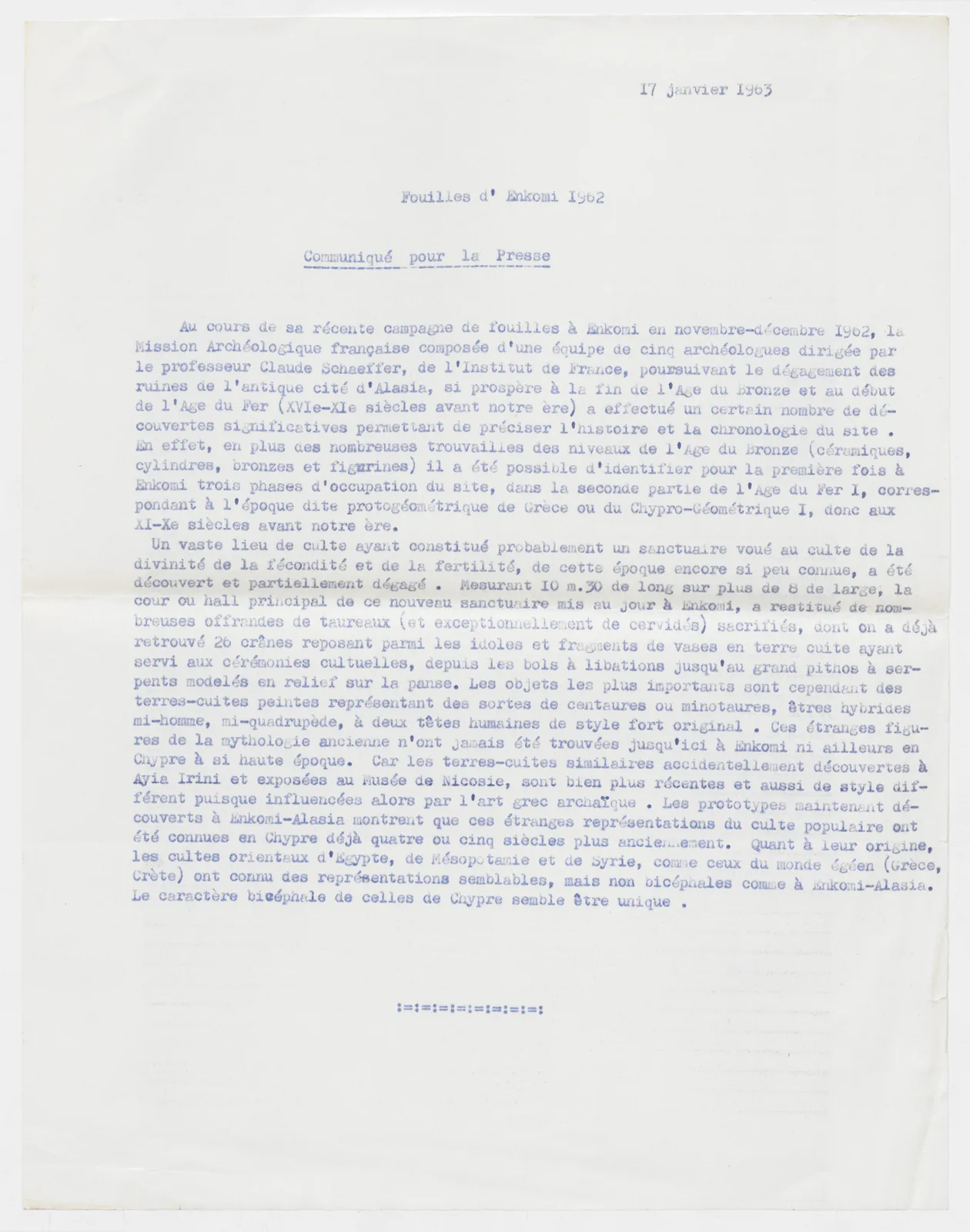
During its recent excavation campaign at Enkomi in November-December 1962, the French Archaeological Mission, consisting of a team of five archaeologists led by Professor Claude Schaeffer, of the Institut de France, continuing the clearing of the ruins of the ancient city of Alasia, so prosperous at the end of the Bronze Age and at the beginning of the Iron Age (XVIe-XIe centuries before our era) has made a number of discoveries significant discoveries allowing the history and chronology of the site to be clarified . Indeed, in addition to the numerous finds from the Bronze Age levels (pottery, cylinder seals, bronzes and figurines) it has been possible to identify for the first time at Enkomi three phases of occupation of the site, in the second part of the Iron Age I, corresponding to the so-called Protogeometric period of Greece or Cypro-Geometric I, hence to the XI-Xe centuries before our era. A vast place of worship probably constituting a sanctuary dedicated to the cult of the deity of fecundity and fertility, of this period still so little known, has been discovered and partially cleared . Measuring 10 m.30 long by over 8 wide, the courtyard or main hall of this new sanctuary uncovered at Enkomi, has yielded numerous offerings of bulls (and exceptionally of deer) sacrificed, of which already recovered 26 skulls lying among the idols and fragments of terracotta vessels having served in cult ceremonies, from libation bowls to the large pithos with serpents modelled in relief on the body. The most important objects, however, are painted terracottas representing kinds of centaurs or minotaurs, hybrid beings half-man, half-quadruped, with two human heads, of very original style . These strange figures of ancient mythology have never been found so far at Enkomi nor elsewhere in Cyprus at so early a date. For the similar terracottas accidentally discovered at Ayia Irini and exhibited in the Nicosia Museum, are much more recent and also of a different style since then influenced by Greek Archaic art . The prototypes now uncovered at Enkomi-Alasia show that these strange representations of popular cult have been known in Cyprus already four or five centuries earlier. As for their origin, the Oriental cults of Egypt, Mesopotamia and Syria, as well as those of the Aegean world (Greece, Crete) have known similar representations, but not bicephalous like those at Enkomi-Alasia. The bicephalous character of those of Cyprus seems to be unique .
:=:=:=:=:=:=:=:
65 figures hard to readstruck struck outadded written in above” jug ditto, and what it repeatsword reading not certain