
Unnumbered pageScan 190 of 204
Stamp: 18 JAN 1963
Stamp: DUPLICATA
Margin top: Com. to Mr Karagheorghis
Margin top: on 21. 1. 63.
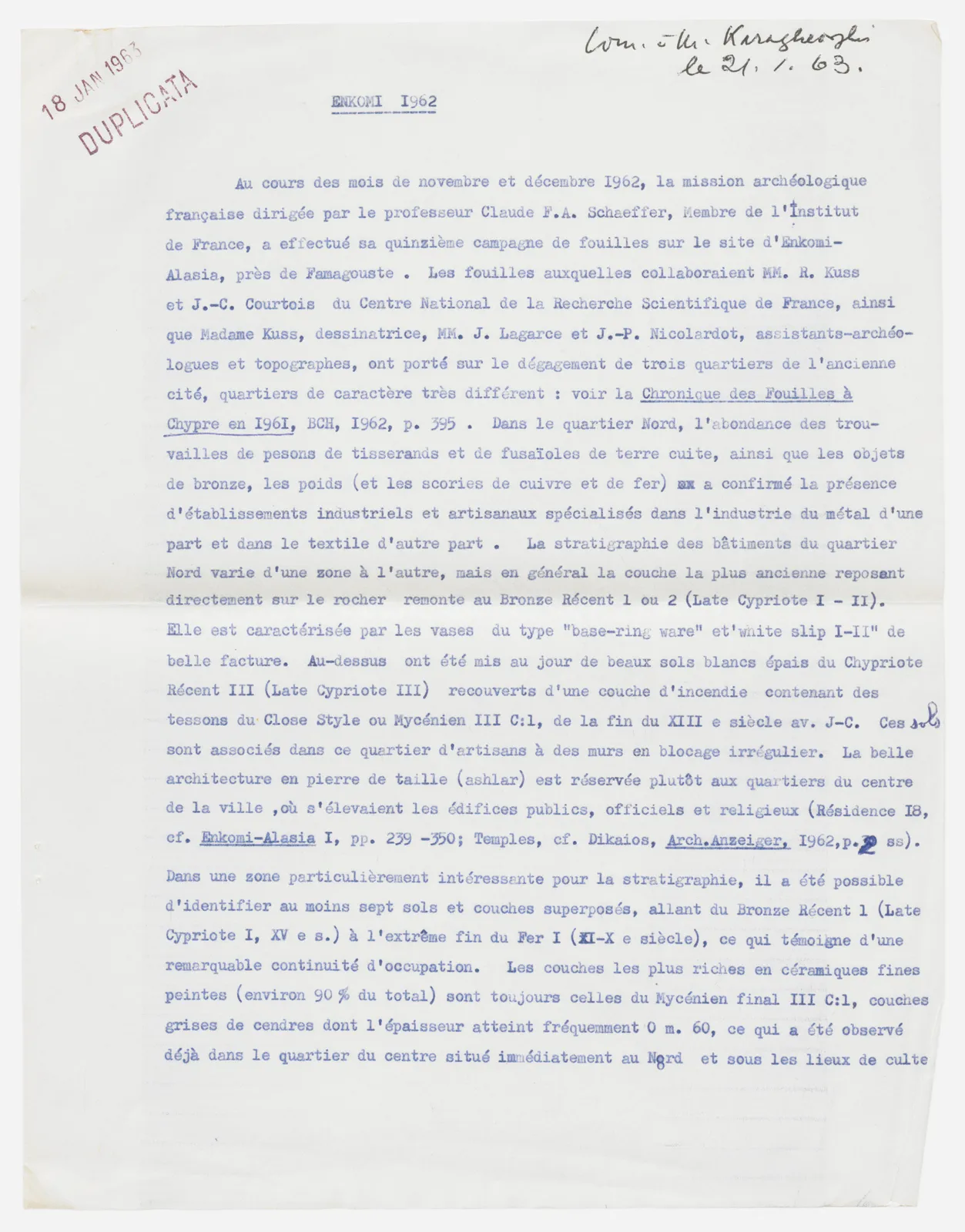
ENKOMI 1962
During the months of November and December 1962, the archaeological mission French, directed by Professor Claude F.A. Schaeffer, Member of the Institut of France, carried out its fifteenth season of excavations at the site of Enkomi- Alasia, near Famagusta. The excavations in which Messrs R. Kuss and J.-C. Courtois of the Centre National de la Recherche Scientifique de France, as well as Mrs Kuss, draughtswoman, Messrs J. Lagarce and J.-P. Nicolardot, assistant archaeologists, and surveyors, were concerned with clearing three quarters of the former city, quarters of very different character: see the Chronique des Fouilles à Chypre en 1961, BCH, 1962, p. 395. In the North quarter, the abundance of finds of loom weights and fired clay spindle whorls, as well as the objects of bronze, weights (and copper and iron slag) xx confirmed the presence of industrial and craft establishments specialised in the metal industry on one hand and in textiles on the other. The stratigraphy of the buildings of the quarter North varies from one zone to another, but generally the earliest layer resting directly on the rock dates to Late Bronze 1 or 2 (Late Cypriot I - II). It is characterised by vessels of the "base-ring ware" and "white slip I-II" type, of fine make. Above were uncovered fine thick white floors of the Late Cypriot III (Late Cypriot III) covered by a layer of burning containing sherds of Close Style or Mycenaean III C:1, from the end of the XIII e century BC. These floors are associated in this craftsmen's quarter with walls of irregular rubble. The fine architecture of ashlar is reserved rather for the quarters of the centre of the town, where the public, official and religious buildings stood (Residence 18, cf. Enkomi-Alasia I, pp. 239 -350; Temples, cf. Dikaios, Arch.Anzeiger, 1962,p. 2 ff.).
In an area particularly interesting for stratigraphy, it was possible to identify at least seven superimposed floors and layers, ranging from Late Bronze 1 (Late Cypriot I, XV e c.) to the very end of Iron I (XI-X e century), which attests a remarkable continuity of occupation. The layers richest in fine painted pottery (about 90 % of the total) are always those of the final Mycenaean III C:1, layers grey of ash whose thickness frequently reaches 0 m. 60, which has been observed already in the centre quarter located immediately to the North and beneath the places of worship
65 figures hard to readstruck struck outadded written in above” jug ditto, and what it repeatsword reading not certain