
Page 10Scan 23 of 54
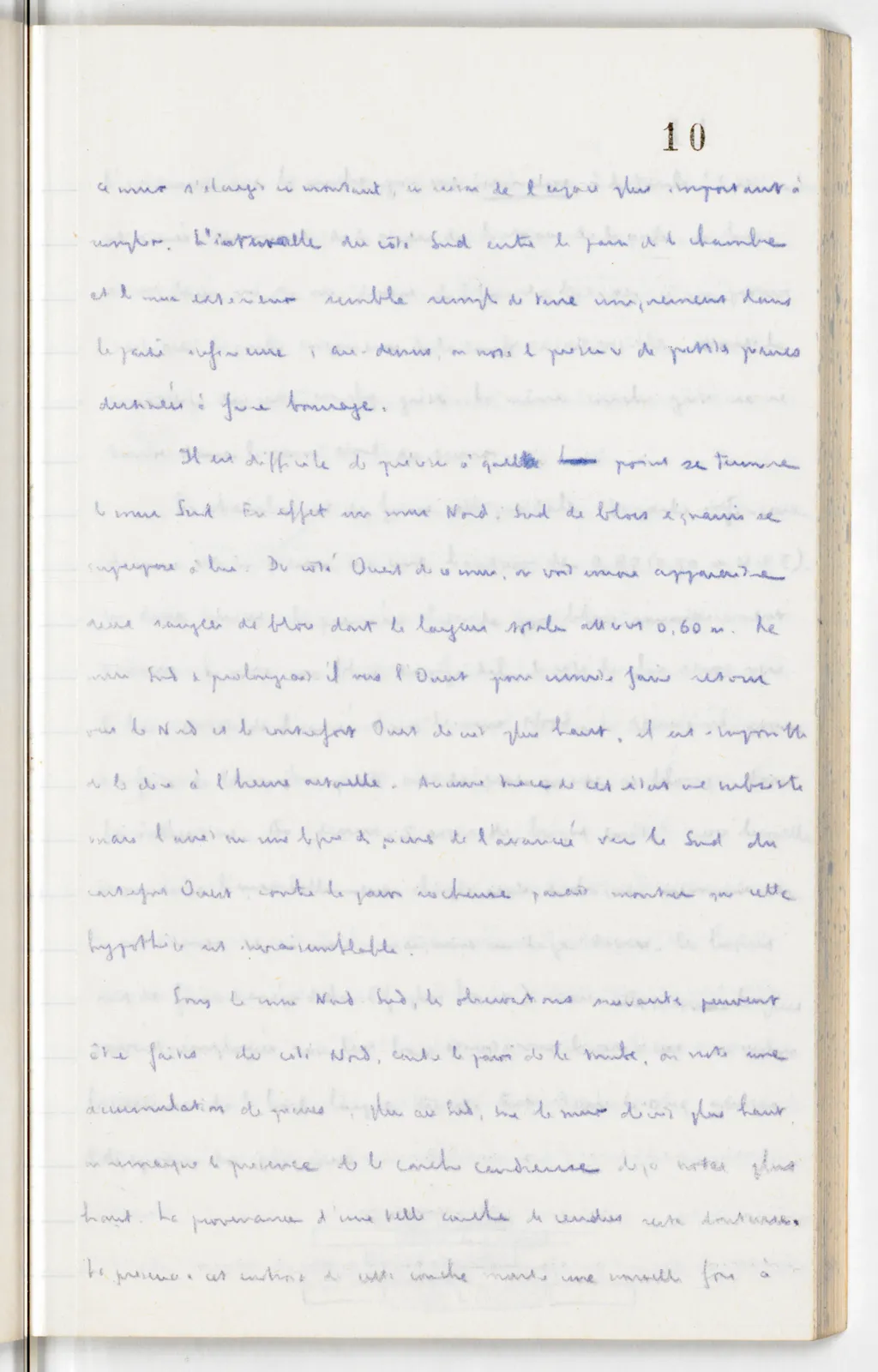
this wall widens as it rises, owing to the larger space to be filled. The gap on the South side between the wall of the chamber and the outer wall seems filled with earth only in the lower part; above, one notes the presence of small stones intended as packing.
It is difficult to specify at what the the point the South wall ends. Indeed a North-South wall of squared blocks is superimposed on it. On the West side of this wall, one still sees two rows of blocks whose total width reaches 0,60 m. The South wall, did it extend towards the West to then turn back towards the North and the West buttress described above, it is impossible to say at present. No trace of this state survives but the stop on a line of stones of the projection towards the South of the West buttress, against the rock face, seems to show that this hypothesis is implausible.
Beneath the North-South wall, the following observations can be made: on the North side, against the wall of the tomb, one notes an accumulation of stones; further South, under the wall described above, one notices the presence of the ash layer already noted more above. The origin of such a layer of ashes remains doubtful. The presence of this layer at this spot shows once again that
65 figures hard to readstruck struck outadded written in above” jug ditto, and what it repeatsword reading not certain