
Page 4Scan 41 of 42
Continued from p. 5
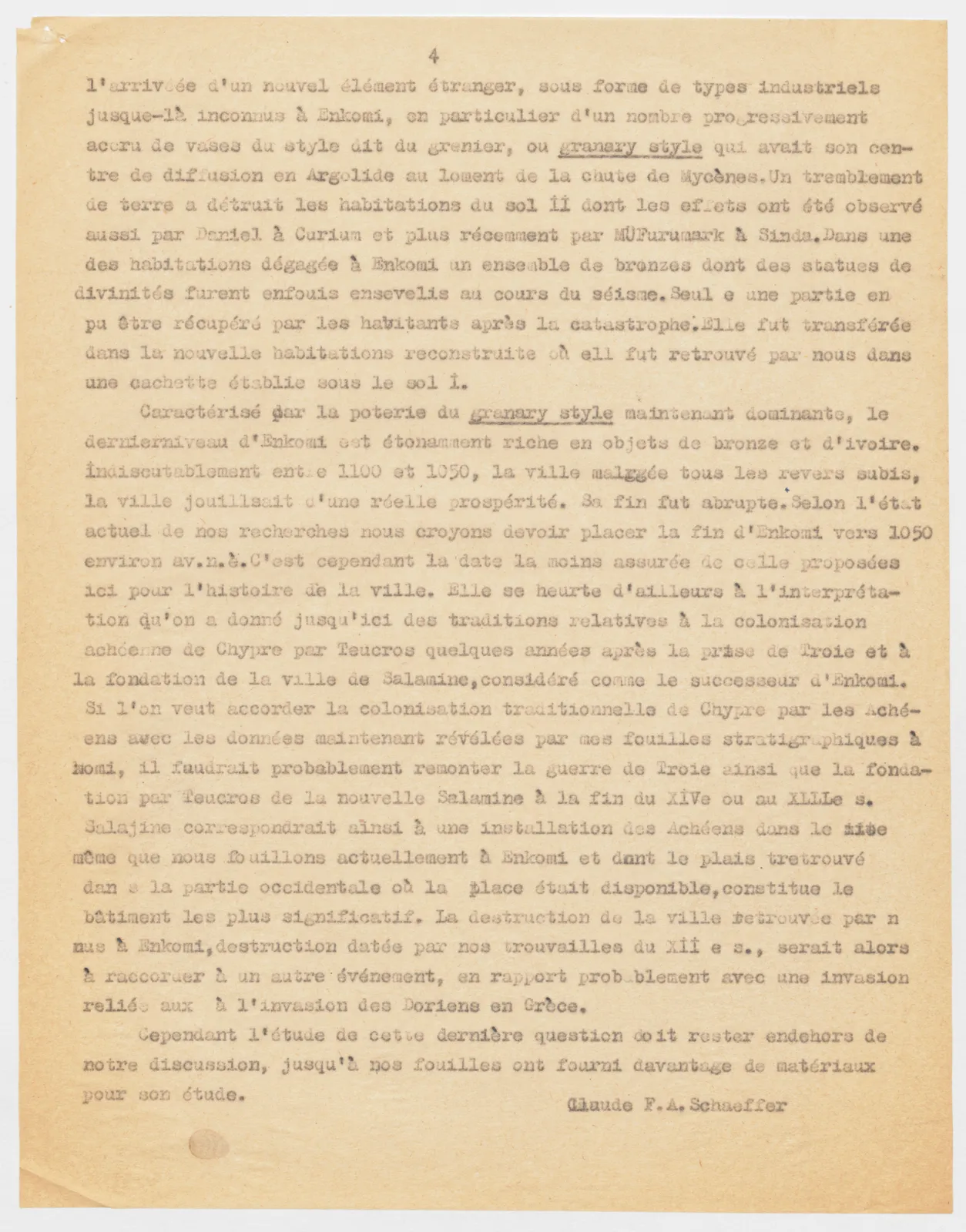
… the arrival of a new foreign element, in the form of industrial types hitherto unknown at Enkomi, in particular a progressively increasing number of vessels of the so-called granary style, which had its centre of diffusion in Argolis at the time of the fall of Mycenae. An earthquake destroyed the houses of floor II, the effects of which have been observed also by Daniel at Curium and more recently by MUFurumark at Sinda. In one of the houses cleared at Enkomi a group of bronzes, including statues of deities were buried, entombed during the earthquake. Only a part of them could be recovered by the inhabitants after the catastrophe. It was transferred to the new rebuilt house where it was found by us in a hiding place constructed under floor I.
Characterised by granary style pottery, now dominant, the last level at Enkomi is surprisingly rich in bronze and ivory objects. Indisputably between 1100 and 1050, the town, despite all the reverses suffered, the town enjoyed real prosperity. Its end was abrupt. According to the state of our present research we believe we must place the end of Enkomi around 1050 c. B.C. This is however the least certain of the dates proposed here for the history of the town. It moreover conflicts with the interpretation hitherto given to the traditions relating to the colonisation Achaean of Cyprus by Teucer a few years after the fall of Troy and to the foundation of the city of Salamis, regarded as the successor of Enkomi. If one wishes to reconcile the traditional colonisation of Cyprus by the Achaeans with the data now revealed by my stratigraphic excavations at Enkomi, one would probably have to move back the Trojan War as well as the foundation by Teucer of the new Salamis to the end of the 14th or the 13th c. Salajine would thus correspond to a settlement of the Achaeans on the site itself which we are currently excavating at Enkomi and whose palace found in the western part, where space was available, constitutes the most significant building. The destruction of the town found by us at Enkomi, a destruction dated by our finds to the 12th c., would then be connected with another event, probably related to an invasion linked to the invasion of the Dorians in Greece. However, the study of this last question must remain outside of our discussion, until our excavations have provided more material for its study.
Claude F.A. Schaeffer
65 figures hard to readstruck struck outadded written in above” jug ditto, and what it repeatsword reading not certain