
Unnumbered pageScan 37 of 42
Continued from scan 36
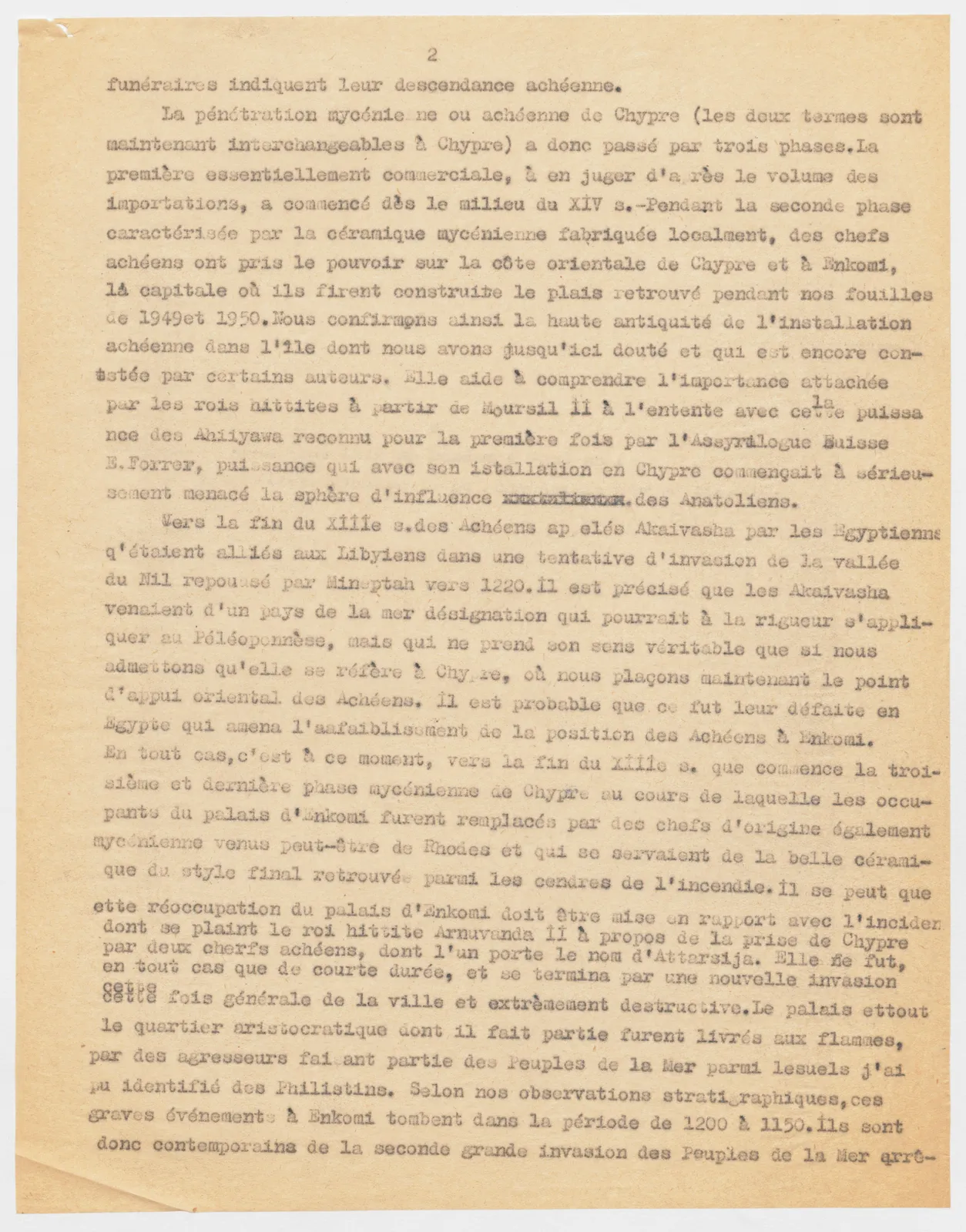
… funerary evidence indicates their Achaean descent. The Mycenaean or Achaean penetration of Cyprus (the two terms are now interchangeable in Cyprus) has thus passed through three phases. The first essentially commercial, judging by the volume of imports, began as early as the middle of the XIV c.-During the second phase characterised by locally made Mycenaean pottery, Achaean chiefs seized power on the east coast of Cyprus and at Enkomi, the capital where they had built the palace found during our excavations of 1949 and 1950. We thus confirm the great antiquity of the Achaean settlement on the island, which we had until now doubted and which is still contested by certain authors. It helps to understand the importance attached by the Hittite kings from Mursilis II onward to the understanding with this power of the Ahhiyawa, first recognised by the Swiss Assyriologist E. Forrer, a power which, with its settlement in Cyprus, was beginning to seriouslythreaten the sphere of influence of the Anatolians. Towards the end of the 13th c., Achaeans called Akaivasha by the Egyptians who were allied with the Libyans in an attempted invasion of the valley of the Nile, repulsed by Merneptah around 1220. It is specified that the Akaivasha came from a land of the sea, a designation which strictly could apply to the Peloponnese, but which takes on its true meaning only if we accept that it refers to Cyprus, where we now place the eastern support-point of the Achaeans. It is probable that it was their defeat in Egypt that led to the weakening of the Achaean position at Enkomi. In any case, it is at this moment, towards the end of the 13th c., that the third and last Mycenaean phase of Cyprus begins, during which the occupants of the palace of Enkomi were replaced by chiefs also of Mycenaean origin, perhaps coming from Rhodes, who used the fine pottery of the final style found among the ashes of the fire. It may be that this reoccupation of the palace of Enkomi must be connected with the incident of which the Hittite king Arnuwanda II complains, concerning the seizure of Cyprus by two Achaean chiefs, one of whom bears the name Attarsiya. It was not, in any case, of short duration, and ended with a new invasion this time general of the city and extremely destructive. The palace and all the aristocratic quarter of which it forms part were given to the flames, by attackers belonging to the Sea Peoples, among whom I have been able to identify Philistines. According to our stratigraphic observations, these serious events at Enkomi fall within the period 1200 to 1150. They are therefore contemporary with the second great invasion of the Sea Peoples, which
65 figures hard to readstruck struck outadded written in above” jug ditto, and what it repeatsword reading not certain