
Unnumbered pageScan 13 of 42
-7-
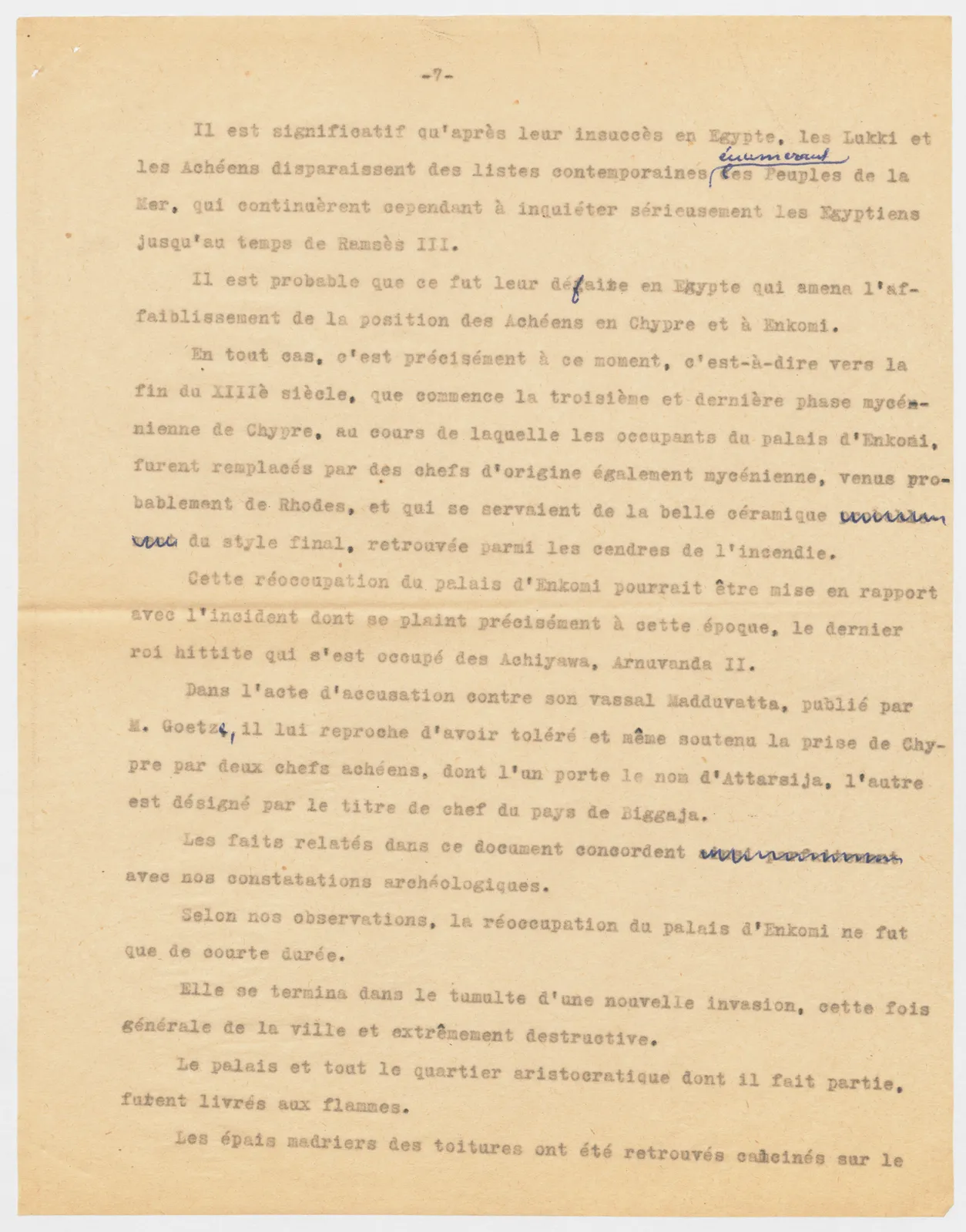
It is significant that after their failure in Egypt, the Lukki and the Achaeans disappear from the contemporary lists [handwritten: enumerating] (the Peoples of the Sea, who nevertheless continued to seriously trouble the Egyptians until the time of Ramesses III.
It is probable that it was their defeat in Egypt that brought about the weakening of the position of the Achaeans in Cyprus and at Enkomi.
In any case, it is precisely at this moment, i.e. towards the end of the 13th century, that the third and last Mycenaean phase of Cyprus begins, during which the occupants of the palace at Enkomi, were replaced by chiefs of likewise Mycenaean origin, probably come from Rhodes, who used the fine pottery [handwritten: new] [handwritten: this] of the final style, found among the ashes of the fire.
This reoccupation of the palace at Enkomi could be linked with the incident about which, precisely at this time, the last Hittite king who dealt with the Ahhiyawa, Arnuwanda II, complains.
In the indictment against his vassal Madduwatta, published by Mr Goetze, he reproaches him for having tolerated and even supported the seizure of Cyprus by two Achaean chiefs, one of whom bears the name Attarsija, the other is designated by the title of chief of the land of Biggaja.
The facts related in this document agree entirely with our archaeological observations.
According to our observations, the reoccupation of the palace at Enkomi was only of short duration.
It ended in the turmoil of a new invasion, this time general across the town and extremely destructive.
The palace and the whole aristocratic quarter of which it forms part, were given over to the flames.
The thick beams of the roofs were found calcined on the
65 figures hard to readstruck struck outadded written in above” jug ditto, and what it repeatsword reading not certain