
Unnumbered pageScan 29 of 36
Continued from p. -14-
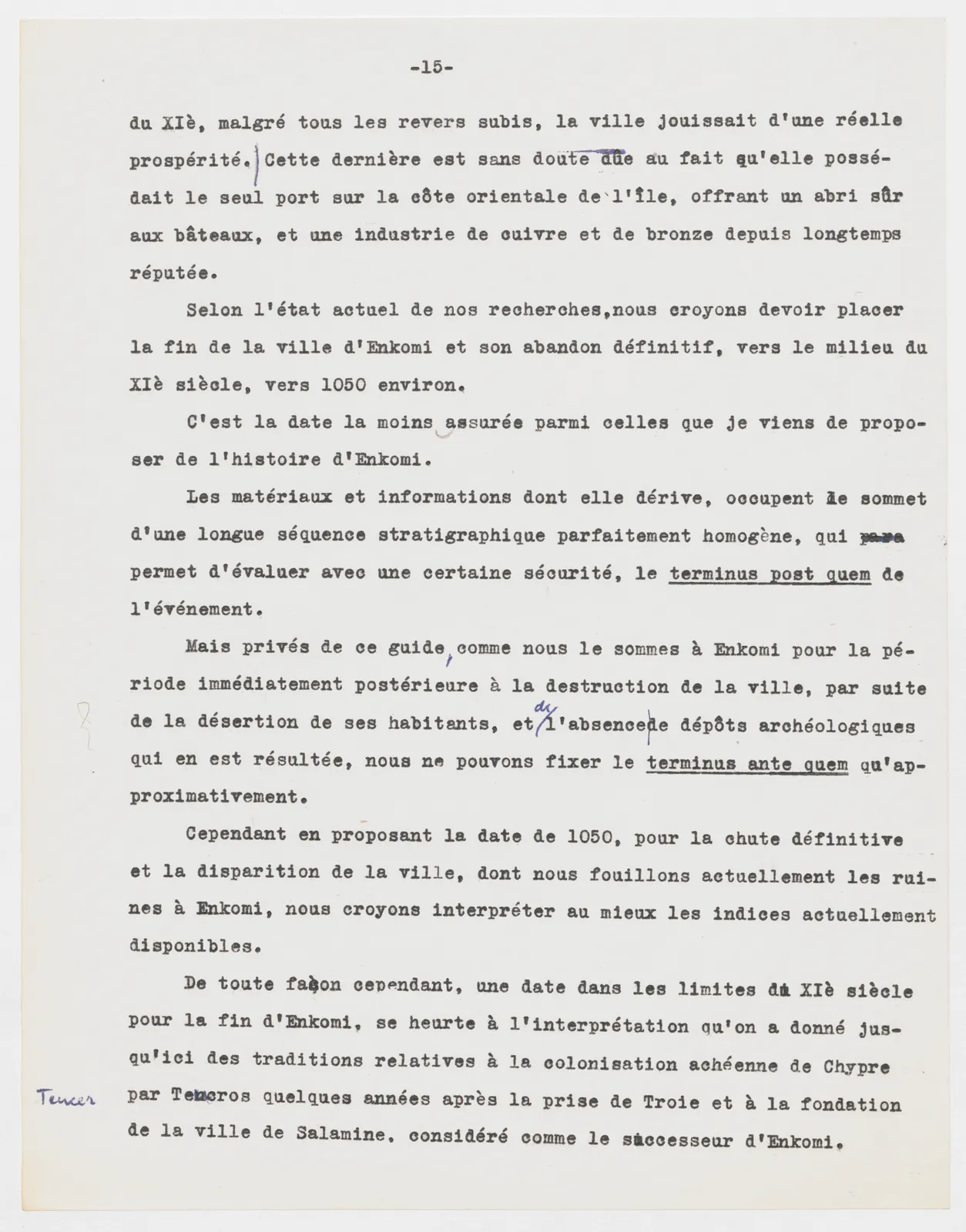
… of the 11th c., despite all the reverses suffered, the town enjoyed a real prosperity. This was no doubt due to the fact that it possessed the only harbour on the east coast of the island, offering a safe shelter for ships, and a copper and bronze industry long renowned.
According to the present state of our research, we believe we must place the end of the town of Enkomi and its final abandonment, towards the middle of the 11th c., around 1050.
This is the least certain of the dates I have just proposof the history of Enkomi.
The materials and information from which it derives occupy the top of a long, perfectly homogeneous stratigraphic sequence, which appears allows one to assess with some certainty the terminus post quem of the event.
But deprived of this guide, as we are at Enkomi for the period immediately following the destruction of the town, as a result of the desertion of its inhabitants, and [handwritten: of the] the absence of archaeological deposits which resulted from it, we cannot fix the terminus ante quem except approximately —
However, in proposing the date of 1050 for the final fall and disappearance of the town, whose ruins we are currently excavating at Enkomi, we believe we are best interpreting the evidence currently available.
In any case, however, a date within the limits of the 11th c. for the end of Enkomi, conflicts with the interpretation given so far of the traditions relating to the Achaean colonisation of Cyprus by Teucros a few years after the fall of Troy and the foundation of the town of Salamis, regarded as the successor of Enkomi.
Handwritten: Teucer
65 figures hard to readstruck struck outadded written in above” jug ditto, and what it repeatsword reading not certain