
Page 13 in headerScan 25 of 36
-13-
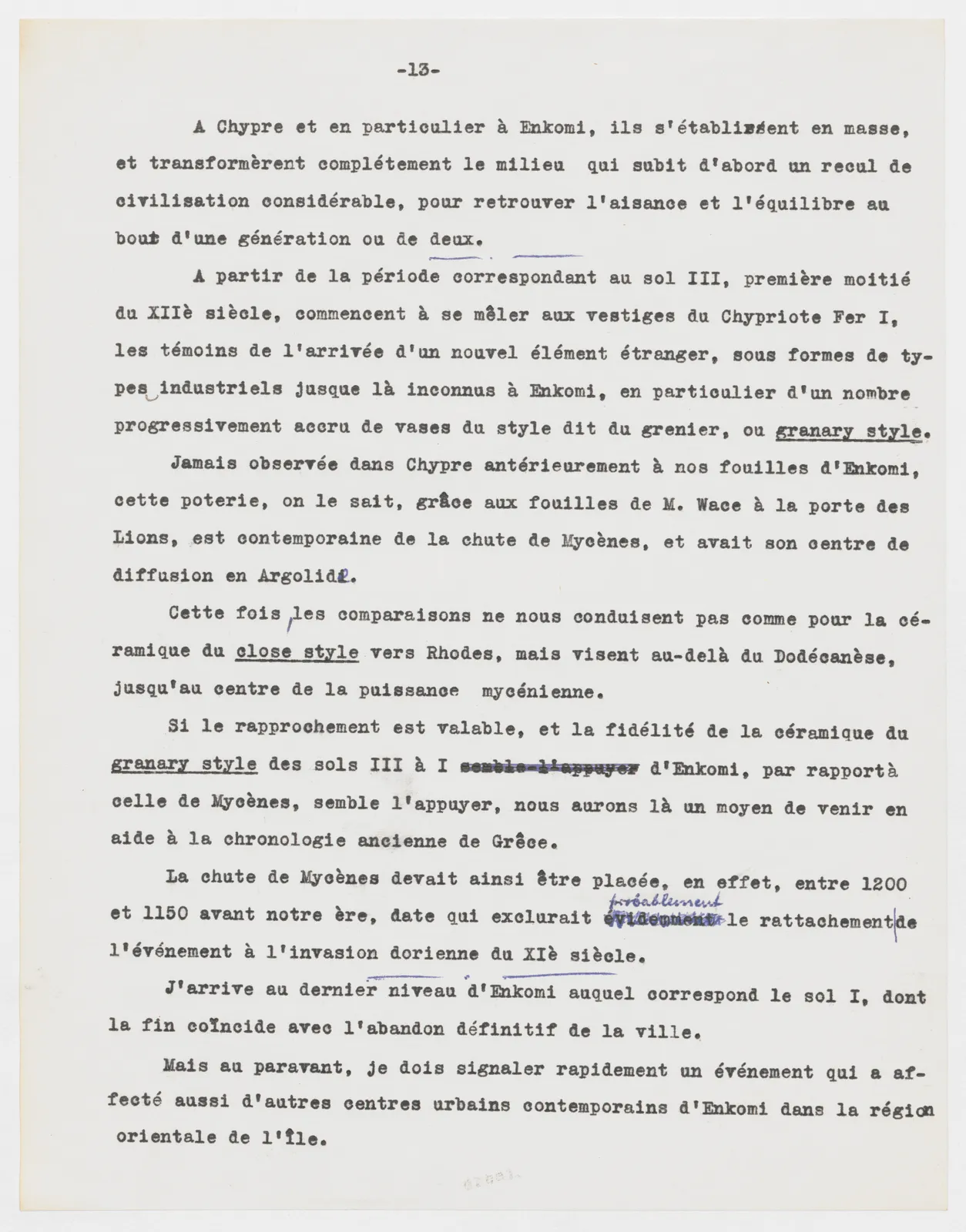
In Cyprus and particularly at Enkomi, they settled en masse, and completely transformed the milieu, which first underwent a decline in considerable civilisation, before regaining ease and balance at the end of a generation or two.
From the period corresponding to floor III, first half of the XIIè century, begin to mix with the remains of Cypriot Iron I, the evidence of the arrival of a new foreign element, in the form of industrial types hitherto unknown at Enkomi, in particular of a number progressively increased of vessels of the so-called granary style, or granary style.
Never observed in Cyprus prior to our excavations at Enkomi, this pottery, as is known, thanks to Mr Wace's excavations at the Lions Gate, is contemporary with the fall of Mycenae, and had its centre of distribution in Argolid.
This time the comparisons do not lead us, as for the close style pottery, towards Rhodes, but aim beyond the Dodecanese, as far as the centre of Mycenaean power.
If the comparison is valid, and the fidelity of the pottery of the granary style from floors III to I seems to rest at Enkomi, in relation to that of Mycenae, seems to support it, we shall have there a means of coming to the aid of the early chronology of Greece.
The fall of Mycenae was thus to be placed, indeed, between 1200 and 1150 before our era, a date which would obviously exclude the linking of the event to the Dorian invasion of the XIè century.
I come to the last level at Enkomi, to which floor I corresponds, whose end coincides with the definitive abandonment of the town.
But beforehand, I must briefly mention an event which also affected other urban centres contemporary with Enkomi in the eastern part of the island.
Handwritten: probablement inserted above "évidemment" with strike-through on "évidemment"
65 figures hard to readstruck struck outadded written in above” jug ditto, and what it repeatsword reading not certain