
Unnumbered pageScan 17 of 36
-9-
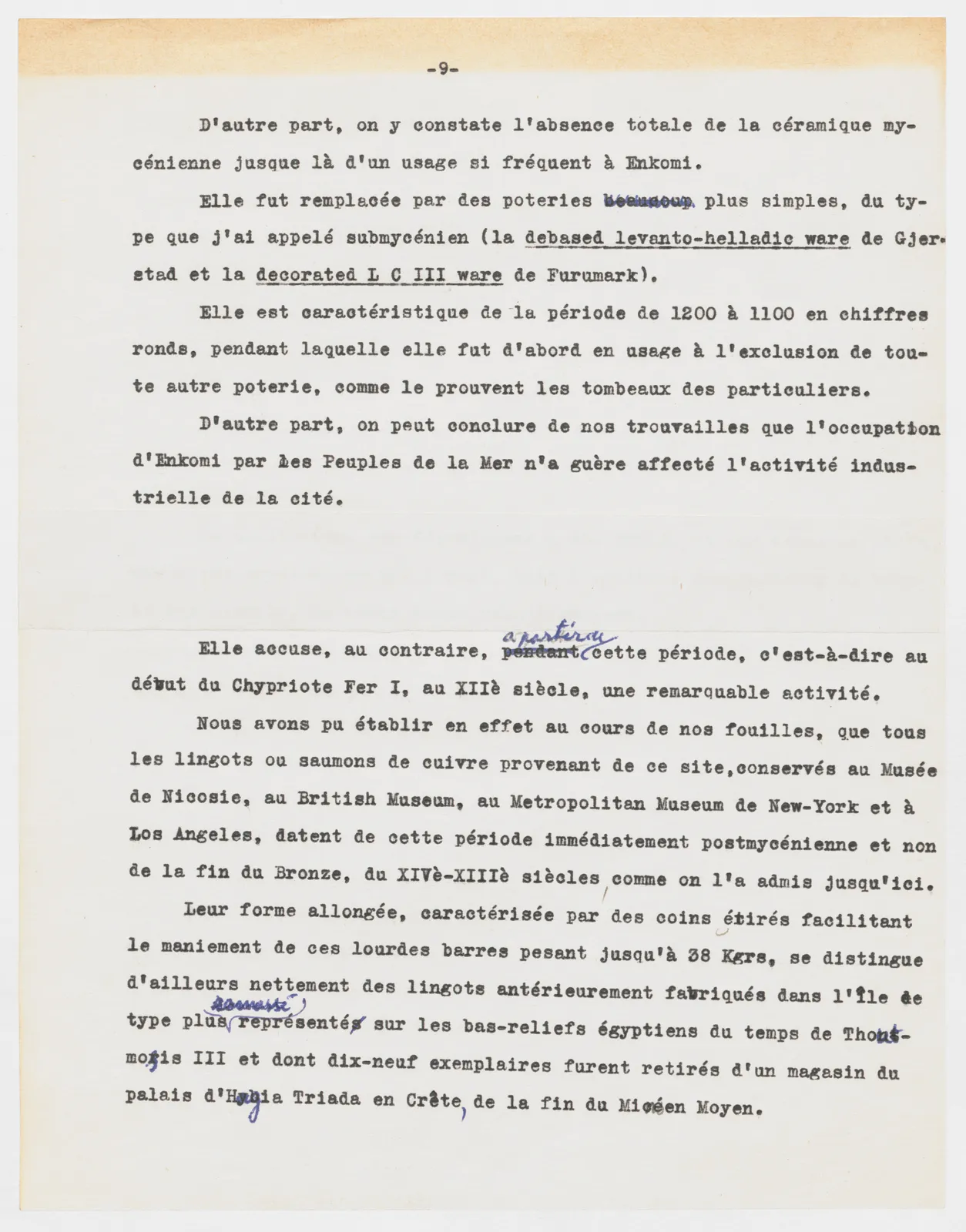
On the other hand, one notes there the total absence of mycenaean pottery, hitherto so frequently used at Enkomi.
It was replaced by [handwritten: much] much simpler pottery, of the type that I have called submycenaean (the debased Levanto-Helladic ware of Gjerstad and the decorated L C III ware of Furumark).
It is characteristic of the period of 1200 to 1100 in round figures, during which it was first in use to the exclusion of all other pottery, as the tombs of private individuals prove.
On the other hand, one may conclude from our finds that the occupation of Enkomi by the Sea Peoples scarcely affected the industrial activity of the city.
[illegible]
On the contrary, it shows, [handwritten: from the] during this period, that is to say at the beginning of Cypriot Iron I, in the 12th century, a remarkable activity.
Indeed we were able to establish in the course of our excavations that all the copper ingots or pigs coming from this site, preserved in the Museum of Nicosia, in the British Museum, the Metropolitan Museum of New York and at Los Angeles, date from this immediately post-Mycenaean period and not from the end of the Bronze Age, of the 14th-13th centuries as has been admitted until now.
Their elongated shape, characterised by stretched corners facilitating the handling of these heavy bars weighing up to 38 Kgrs, is distinguished moreover clearly from the ingots previously made on the island of type more [handwritten: numerous] represented represented on the Egyptian bas-reliefs of the time of Thutmosis III, and of which nineteen examples were taken from a storeroom of the palace of Hagia Triada in Crete, of the end of the Middle Minoan.
65 figures hard to readstruck struck outadded written in above” jug ditto, and what it repeatsword reading not certain