
Unnumbered pageScan 15 of 36
Continued from scan 14
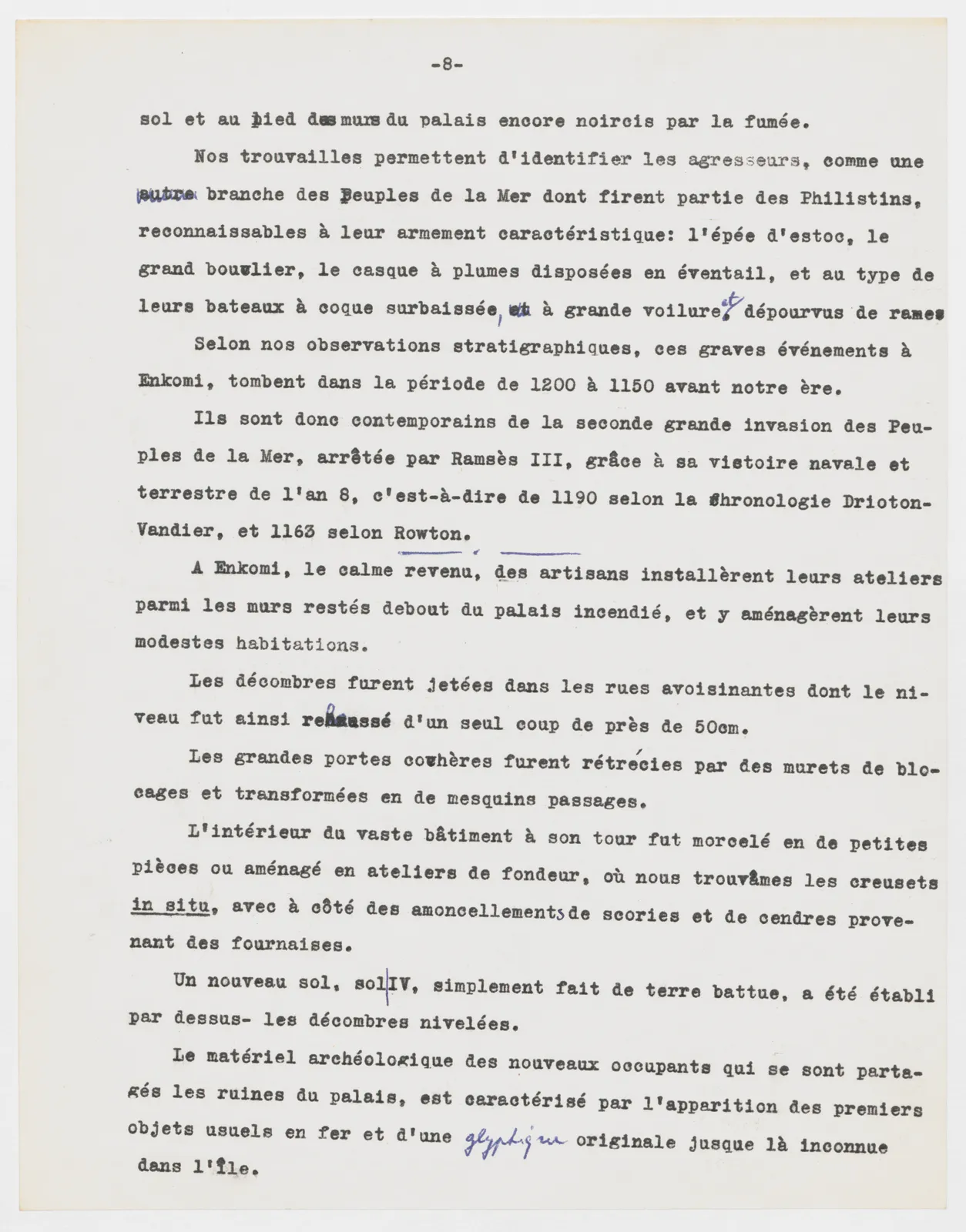
… floor and at the foot of the palace walls still blackened by smoke.
Our finds make it possible to identify the attackers as another branch of the Sea Peoples, of which the Philistines formed part, recognisable by their characteristic armament: the thrusting sword, the large shield, the helmet with plumes arranged in a fan, and by the type of their ships with a flat-bottomed hull, large sail and no oars.
According to our stratigraphic observations, these serious events at Enkomi fall within the period from 1200 to 1150 before our era.
They are therefore contemporary with the second great invasion of the Sea Peoples, halted by Ramesses III, thanks to his naval and land victory of year 8, i.e. of 1190 according to the Drioton- Vandier chronology, and 1163 according to Rowton.
At Enkomi, with calm restored, craftsmen set up their workshops among the walls still standing of the burnt palace, and fitted out their modest dwellings there.
The debris was thrown into the neighbouring streets, whose level was thus raised at a single stroke by nearly 50cm.
The large corbelled doors were narrowed by low walls of blockings and converted into mean passages.
The interior of the vast building in turn was broken up into small rooms or fitted out as founders' workshops, where we found the crucibles in situ, with beside them heaps of slag and ash from the furnaces.
A new floor, floor IV, simply of beaten earth, was laid over the levelled debris.
The archaeological material of the new occupants who shared the ruins of the palace is characterised by the appearance of the first everyday iron objects and an original glyptic hitherto unknown on the island.
65 figures hard to readstruck struck outadded written in above” jug ditto, and what it repeatsword reading not certain