
Unnumbered pageScan 9 of 9
Handwritten: from Frances F. Jones
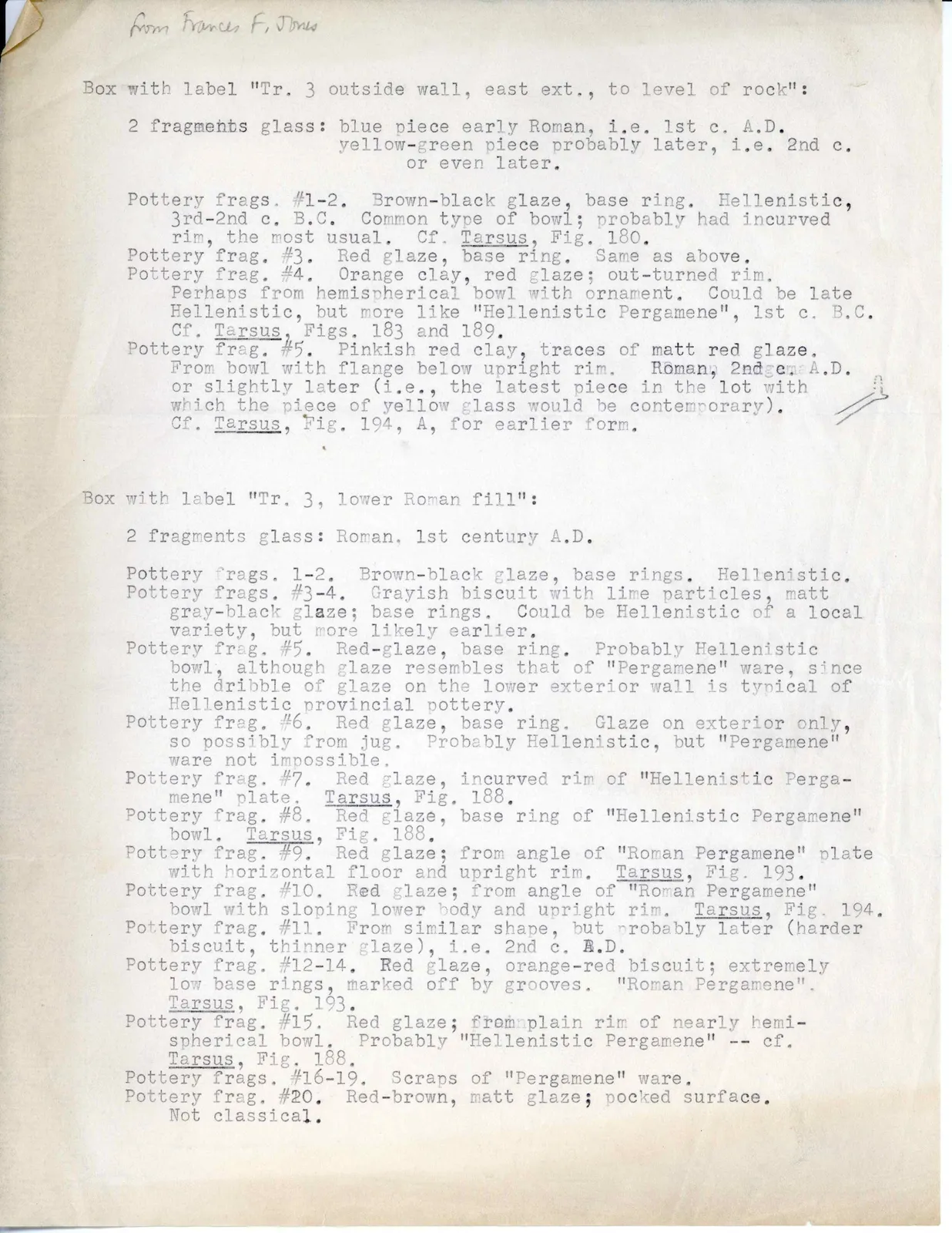
Box with label "Tr. 3 outside wall, east ext., to level of rock":
2 fragments glass: blue piece early Roman, i.e. 1st c. A.D. yellow-green piece probably later, i.e. 2nd c. or even later.
Pottery frags. #1-2. Brown-black glaze, base ring. Hellenistic, 3rd-2nd c. B.C. Common type of bowl; probably had incurved rim, the most usual. Cf. Tarsus, Fig. 180. Pottery frag. #3. Red glaze, base ring. Same as above. Pottery frag. #4. Orange clay, red glaze; out-turned rim. Perhaps from hemispherical bowl with ornament. Could be late Hellenistic, but more like "Hellenistic Pergamene", 1st c. B.C. Cf. Tarsus, Figs. 183 and 189. Pottery frag. #5. Pinkish red clay, traces of matt red glaze. From bowl with flange below upright rim. Roman, 2nd c. A.D. or slightly later (i.e., the latest piece in the lot with which the piece of yellow glass would be contemporary). Cf. Tarsus, Fig. 194, A, for earlier form.
Box with label "Tr. 3, lower Roman fill":
2 fragments glass: Roman. 1st century A.D.
Pottery frags. 1-2. Brown-black glaze, base rings. Hellenistic. Pottery frags. #3-4. Grayish biscuit with lime particles, matt gray-black glaze; base rings. Could be Hellenistic of a local variety, but more likely earlier. Pottery frag. #5. Red-glaze, base ring. Probably Hellenistic bowl, although glaze resembles that of "Pergamene" ware, since the dribble of glaze on the lower exterior wall is typical of Hellenistic provincial pottery. Pottery frag. #6. Red glaze, base ring. Glaze on exterior only, so possibly from jug. Probably Hellenistic, but "Pergamene" ware not impossible. Pottery frag. #7. Red glaze, incurved rim of "Hellenistic Pergamene" plate. Tarsus, Fig. 188. Pottery frag. #8. Red glaze, base ring of "Hellenistic Pergamene" bowl. Tarsus, Fig. 188. Pottery frag. #9. Red glaze; from angle of "Roman Pergamene" plate with horizontal floor and upright rim. Tarsus, Fig. 193. Pottery frag. #10. Red glaze; from angle of "Roman Pergamene" bowl with sloping lower body and upright rim. Tarsus, Fig. 194. Pottery frag. #11. From similar shape, but probably later (harder biscuit, thinner glaze), i.e. 2nd c. B.D. Pottery frag. #12-14. Red glaze, orange-red biscuit; extremely low base rings, marked off by grooves. "Roman Pergamene". Tarsus, Fig. 193. Pottery frag. #15. Red glaze; from plain rim of nearly hemispherical bowl. Probably "Hellenistic Pergamene" -- cf. Tarsus, Fig. 188. Pottery frags. #16-19. Scraps of "Pergamene" ware. Pottery frag. #20. Red-brown, matt glaze; pocked surface. Not classical.
65 figures hard to readstruck struck outadded written in above” jug ditto, and what it repeatsword reading not certain