
Page 15Scan 8 of 92
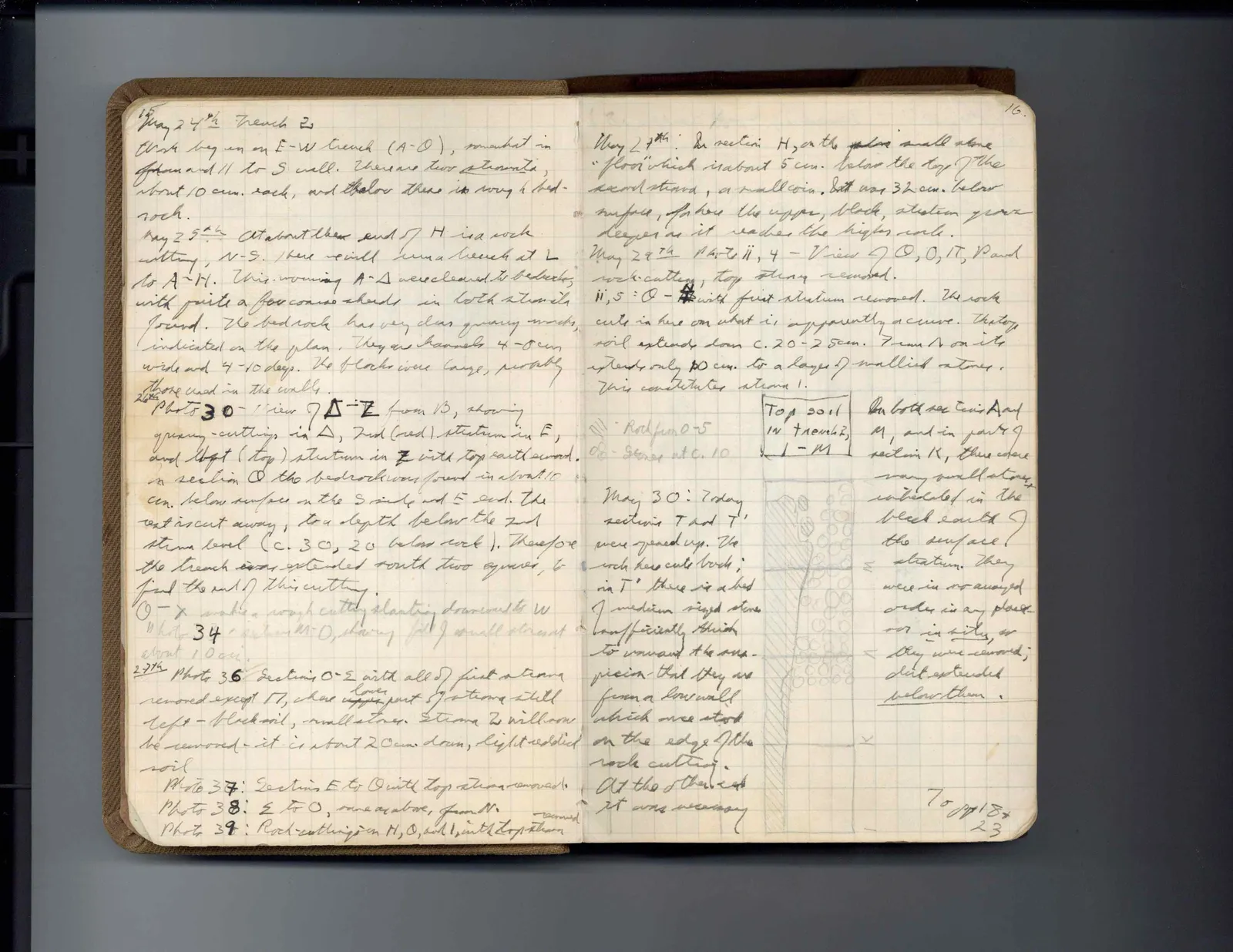
May 24thMay 24th Trench 2. Work began on E-W trench (A-O), somewhat in from and // to S. wall. There are two strata, about 10 cm. each, and below there is rough bedrock.
May 25thMay 25th At about the end of H is a rockcutting, N-S. There is inll run a bench at L to A-H. This morning A-Δ were cleared to bedrock, with quite a few coarse sherds in both strata found. The bed rock has very clear quarry-marks, indicated on the plan. They are channels 4-8 cm. wide and 4-10 deep. The blocks were large, probably those used in the walls.
26th Photo 30: View of \Δ- \Z\ from B, showing quarry-cuttings in Δ, 2nd (red) stratum in E, and top (top) stratum in Z with top earth removed.
In section O the bedrock was found in about 10 cm. below surface in the S side, and E end. The rest is cut away, to a depth below the 2nd strum level (c. 30, 20 below rock). Therefore the trench is was extended south two squares, to find the end of this cutting. O-X makes a rough cutting slanting downward to W
Photo 34: sections M-O, showing first of small stones at about 10 cm.
27th Photo 35: Sections O-Z with all of first stratum removed except lower \Π\, where upper part of stratum still kept - black soil, small stones. Struma 2 will now be removed - it is about 20 cm. down, light reddish soil.
Photo 37: Sections E to O with top stratum removed. Photo 38: E to O, same as above, from N. removed Photo 39: Rock-cuttings in M, O, and I, with top stratum
Right page
May 27thMay 27th: In section H, on the yellow small stone "floor" which is about 5 cm. below the top of the second stratum, a small coin. Depth was 32 cm. below surface, for here the upper, black, stratum grew deeper as it reaches the higher rock.
May 29thMay 29th Photo II, 4 - View of Q, O, Π, P and rock-cutting, top strum removed. II, 5: Q-N \Π\ with first stratum removed. The rock cuts in here on what is apparently a curve. The top soil extends down c. 20-25 cm. From N on its extends only 10 cm. to a layer of mallish stones. This constitutes stratum 1.
/// - Rock from 0-5 O0 - Stones, at c. 10
May 30Today sections T and T' were opened up. The rock here cuts back; in T' there is a bed of medium sized stones in sufficiently thick to warrant the suspicion that they m form a low wall which once stood on the edge of the rock cutting. At the other end it was necessary
Drawing: vertical column with layers; labels: Top soil in trench 2, I-M, [hatching for rock], [circles for stones
Written beside sketch:
In both sections A and M, and in part of section K, there were many small stones imbedded in the black earth of the surface stratum. They were in no arranged order in any place nor in situ, as they were removed; dirt extended below them.
To pp 18 & 23
65 figures hard to readstruck struck outadded written in above” jug ditto, and what it repeatsword reading not certain