
Unnumbered pageScan 55 of 92
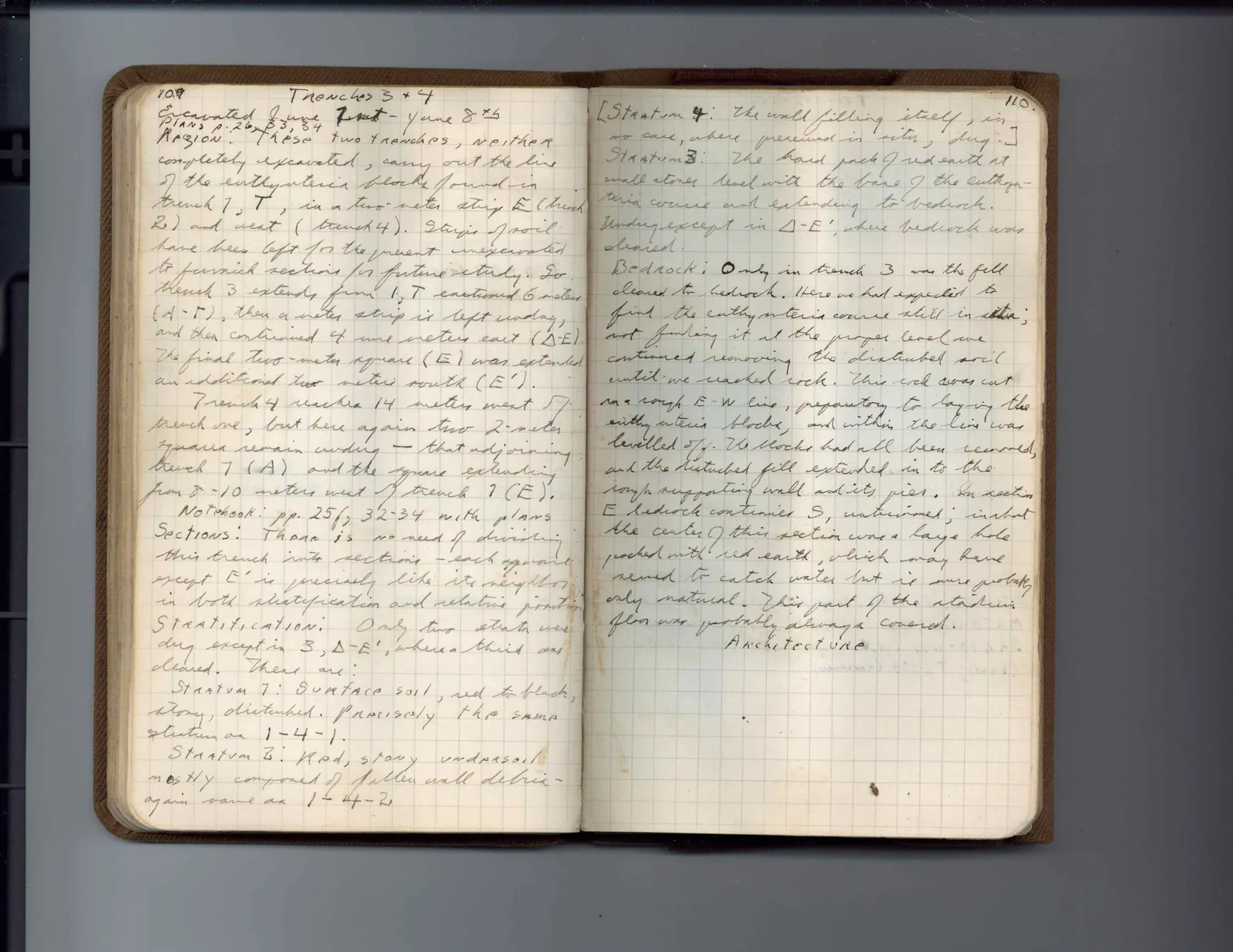
109 | Trenches 3 & 4 Excavated June 7 or 8 - June 8th Plans p. 26, 33, 34 Region: These two trenches, neither completely excavated, carry out the line of the euthynteria blocks found in trench 7, T, in a two-meter strip E (trench 3) and west (trench 4). Strips of soil have been left for the present unexcavated to furnish sections for future study. So trench 3 extends from 7, T eastward 6 meters (A-D), then a meter strip is left undug, and then continued & one meters east (Δ-E). The final two-meter square (E) was extended an additional two meters south (E'). Trench 4 reaches 14 meters west of trench one, but here again two 2-meter squares remain undug - that adjoining trench 7 (A) and the square extending from 8-10 meters west of trench 7 (E). Notebook: pp. 25 f, 32-34 with plans Sections: There is no need of dividing this trench into sections - each square except E' is precisely like its neighbor in both stratification and relative position Stratification: Only two strata were dug except in 3, Δ-E', where a third was cleared. These are: Stratum 1: Surface soil, red to black, stony, disturbed. Precisely the same stratum as 1-4-1. Stratum 2: Red, stony undersoil, mostly composed of fallen wall debris - again same as 1-4-2.
Right page
110. [Stratum 4: The wall filling itself, in no case, where preserved in situ, dug.] Stratum 3: The hard pack of red earth & small stones level with the base of the euthynteria course and extending to bedrock. Undug except in Δ-E', where bedrock was cleared. Bedrock: Only in trench 3 was the fill cleared to bedrock. Here we had expected to find the euthynteria course still in situ; not finding it at the proper level we continued removing the disturbed soil until we reached rock. This rock was cut in a rough E-W line, preparatory to laying the euthynteria blocks, and within the line was levelled off. The blocks had all been removed, and the disturbed fill extended in to the rough supporting wall and its pier. In section E bedrock continues S, waterworn; in about the center of this section was a large hole packed with red earth, which may have served to catch water but is more probably only natural. This part of the stadium floor was probably always covered. Architecture
65 figures hard to readstruck struck outadded written in above” jug ditto, and what it repeatsword reading not certain