
Unnumbered pageScan 39 of 92
77 Trench 1 North Seating Section, [underlined: Σ - Φ/] Plans p. 11, 17, 33
Underlined: STRATIFICATION
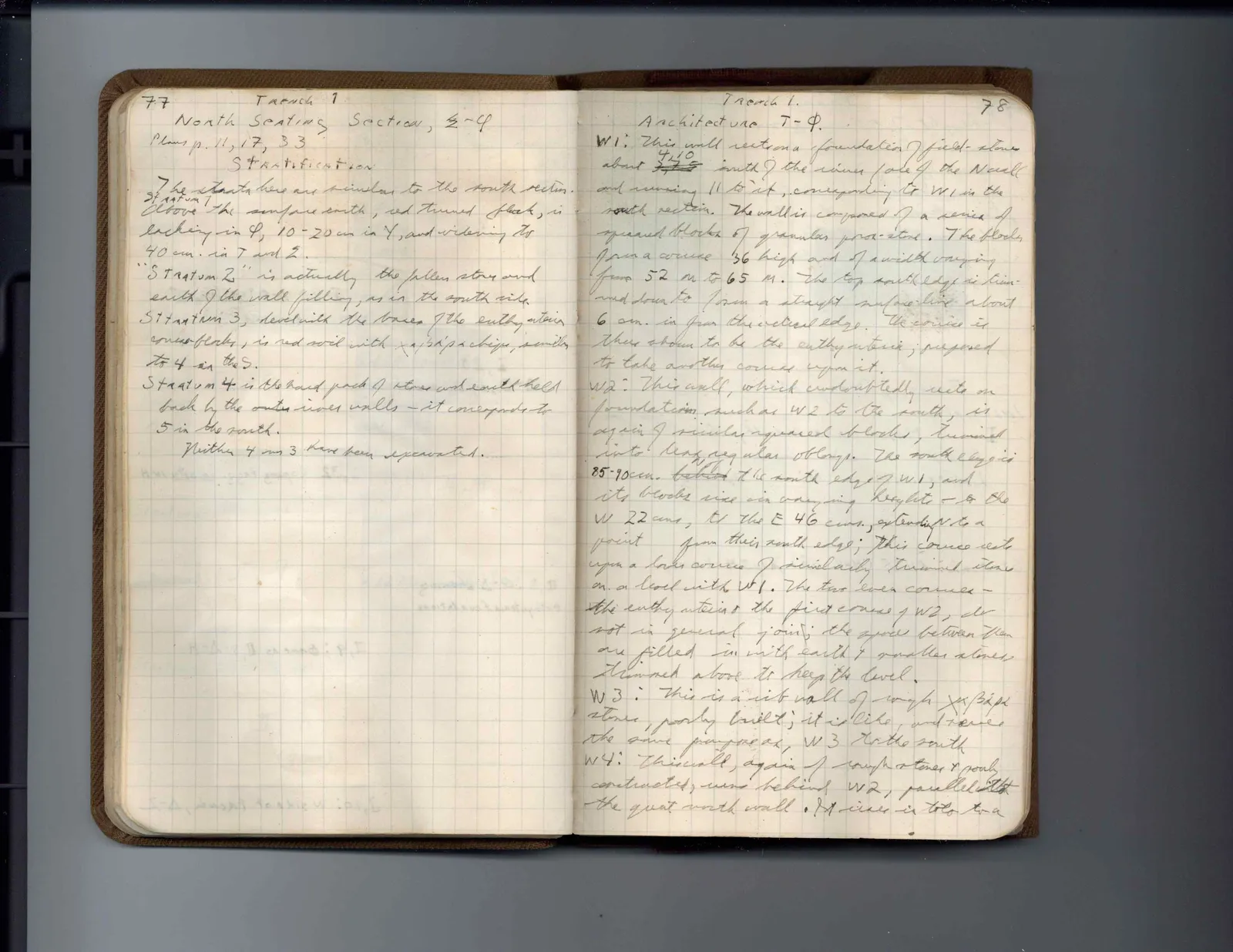
The strata here are similar to the south section. Stratum 1 Above the surface earth, red trimmed flakes, is lacking in Φ, 10-20 cm in Y, and widening to 40 cm. in T and Σ. "Stratum 2" is actually the fallen stone and earth of the wall filling, as in the south side. Stratum 3, level with the bases of the euthynteria course flakes, is red soil with xarápachips, similar to 4 in the S. Stratum 4 is the hard pack of stones and earth held back by the outer river walls - it corresponds to 5 in the south. Neither 4 nor 3 have been excavated.
Right page
Trench 1. 78 Architecture T- Φ. W1: This wall rests on a foundation of field-stones about 4,50 south of the inner face of the N wall and running || to it, corresponding to W1 in the south section. The wall is composed of a series of squared blocks of granular poros-stone. The blocks form a course 36 high and of a width varying from 52 m to 65 m. The top south edge is trimmed down to form a straight surface line about 6 cm. in from the actual edge. The course is thus shown to be the euthynteria; prepared to take another course upon it. W2: This wall, which undoubtedly rests on foundation such as W2 to the south, is again of similar squared blocks, trimmed into long regular oblongs. The south edge is 85-90 cm. behind the south edge of W1, and its blocks rise in varying heights - to the W 22 cms, to the E 46 cms., extending to a point from their south edge; this course rests upon a lower course of similarly trimmed stone on a level with W1. The two even courses - the euthynteria & the first course of W2, do not in general join; the spaces between them are filled in with earth & smaller stones, trimmed above to keep the level. W3: This is a rib wall of rough xarápa stones, poorly built; it is like, and serves the same purpose as, W3 to the south W4: This wall, again of rough stones & poorly constructed, runs behind W2, parallel with the great north wall. It rises in toto to a
65 figures hard to readstruck struck outadded written in above” jug ditto, and what it repeatsword reading not certain