
Unnumbered pageScan 49 of 85
116. T1009 - T1010
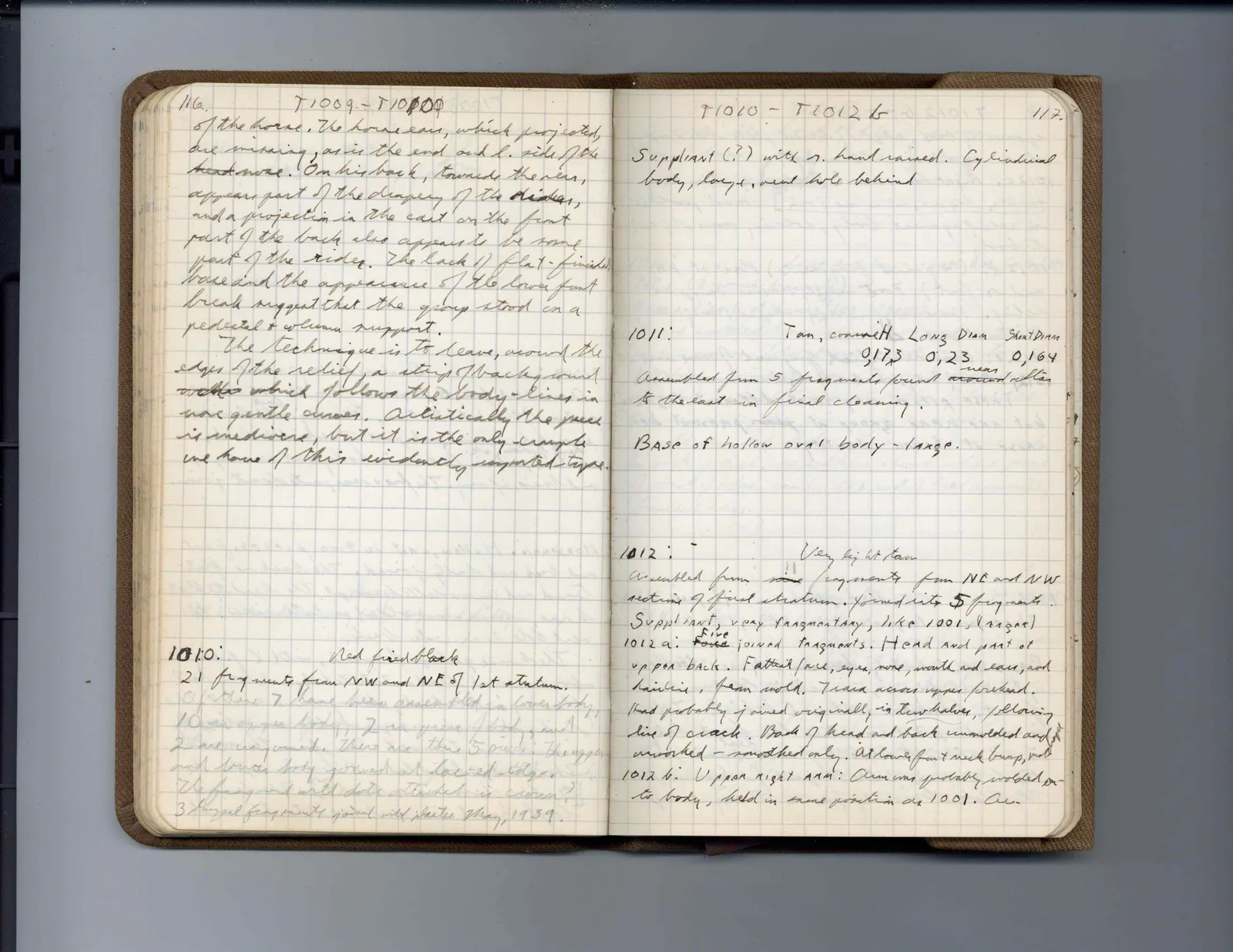
of the horse. The horse ears, which projected, are missing, as is the end and l. side of the headmore. On his back, towards the rear, appears part of the drapery of the didas, and a projection in the cast on the front part of the back also appears to be some part of the rider. The back is flat-finished There and the appearance of the lower front break suggest that the group stood on a pedestal or column support.
The technique is to leave, around the edges of the relief, a strip of background water which follows the body-lines in more gentle curves. Artistically the piece is mediocre, but it is the only example we have of this evidently imported type.
1010: Red fired black 21 fragments from NW and NE of 1st stratum. Of these 7 have been assembled in lower body, 10 in upper body, 2 in piece of body, and 2 are unjoined. There are thus 5 pieces. The upper and lower body joined at laevad edge. The fragment with dole attached is crown? 3 hinged fragments joined with darter May, 1939.
Right page
T1010 - T1012 b 117.
Suppliant (?) with r. hand raised. Cylindrical body, large, vent hole behind
1011: Tan, [illegible] Long Diam Short Diam 0,17,3 0,23 0,164
Assembled from 5 fragments, found near around altar to the east in final cleaning.
Base of hollow oval body - large.
1012: Very light tan
Assembled from six fragments from NE and NW sections of first stratum. Joined into 5 fragments. Suppliant, very fragmentary, like 1001, (larger)
1012 a: Five joined fragments. Head and part of upper back. Fatted face, eyes, nose, mouth and ears, and hairline, from mold. Trace across upper forehead. Head probably joined originally in two halves, following line of crack. Back of head and back unmolded and unworked - smoothed only. At lower front neck bump, mold
1012 b: Upper right arm: Arm was probably molded on to body, held in same position as 1001. Arm
65 figures hard to readstruck struck outadded written in above” jug ditto, and what it repeatsword reading not certain