
Unnumbered pageScan 12 of 24
213
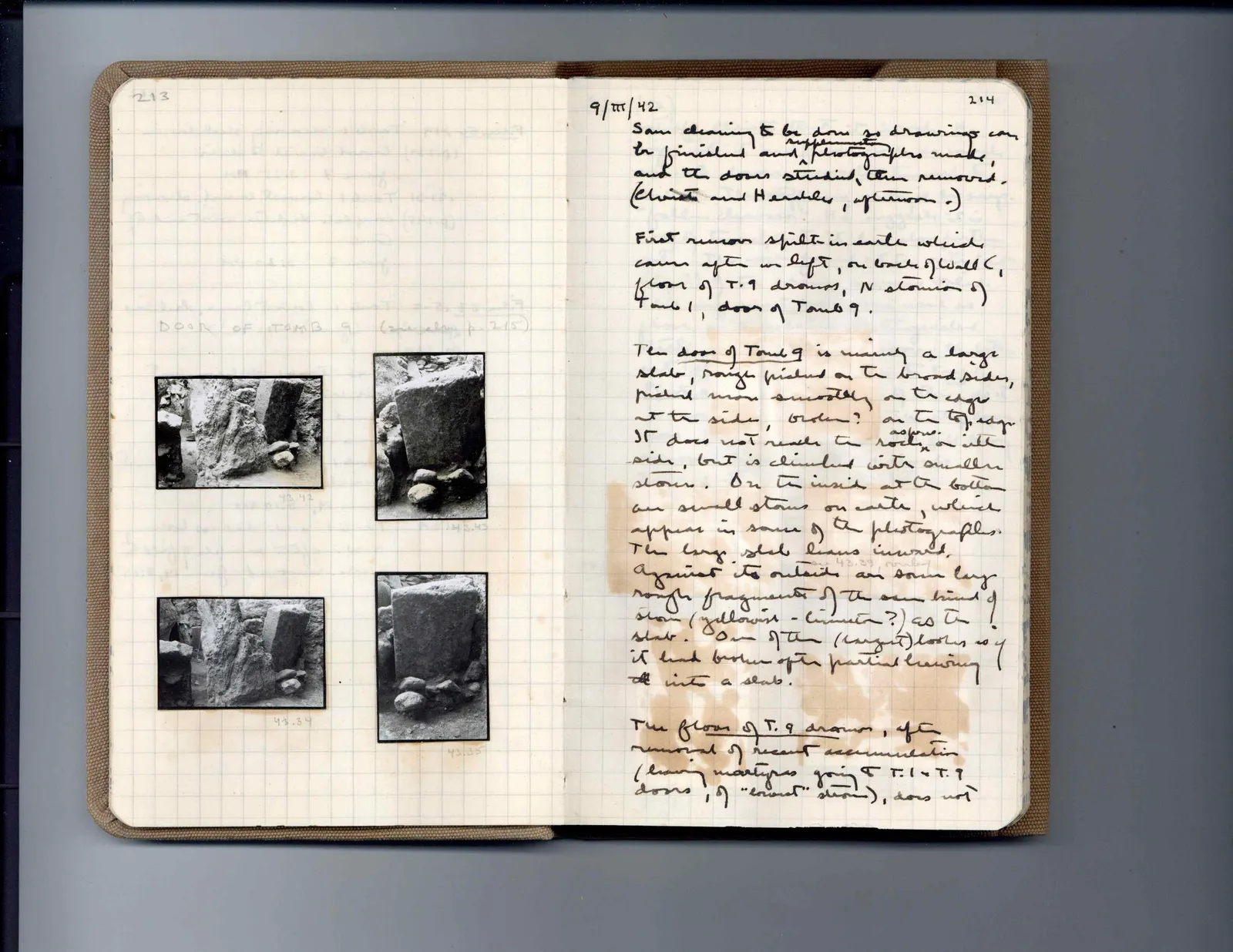
DOOR OF TOMB 9 (see also p. 215)
Photograph
43.42
Photograph
43.43
Photograph
43.34
Photograph
43.35
Right page
214 9/III/42
Some cleaning to be done so drawings can be finished and supplement photographs made, and the doors studied, then removed. (Christo and Herakles, afternoon.)
First remove spilt-in earth which came after we left, on back of Wall C, floor of T. 9 dromos, N stomion of Tomb 1, door of Tomb 9.
The door of Tomb 9 is mainly a large slab, rough picked on the broad sides, picked more smoothly on the edges at the sides, broken? on the top edge It does not reach the rock, as fov., on eith side, but is clinched with smaller stones. On the inside at the bottom are small stones on earth, which appear in some of the photographs. The large slab leans inward. Against its outside are some large rough fragments of the same kind of stone (yellowish - limestone?) as the slab. One of them (largest) looks as if it had broken after partial hewing it into a slab.
The floor of T. 9 dromos, after removal of recent accumulation (leaving martyres going to T. 1 & T. 9 doors, of "cement" stone), does not
65 figures hard to readstruck struck outadded written in above” jug ditto, and what it repeatsword reading not certain