
Unnumbered pageScan 28 of 94
58 date
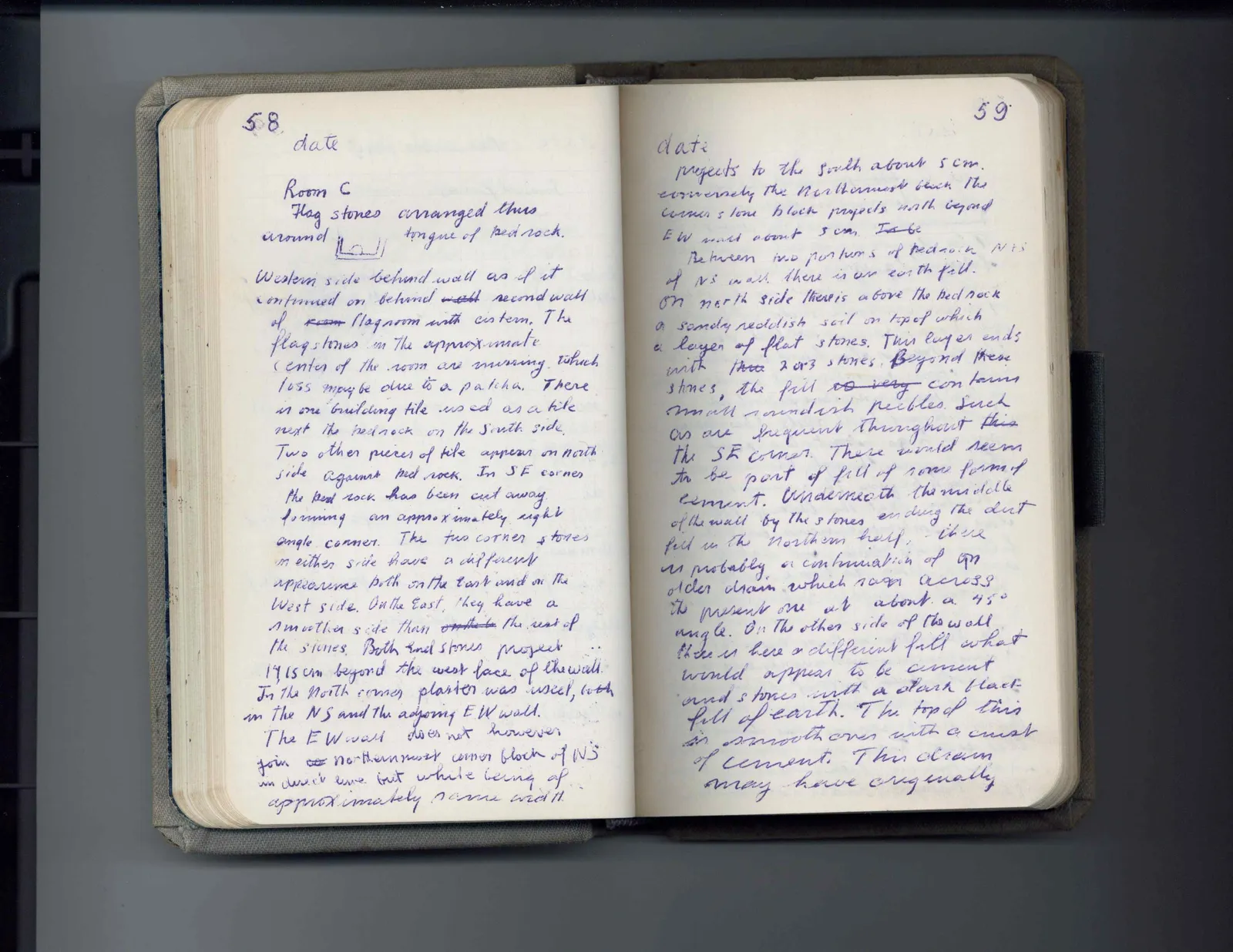
Room C Flag stones arranged thus around (drawing) tongue of bed rock.
Western side behind wall as if it continued on behind wall second wall of room flagroom with cistern. The flagstones in the approximate center of the room are missing. Which loss may be due to a paticha. There is one building tile used as a tile next the bed rock on the South side. Two other pieces of tile appear on North side against bed rock. In SE corner the bed rock has been cut away forming an approximately right angle corner. The two corner stones in either side have a different appearance both on the East and on the West side. On the East, they have a smoother side than on the to the rest of the stones. Both end stones project 14 15 cm beyond the west face of the wall. In the North corner plaster was used, both in the NS and the adjoining EW wall.
The EW wall does not however join on northernmost corner block of NS in direct line but while being of approximately same width
Right page
59 date
projects to the South about 5 cm. conversely the Northernmost brick the corner stone block projects north beyond EW wall about 5 cm. To be
Between two portions of bedrock in NS of NS wall there is an earth fill. On North side there is above the bed rock a sandy reddish soil on top of which a layer of flat stones. This layer ends with two 2 or 3 stones. Beyond these stones, the fill is very contains small roundish pebbles. Such as are frequent throughout this the SE corner. There would seem to be part of fill of some form of cement. Underneath the middle of the wall by the stones ending the dirt fill in the northern half, there is probably a continuation of an older drain which ran across the present one at about. a 45° angle. On the other side of the wall there is here a different fill what would appear to be cement and stones with a dark black fill of earth. The top of this is smooth over with a crust of cement. This drain may have originally
65 figures hard to readstruck struck outadded written in above” jug ditto, and what it repeatsword reading not certain